



Paste the draft
Drop the subject line and body you are about to send. We screen the copy for deceptive subjects, shouting formatting, image-only bodies, and stacked pressure phrases.
Audit your copy against the sender-signal checklist that modern filters actually read, then verify any address before you send. Free now.
Trusted by 500,000+ leading GTM teams of all sizes
Content gets audited by hand, recipients by machine. Paste an address, let the nine-check engine score it, read the verdict.
Drop the subject line and body you are about to send. We screen the copy for deceptive subjects, shouting formatting, image-only bodies, and stacked pressure phrases.
Eight content signals fire in sequence: subject honesty, formatting, image ratio, link patterns, pressure phrasing, HTML quality, attachment bait, and unsubscribe.
Inbox-ready, risky, or likely spam, plus the exact signals that tripped and a 0-100 content score. Fix what is flagged, then verify the addresses before you send.
Run your draft down this list before any send. Each one is a pattern filters learned from decades of complaint data, and each one is fixable in minutes.
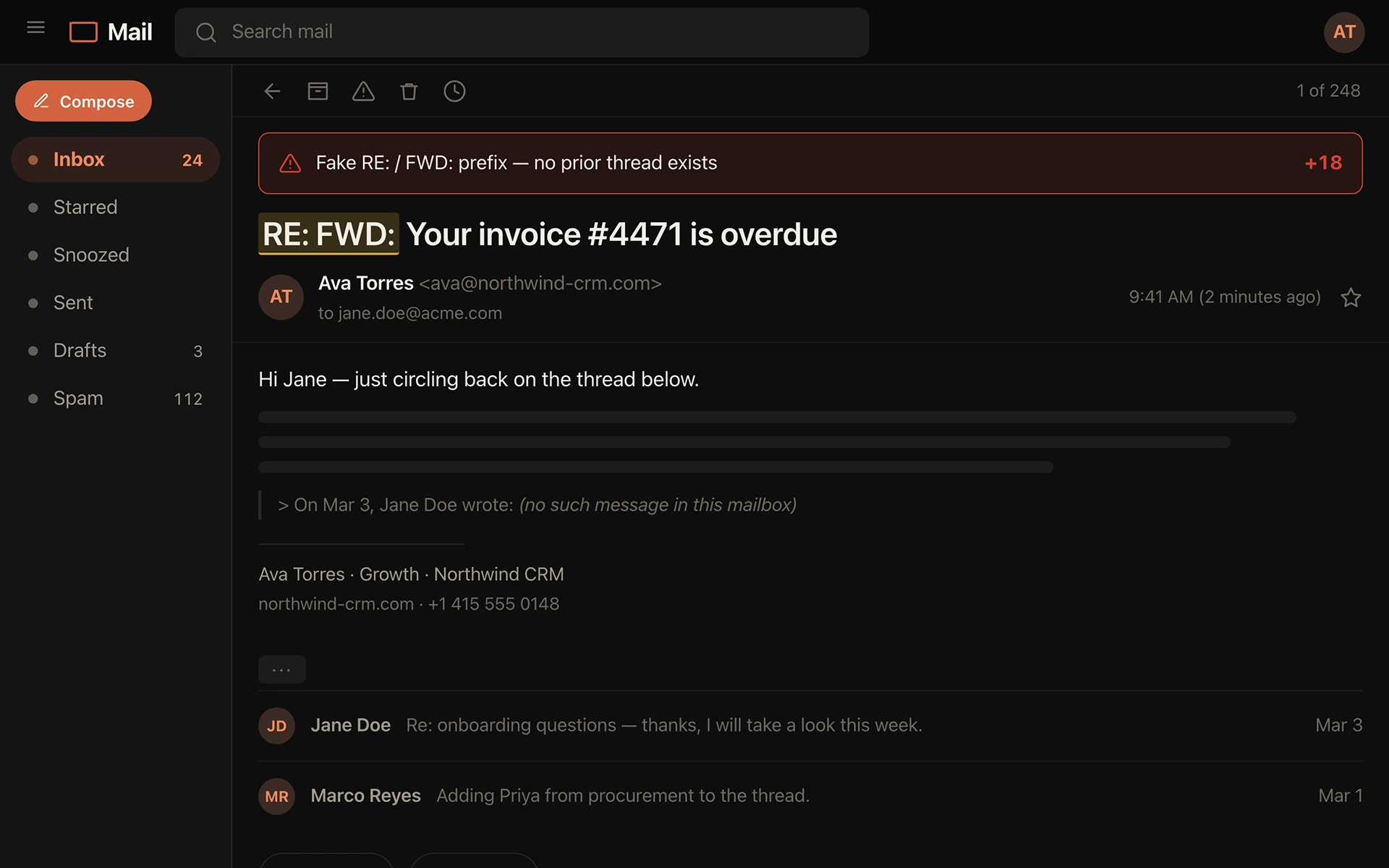
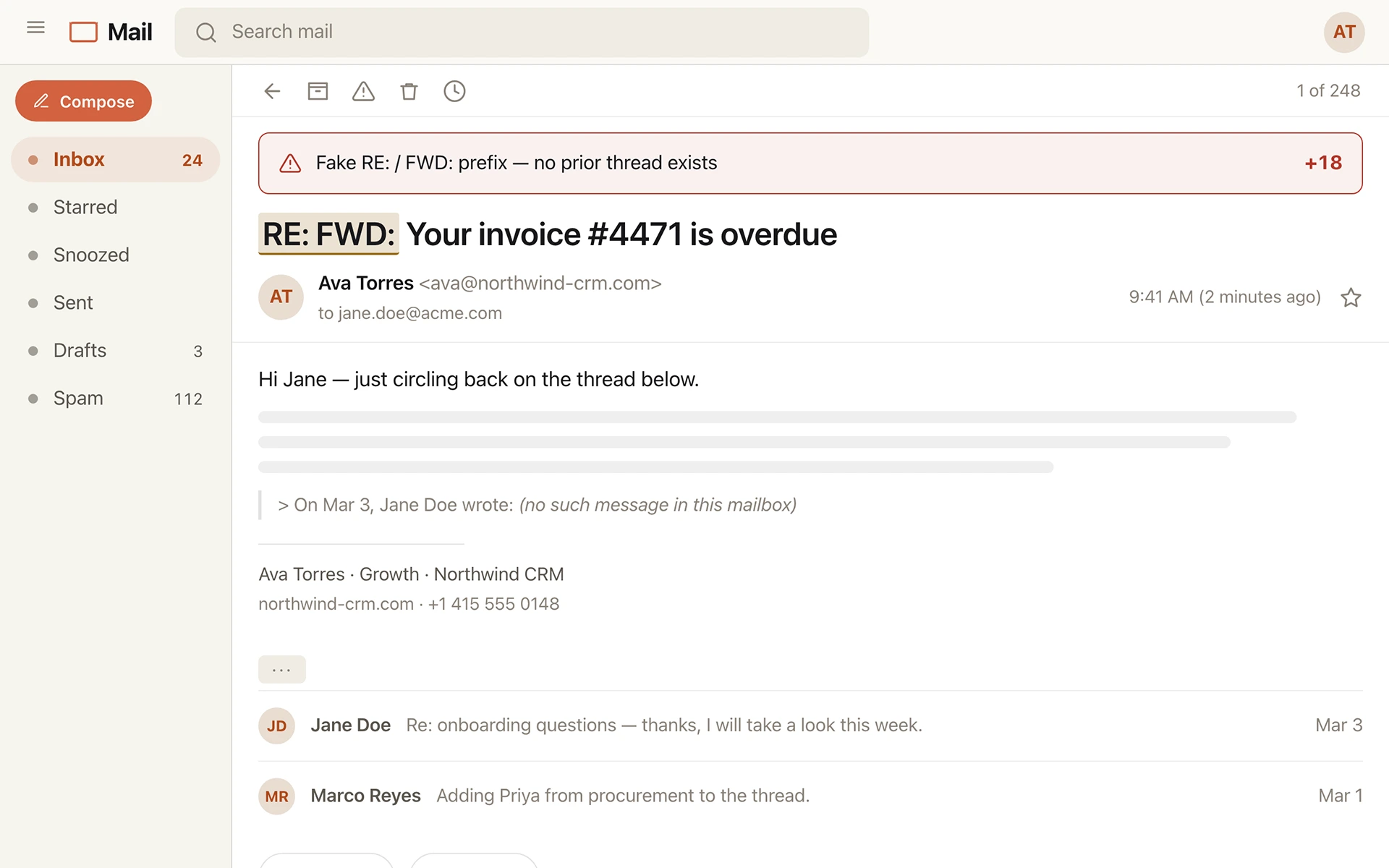
Fake “RE:” and “FWD:” prefixes, or a subject that promises something the body never delivers. CAN-SPAM makes misleading subjects illegal, and filters trained on complaint data treat them as the strongest content signal there is.
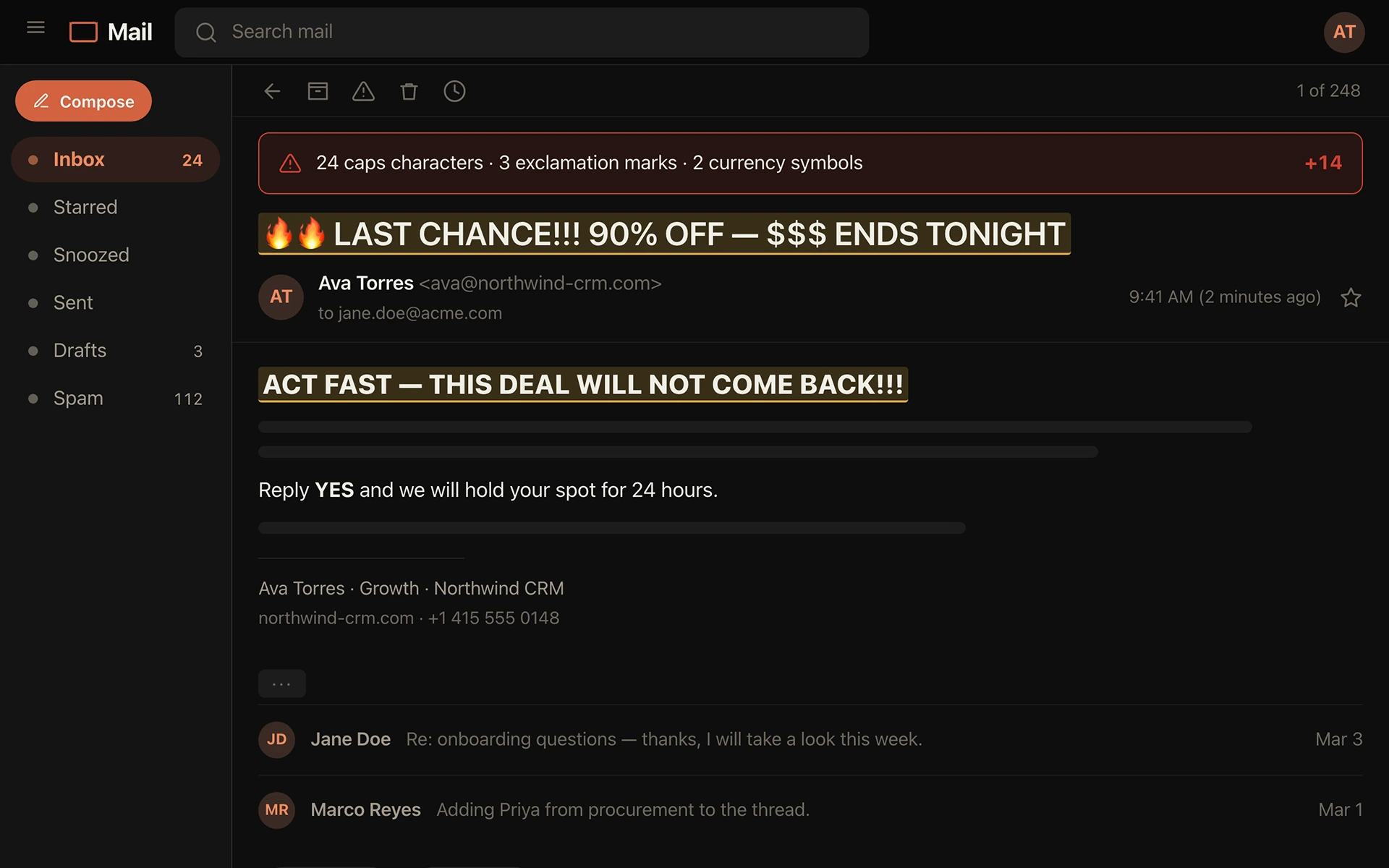
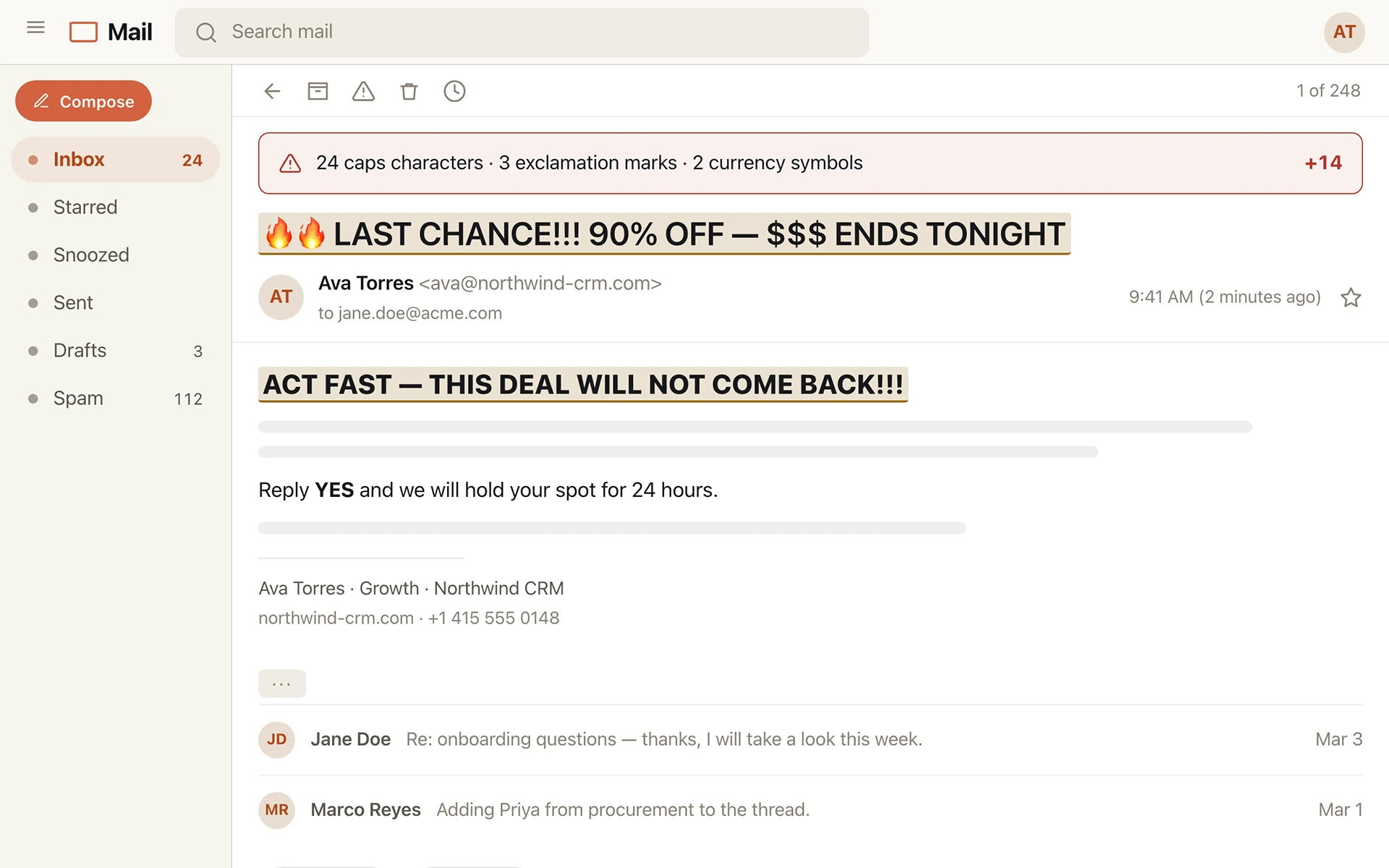
ALL-CAPS subjects, stacked exclamation marks, currency symbols, and emoji walls. None of these carries a fatal penalty on its own, but together they reproduce the exact shape of the mail people already mark as junk every single day.
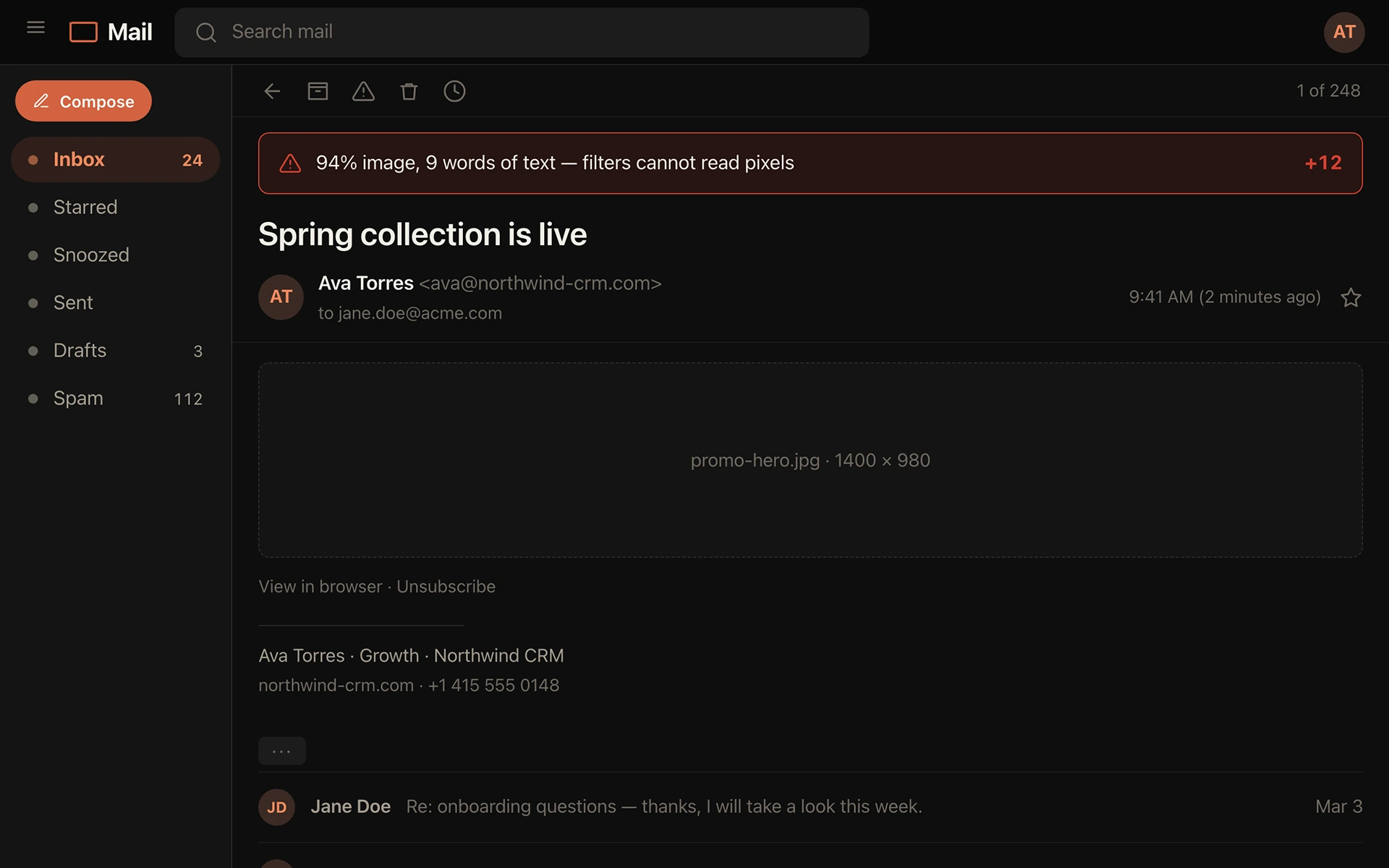
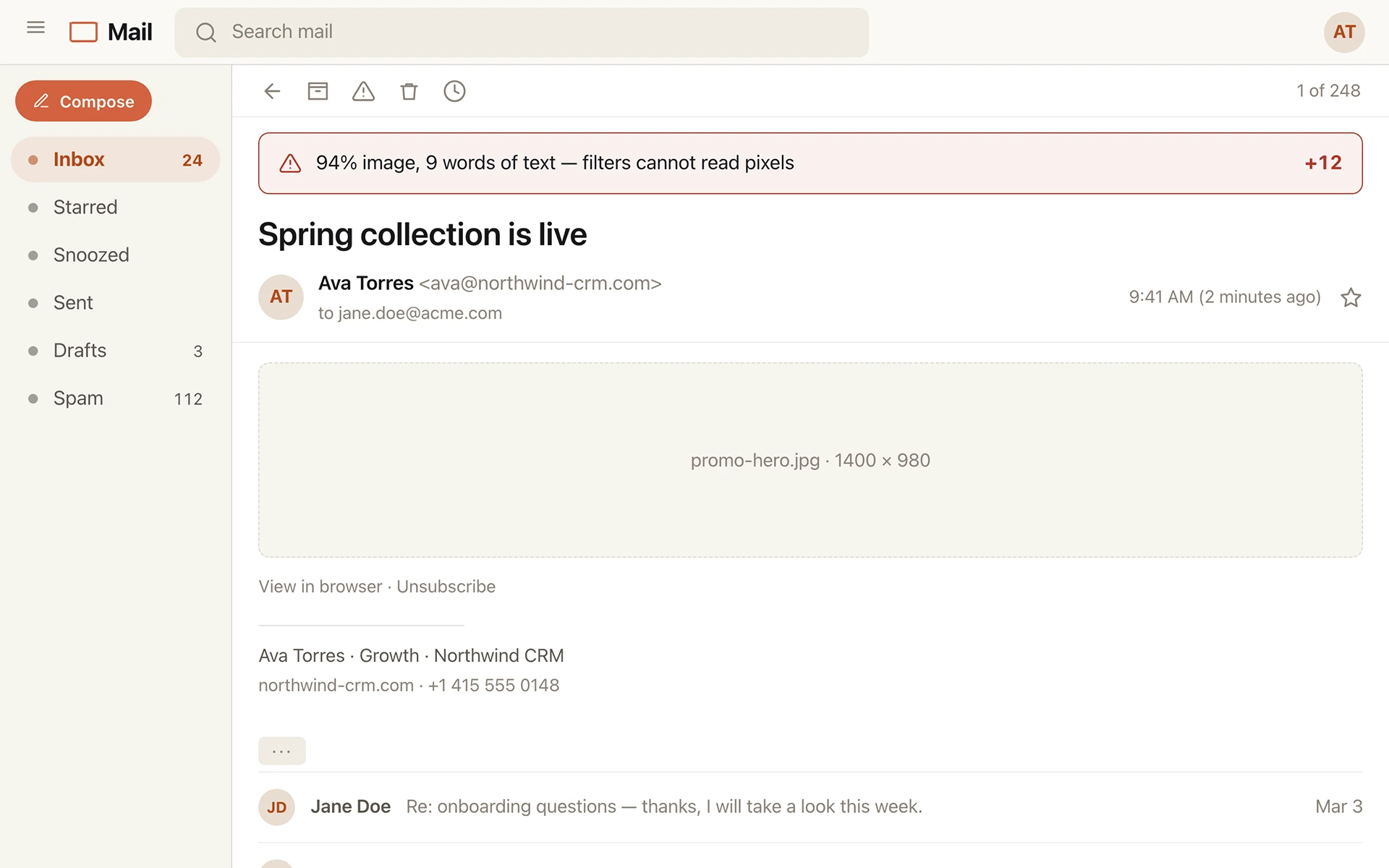
One large image and a dozen words of text is a classic spam silhouette. Filters cannot read pixels, so a body they cannot parse gets scored on suspicion. Keep a healthy text-to-image ratio and always ship real, readable copy in the message.
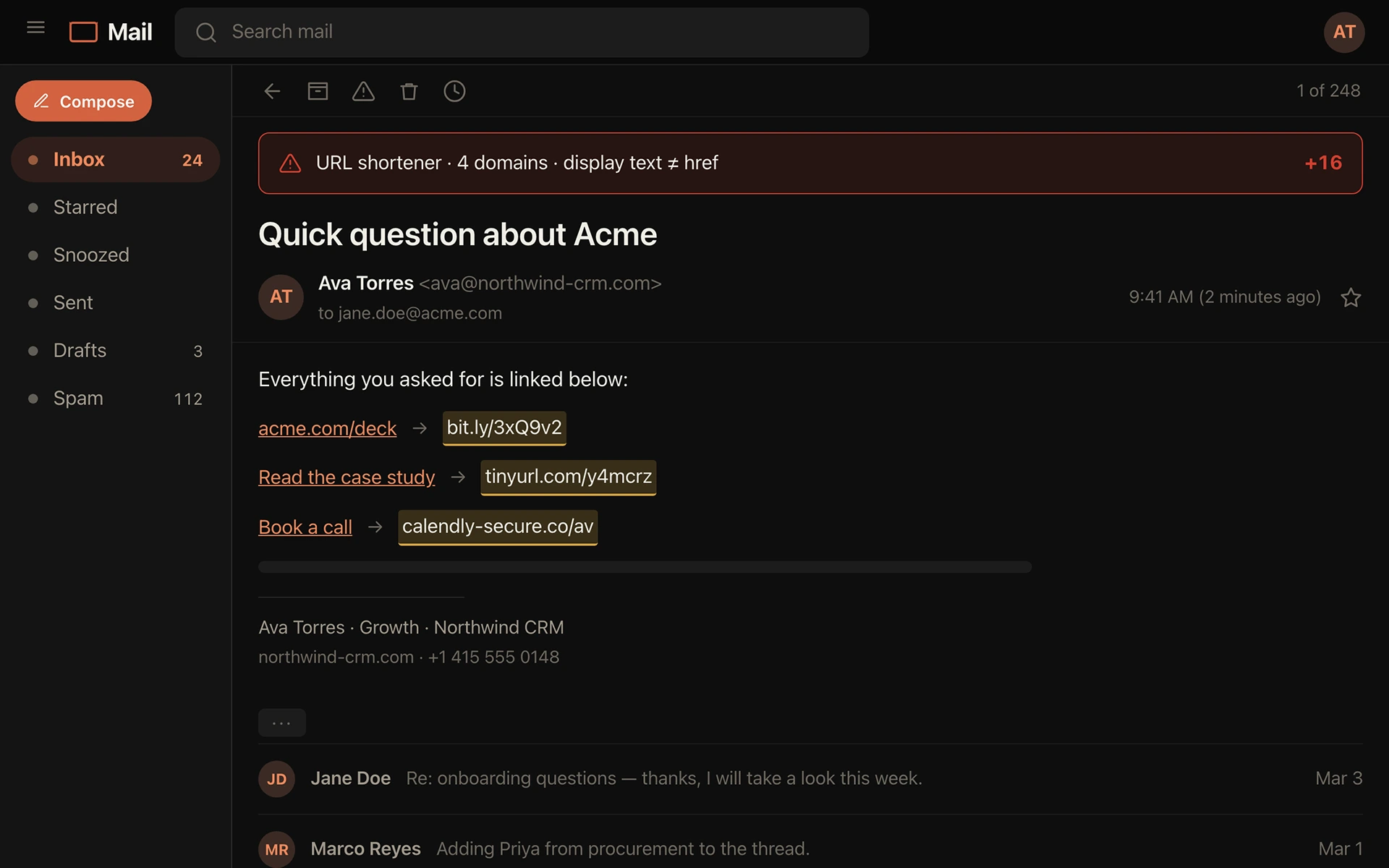
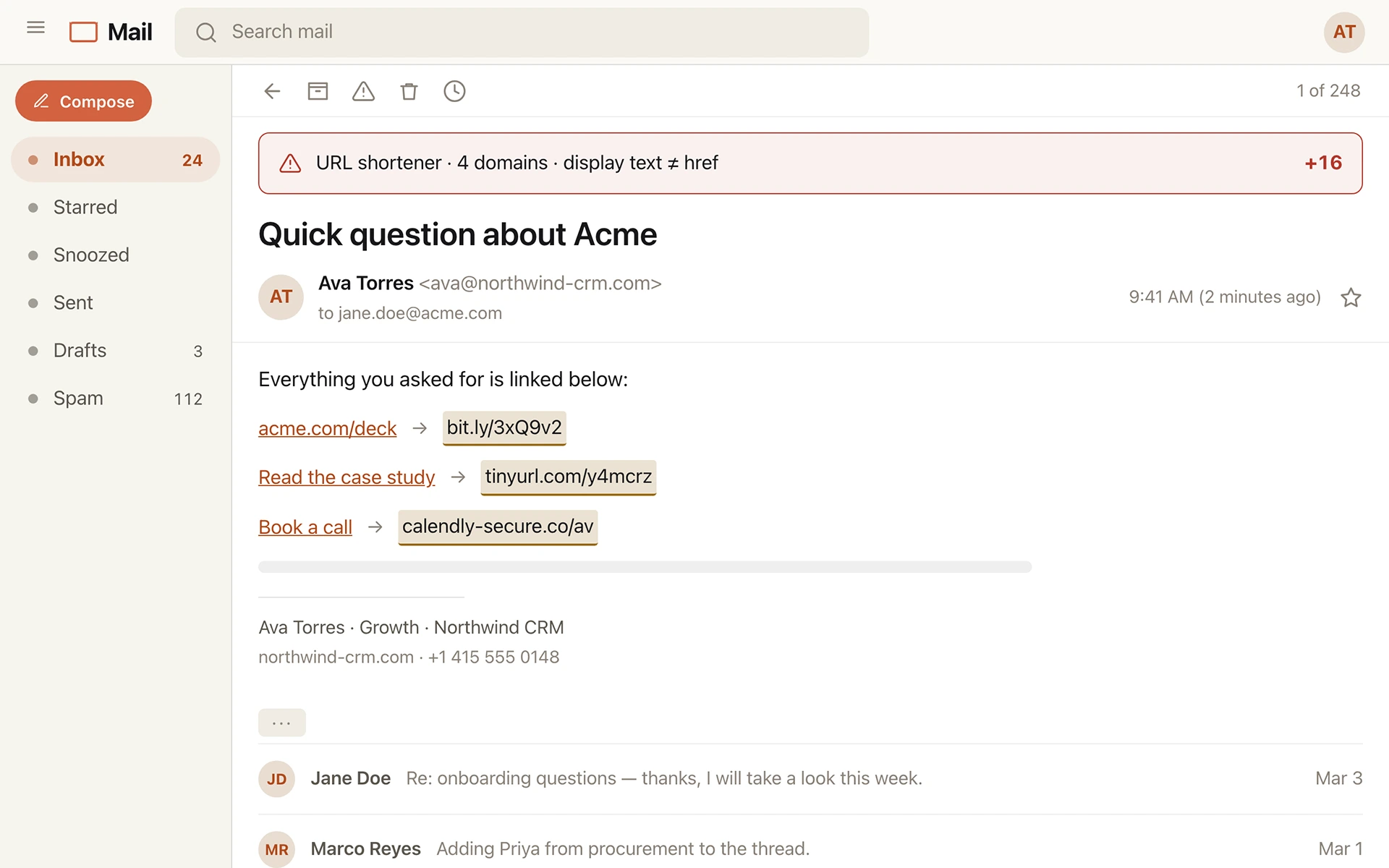
URL shorteners, many different domains in one message, and display text that does not match the underlying href. Phishing detection lives here, and it is unforgiving. Link to one or two domains you actually control. The email link checker audits every URL in the body.
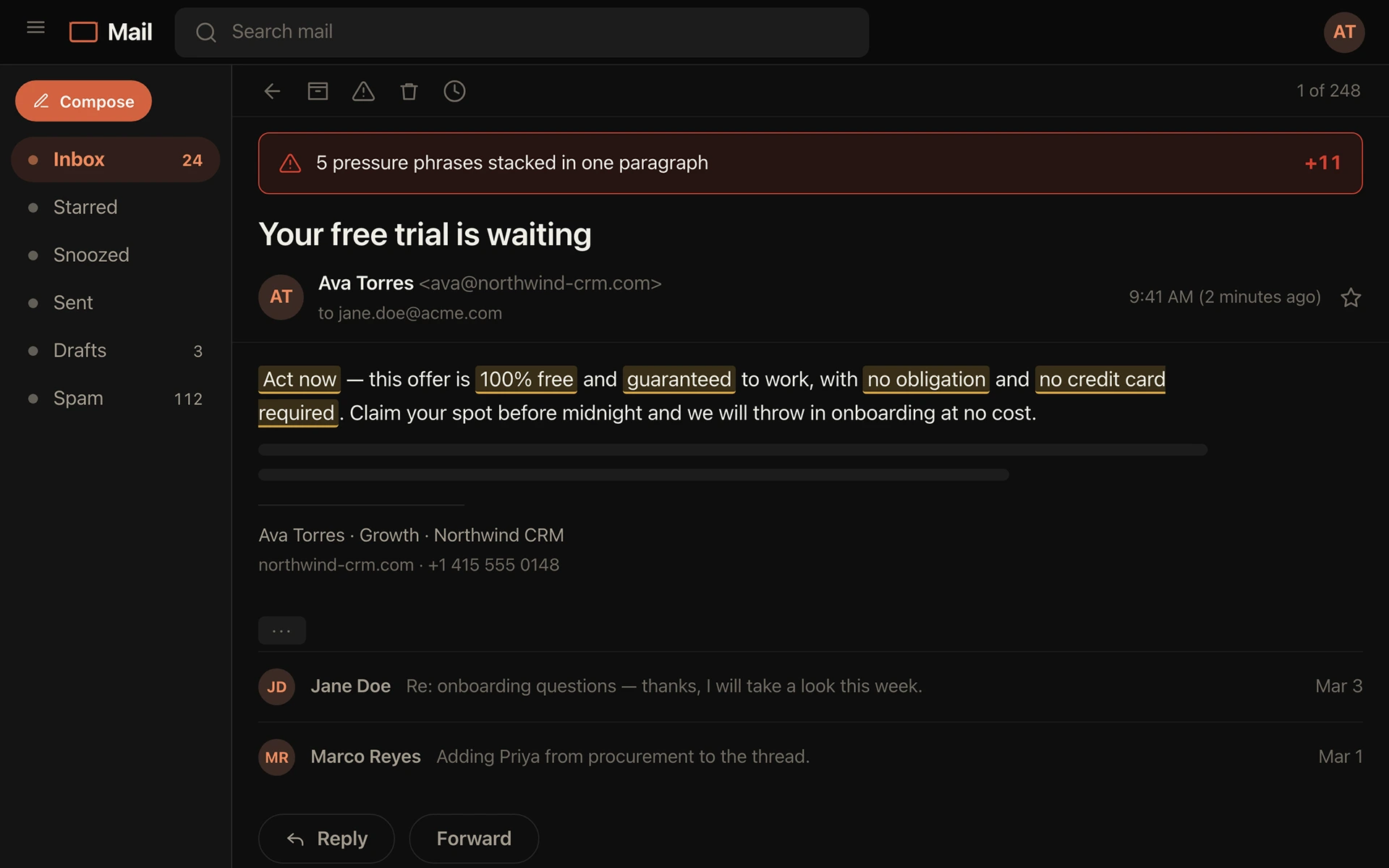
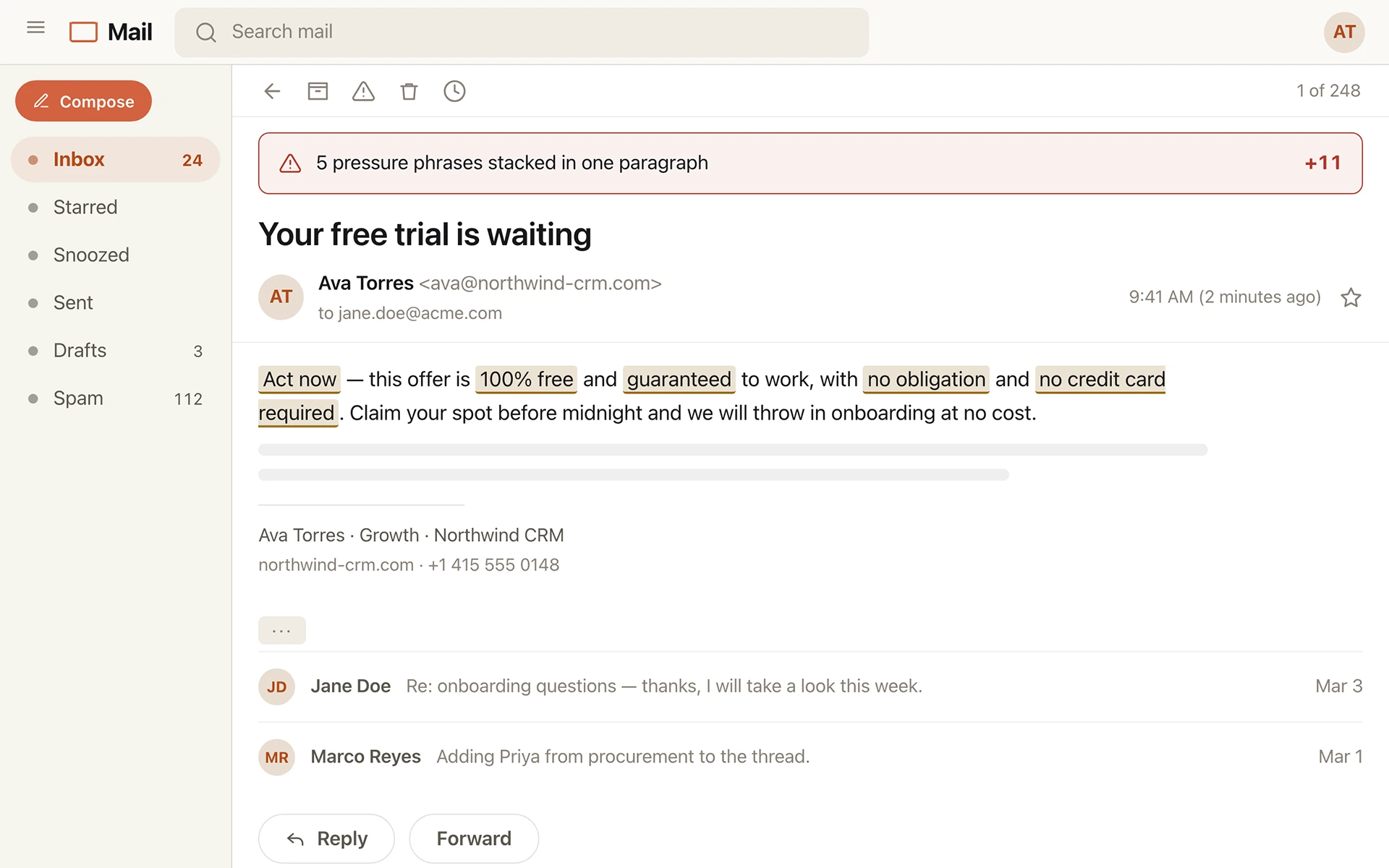
“Act now”, “100% free”, “guaranteed”, “no obligation”. Each phrase is harmless in honest context, but clustered into a pitch-shaped paragraph they still pattern-match against decades of junk. Write like a person, not a late-night ad.
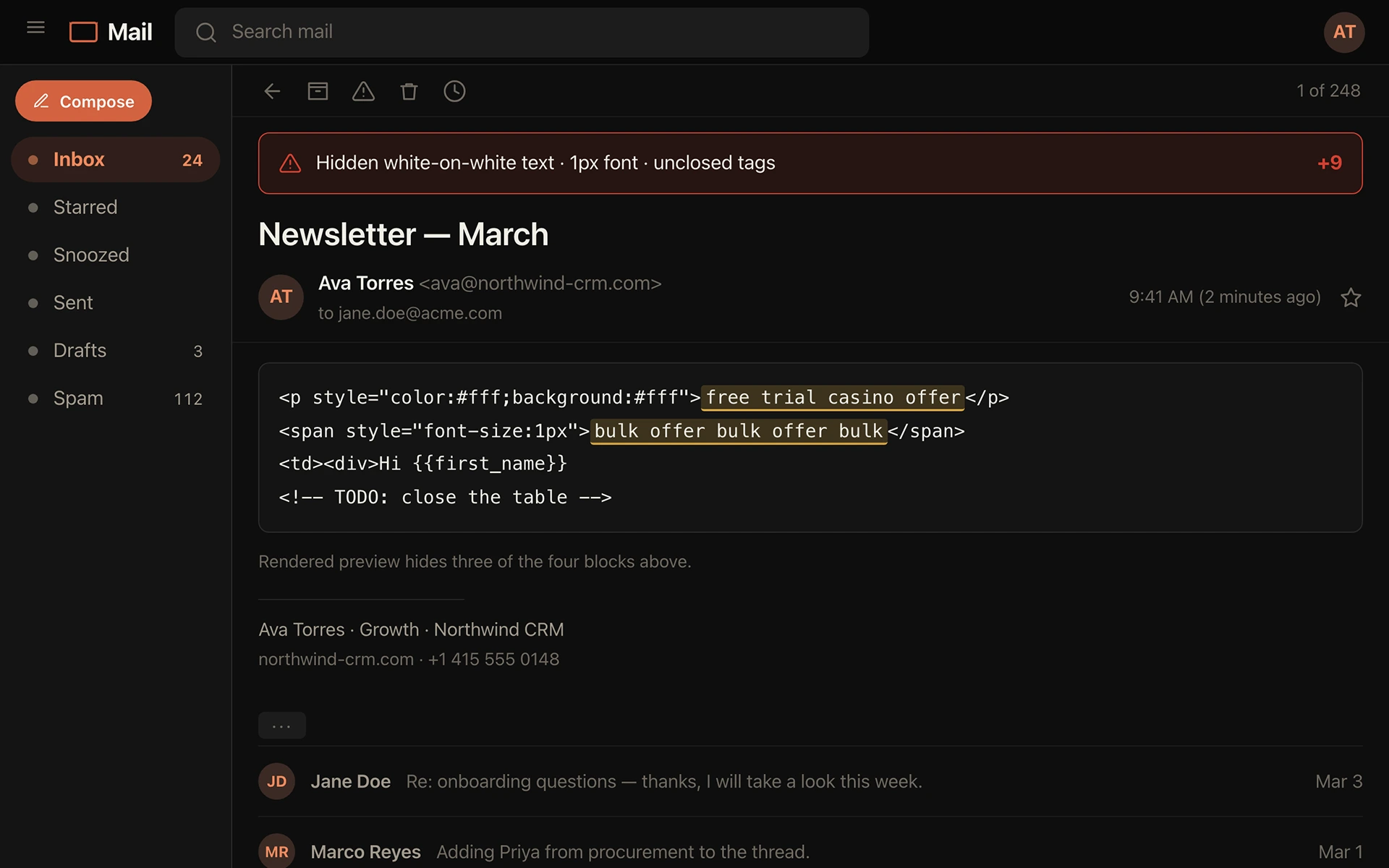
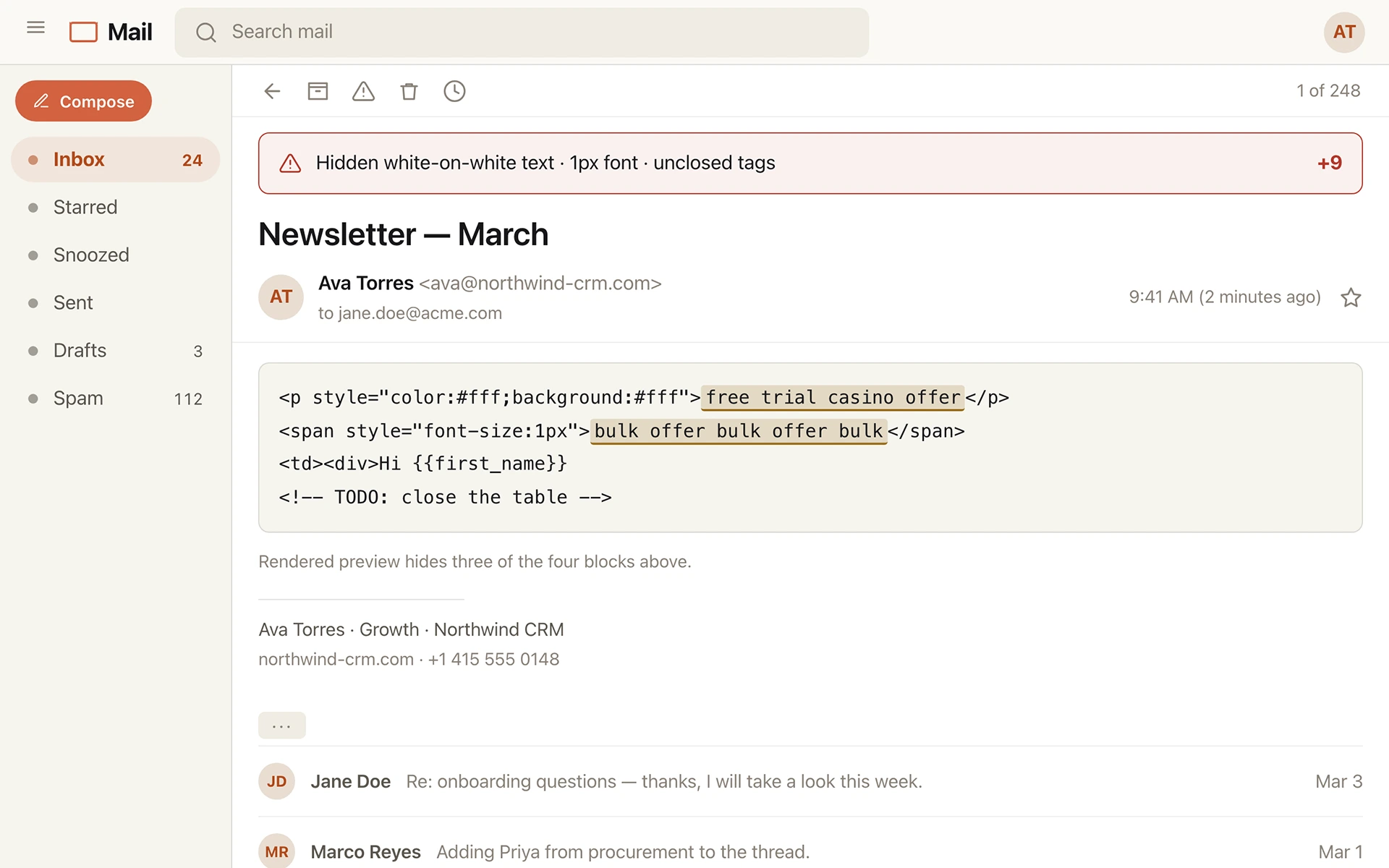
Broken tags, hidden white-on-white text, one-pixel fonts, and leftover template scaffolding. Filters parse your markup before any human ever sees it, and markup built to hide things from a reader is scored as exactly that. The email template checker digs deeper into rendering and broken markup.
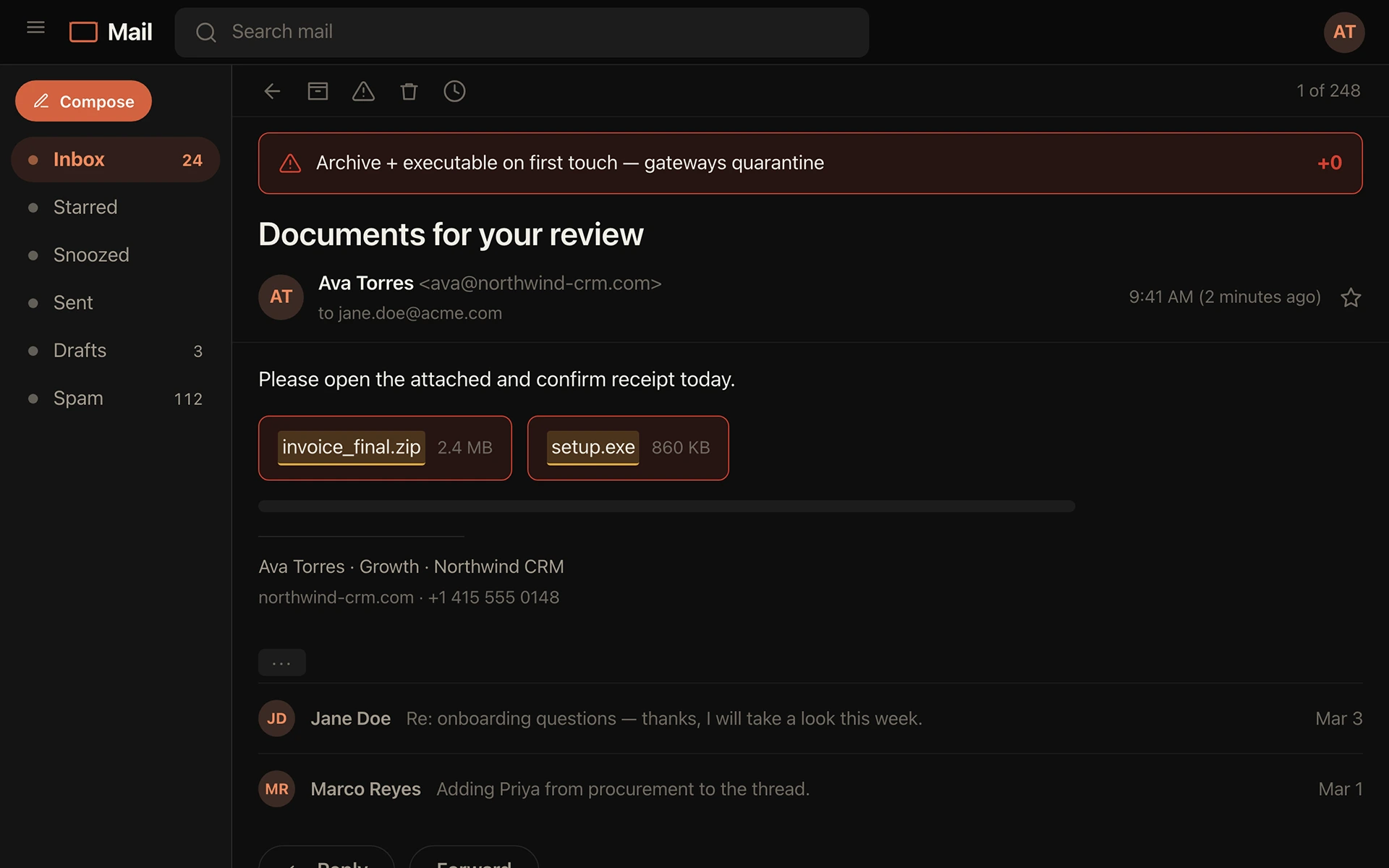
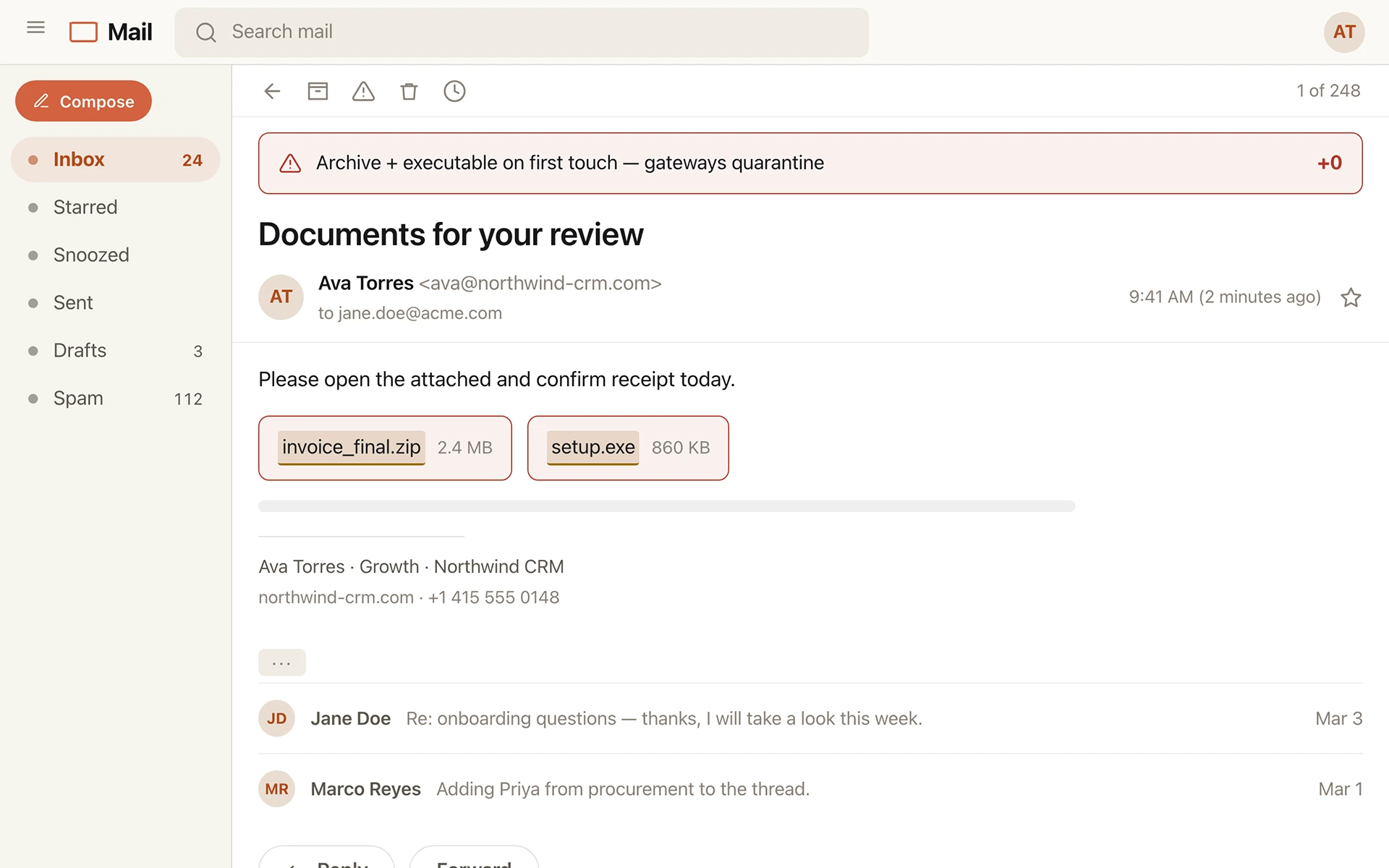
Unexpected .zip, .exe, or .html attachments in a first-touch email. Most gateways quarantine these shapes outright, no questions asked. If a prospect actually needs a file, link to it from a domain you own and control instead of attaching it.
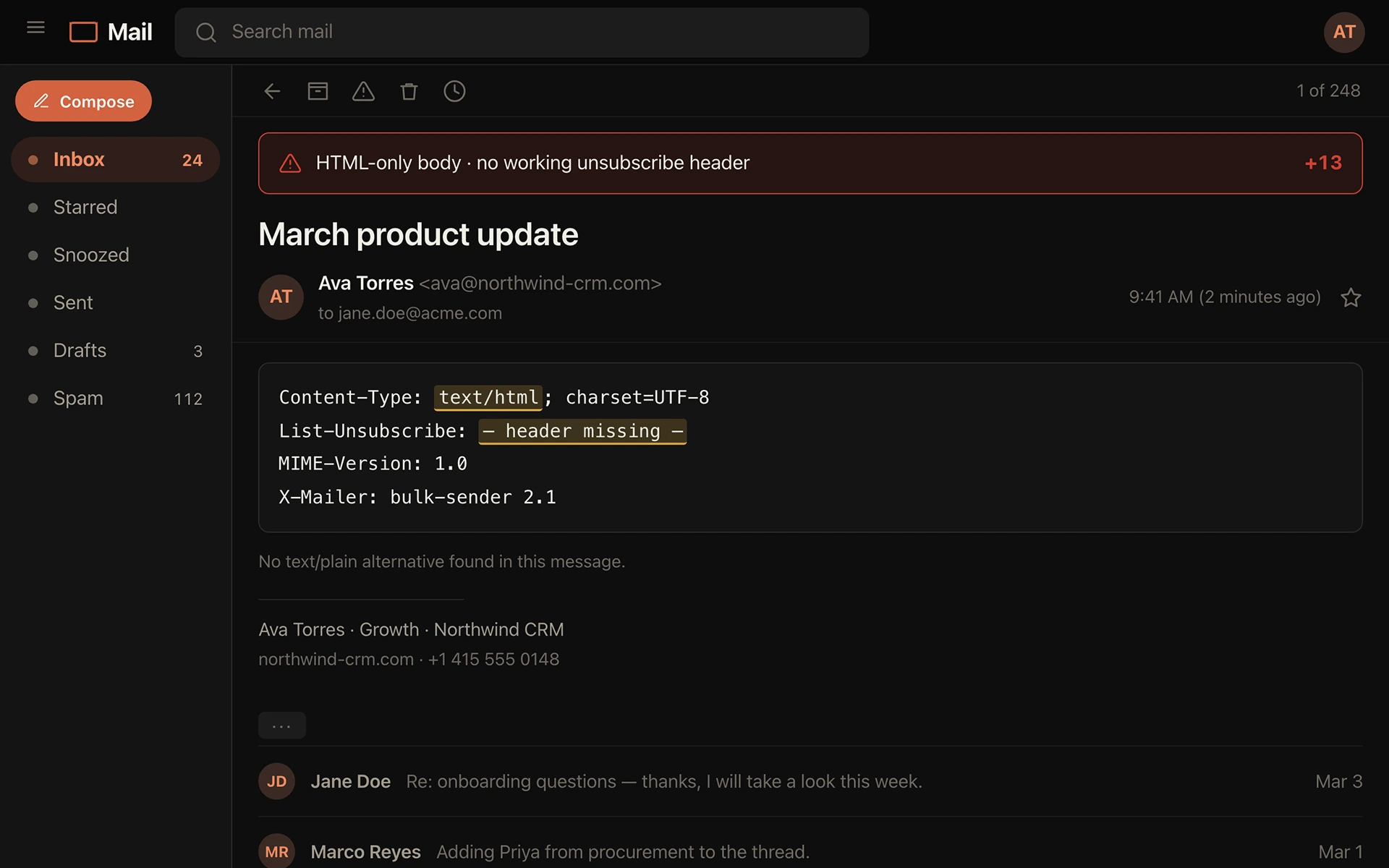
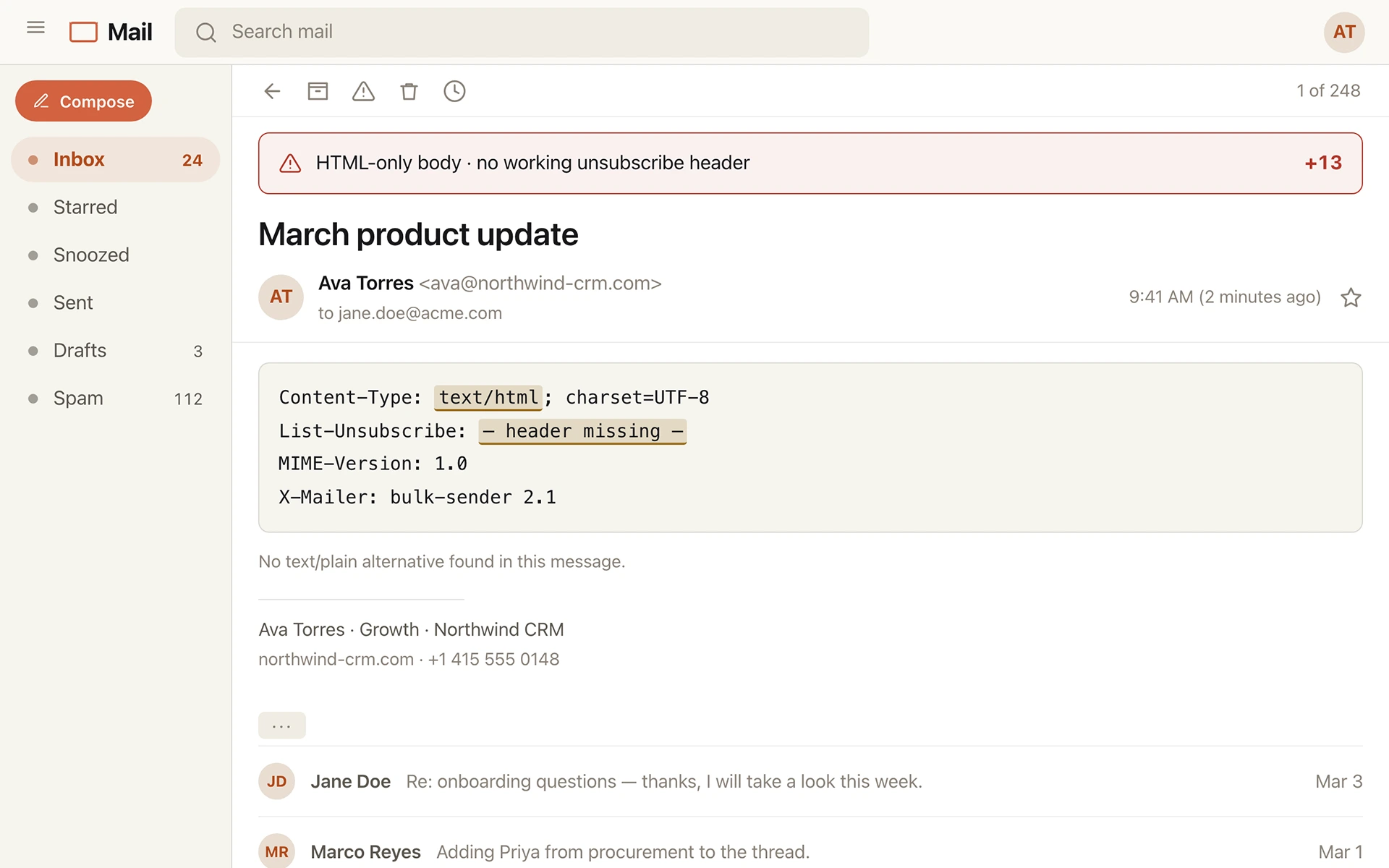
HTML-only messages with no text/plain alternative, and bulk mail without a working unsubscribe link. Both are structural tells that legitimate senders never leave out, so filters read their absence loudly and score you down for it.
Not a trigger-word tally. The signals modern spam filters actually weight, and why a clean content score still keeps passing campaigns that die.
Type email spam content checker into Google and you are usually holding a finished draft and a deadline, wanting one number that says the campaign will land. The classic tools answer with a SpamAssassin-style score: every risky phrase, formatting quirk, and link pattern adds points, and anything over 5.0 gets junked by the older gateways still running those rules. That model is twenty years old and covers a shrinking slice of the inboxes you care about. Treat the score as a lint check on your prose, not a delivery guarantee, then spend the rest on the sender side.
Content scanners score your words. Verifox verifies the recipient the filters judge you on and runs on credits that never expire.
Why both halves matter
You can pass every content scanner on the internet and still hit the junk folder, because bounces and trap hits from a stale list outweigh your best subject line.
Growth leads, marketers, and engineers running real campaigns on real lists, with a verified email on every byline.

We were paying ZeroBounce a four-figure monthly bill and still landing 3% bounces on cold campaigns. Switched the pipeline to Verifox, dropped to 0.4% bounces, and cut the bill by more than 90%.

Other tools flag 30% of our B2B list as 'risky catch-all' and leave the call to us. Verifox returns a real verdict on those addresses, with a confidence score. We send more, we send safer.

We had a Gmail spam-folder problem after a bad list import. Verifox cleaned the list and the warmup ran on the same engine. Back in primary inbox in six weeks. One vendor, half the cost.

Ran a 50,000-address outbound list through Verifox before our quarterly campaign. Bounces landed at 0.7%, sender reputation didn't move, replies were up 22% over last quarter.

Their MCP server let me wire email verification directly into our internal Claude agent in about ten minutes. Zero glue code. No other vendor in this space has thought about that workflow.

Tested Verifox at 10,000 verifications per minute on a Tuesday morning. Latency held under 400ms median, no soft failures, no rate-limit walls. The vendor we benched throttled at 2,000/min.

Our SDRs were enriching from three tools and 14% of the emails were invalid before they hit the sequencer. Verifox sits in the pipeline now and the team stopped seeing 'undeliverable' replies the next week.

Bulk upload, sorted CSV back in twenty minutes, plug into our growth stack. The half-day list-hygiene project per cohort turned into something the marketing intern runs on autopilot.

Verifox returns a 0-100 confidence score per address, not just a label. We thresholded at 75 for the cold sequencer, 60 for nurture, and our deliverability team finally has a knob they can tune.
We were paying ZeroBounce a four-figure monthly bill and still landing 3% bounces on cold campaigns. Switched the pipeline to Verifox, dropped to 0.4% bounces, and cut the bill by more than 90%.
We had a Gmail spam-folder problem after a bad list import. Verifox cleaned the list and the warmup ran on the same engine. Back in primary inbox in six weeks. One vendor, half the cost.
Their MCP server let me wire email verification directly into our internal Claude agent in about ten minutes. Zero glue code. No other vendor in this space has thought about that workflow.
Our SDRs were enriching from three tools and 14% of the emails were invalid before they hit the sequencer. Verifox sits in the pipeline now and the team stopped seeing 'undeliverable' replies the next week.
Verifox returns a 0-100 confidence score per address, not just a label. We thresholded at 75 for the cold sequencer, 60 for nurture, and our deliverability team finally has a knob they can tune.
Other tools flag 30% of our B2B list as 'risky catch-all' and leave the call to us. Verifox returns a real verdict on those addresses, with a confidence score. We send more, we send safer.
Ran a 50,000-address outbound list through Verifox before our quarterly campaign. Bounces landed at 0.7%, sender reputation didn't move, replies were up 22% over last quarter.
Tested Verifox at 10,000 verifications per minute on a Tuesday morning. Latency held under 400ms median, no soft failures, no rate-limit walls. The vendor we benched throttled at 2,000/min.
Bulk upload, sorted CSV back in twenty minutes, plug into our growth stack. The half-day list-hygiene project per cohort turned into something the marketing intern runs on autopilot.
We were paying ZeroBounce a four-figure monthly bill and still landing 3% bounces on cold campaigns. Switched the pipeline to Verifox, dropped to 0.4% bounces, and cut the bill by more than 90%.
Ran a 50,000-address outbound list through Verifox before our quarterly campaign. Bounces landed at 0.7%, sender reputation didn't move, replies were up 22% over last quarter.
Our SDRs were enriching from three tools and 14% of the emails were invalid before they hit the sequencer. Verifox sits in the pipeline now and the team stopped seeing 'undeliverable' replies the next week.
Other tools flag 30% of our B2B list as 'risky catch-all' and leave the call to us. Verifox returns a real verdict on those addresses, with a confidence score. We send more, we send safer.
Their MCP server let me wire email verification directly into our internal Claude agent in about ten minutes. Zero glue code. No other vendor in this space has thought about that workflow.
Bulk upload, sorted CSV back in twenty minutes, plug into our growth stack. The half-day list-hygiene project per cohort turned into something the marketing intern runs on autopilot.
We had a Gmail spam-folder problem after a bad list import. Verifox cleaned the list and the warmup ran on the same engine. Back in primary inbox in six weeks. One vendor, half the cost.
Tested Verifox at 10,000 verifications per minute on a Tuesday morning. Latency held under 400ms median, no soft failures, no rate-limit walls. The vendor we benched throttled at 2,000/min.
Verifox returns a 0-100 confidence score per address, not just a label. We thresholded at 75 for the cold sequencer, 60 for nurture, and our deliverability team finally has a knob they can tune.
Every layer of the stack carries a third-party attestation, so you can ship into regulated industries without rebuilding your compliance posture.

Independently audited to the SOC 2 Type II standard.

Built for the EU with full GDPR data-subject rights.

California opt-out, do-not-sell, plus DSAR handling.

Information security held to the ISO 27001 standard.

AI governance aligned to the new ISO 42001 standard.
Common questions
What teams ask before a send: which content rules still apply, what a safe spam score looks like, and why the list usually matters more than the words. Straight answers, real numbers.
No, and we will not pretend otherwise. Verifox does not read your prose. The eight content signals on this page are a hand-audit checklist drawn from how filters actually score messages, and the widget up top checks the addresses you plan to send to.
That split is deliberate: content problems are fixable in your draft in ten minutes, while list problems need machinery. If your question is whether a specific address is risky, the address-level spam check answers it directly.
Rarely on their own. Gmail and Microsoft moved to machine-learning filters that read context, so “free” in a genuine offer is fine while a stack of pressure phrases in a pitch-shaped sentence still pattern-matches badly.
The exception is older corporate gateways running SpamAssassin-style rules, which do assign per-phrase points. If you sell into enterprises, keep the phrase clusters out of cold email and watch your overall email health instead of any single word.
For SpamAssassin-style scoring, the default junk threshold is 5.0, and careful senders aim under 3. Treat that number as linting, not a guarantee: Gmail and Microsoft publish no score at all and weigh sender history far more than content.
A message that scores 0 can still junk if the sending domain has a poor reputation or the list is full of dead addresses. Score the content once, then spend your remaining time on the sender side.
Because content is a minority input. The usual culprits are missing or misaligned authentication, a domain or IP on a blocklist, and a stale list driving bounces and complaints.
Work through them in order: run an SPF, DKIM, and DMARC check on your domain, scan it with the domain spam checker, confirm nothing is listed via the email blacklist check, then clean the list itself. Most “mystery” junking is one of those four.
A reliable pre-send routine has four steps. Audit the draft against the eight content signals above. Check the rendering and links with the email template checker. Run a deliverability test to seed inboxes across providers. Then verify every recipient so bounces never enter the equation.
The whole routine takes under an hour and removes the guesswork that a single content score never could.
Nine address-level checks run in parallel: syntax against RFC 5321 and 5322, domain existence and MX records, a live SMTP handshake with a mailbox ping, disposable-domain match, role-address detection, catch-all detection, an AI-confidence pass on catch-alls, domain age, and SPF, DKIM, and DMARC authentication.
The catch-all resolution matters most: 20 to 40% of B2B lists fail at catch-all domains, the check most free tools skip.
You can run 4 verifications per day from this page with no account at all. Create a free account and you get 1,000 credits immediately, or 2,500 if you sign up with a work address. No card either way.
Past that, credits are pay-as-you-go and never expire, with volume pricing shown for your region.
Yes, and you should: it is the highest-leverage spam fix available. Upload a CSV or call the API and bulk verification runs at roughly 10,000 emails per minute on the standard tier, with a per-address verdict and confidence score back.
Single checks return in about 380 ms median. The API docs cover both shapes, and the SLA runs 99.9% on Starter up to 99.99% on an annual Volume contract.
No. Every address is processed in memory and discarded the moment the verdict returns. Nothing is logged, retained, or sold, which matters when the list you are cleaning is your customer base.
Verifox is SOC 2 Type II compliant, and the privacy policy spells out exactly what we touch. Live uptime is public at status.verifox.ai.
Yes. The REST API drops the same 9-check engine into signup forms, CRMs, and sequencers, and HubSpot, Salesforce, Zapier, Klaviyo, Mailchimp, and Brevo connect out of the box.
For agents, Verifox ships a native MCP server, so Claude, Cursor, or a custom LLM app can verify recipients before a send without glue code. Point the agent at the MCP URL and the tools are wired.