

Paste your HTML
Drop your email's HTML straight into the checker, the whole template at once. Gmail, Outlook, and Apple Mail markup are all accepted, pasted or typed. Nothing is stored, there's no signup, and no card to start.
Paste your HTML and catch Gmail's 102 KB clip, missing alt text, and the CSS Outlook drops, then walk the six-item pre-send checklist below. Free.
Free to try. No signup, no card.
Trusted by 500,000+ leading GTM teams of all sizes
Three steps, no signup, no card. Paste the template source, let every check run in one instant pass, and read the score with each finding listed.
Drop your email's HTML straight into the checker, the whole template at once. Gmail, Outlook, and Apple Mail markup are all accepted, pasted or typed. Nothing is stored, there's no signup, and no card to start.
Every check fires in one instant pass, no rendering farm and no waiting: file size against Gmail's 102 KB clip, missing alt text, Outlook-unsafe CSS, stripped styles, the viewport meta tag, and the unsubscribe link.
You get a 0-100 score with an excellent, good, or needs-work verdict, plus every finding listed by severity with a plain fix, so you know exactly what to change before the template ships.
The message is only half of what decides the send. The other half is the list, the part almost no template tester checks.
An email template checker, the way most people search for one, reviews the message itself. It scans the subject line and body for spam trigger phrases, flags HTML that popular mail clients mangle, follows every link to catch 404s and broken tracking parameters, and weighs the payload, since heavy or image-only templates get clipped when images are blocked. Each check is worth running before every campaign, and the checklist below pairs every item with the tool that covers it, from the spam content checker for your copy to the email link checker for your URLs.
Six checks, in the order we run them on our own campaigns. Five test the message, the sixth tests the list, which decides whether the rest mattered.
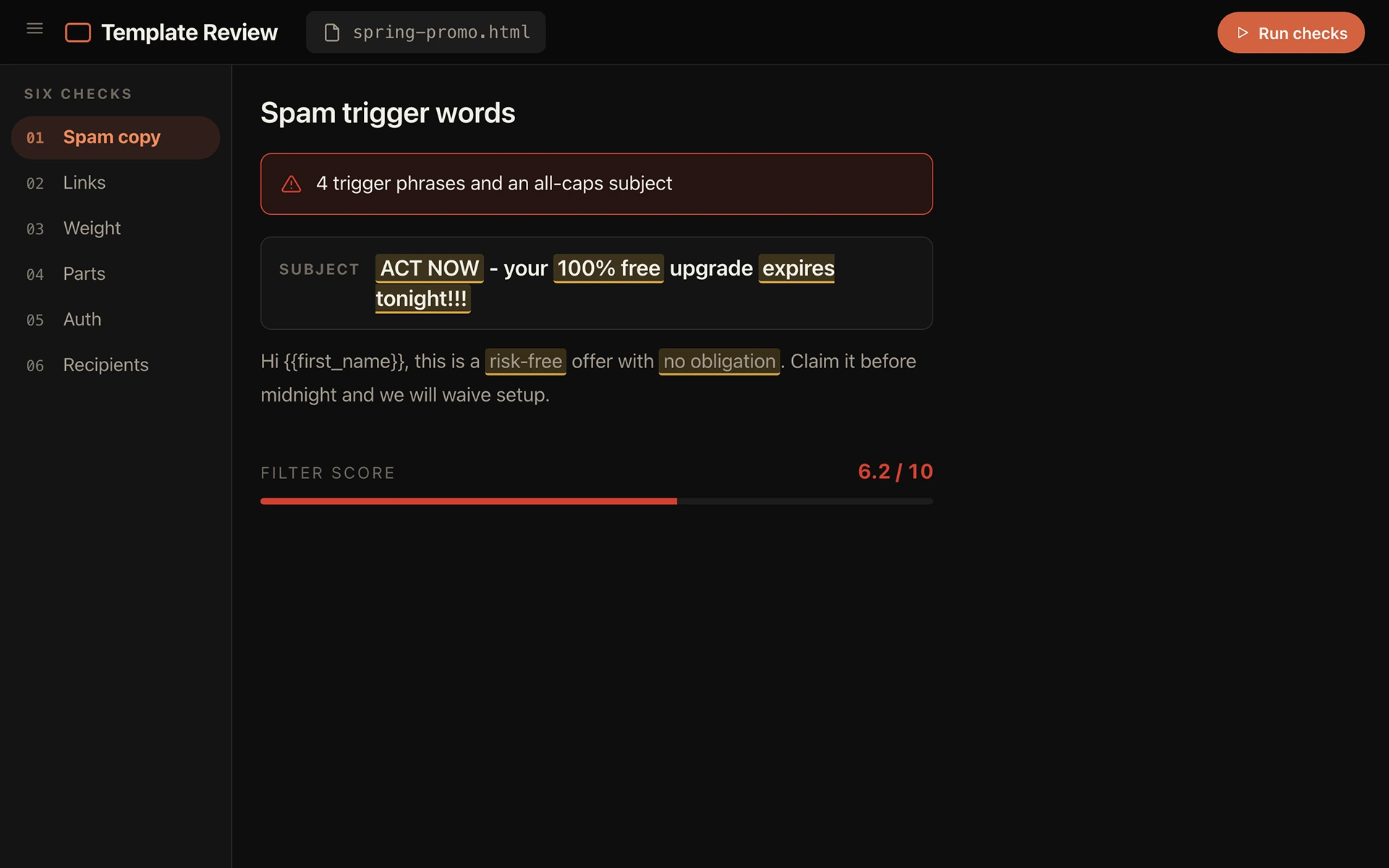
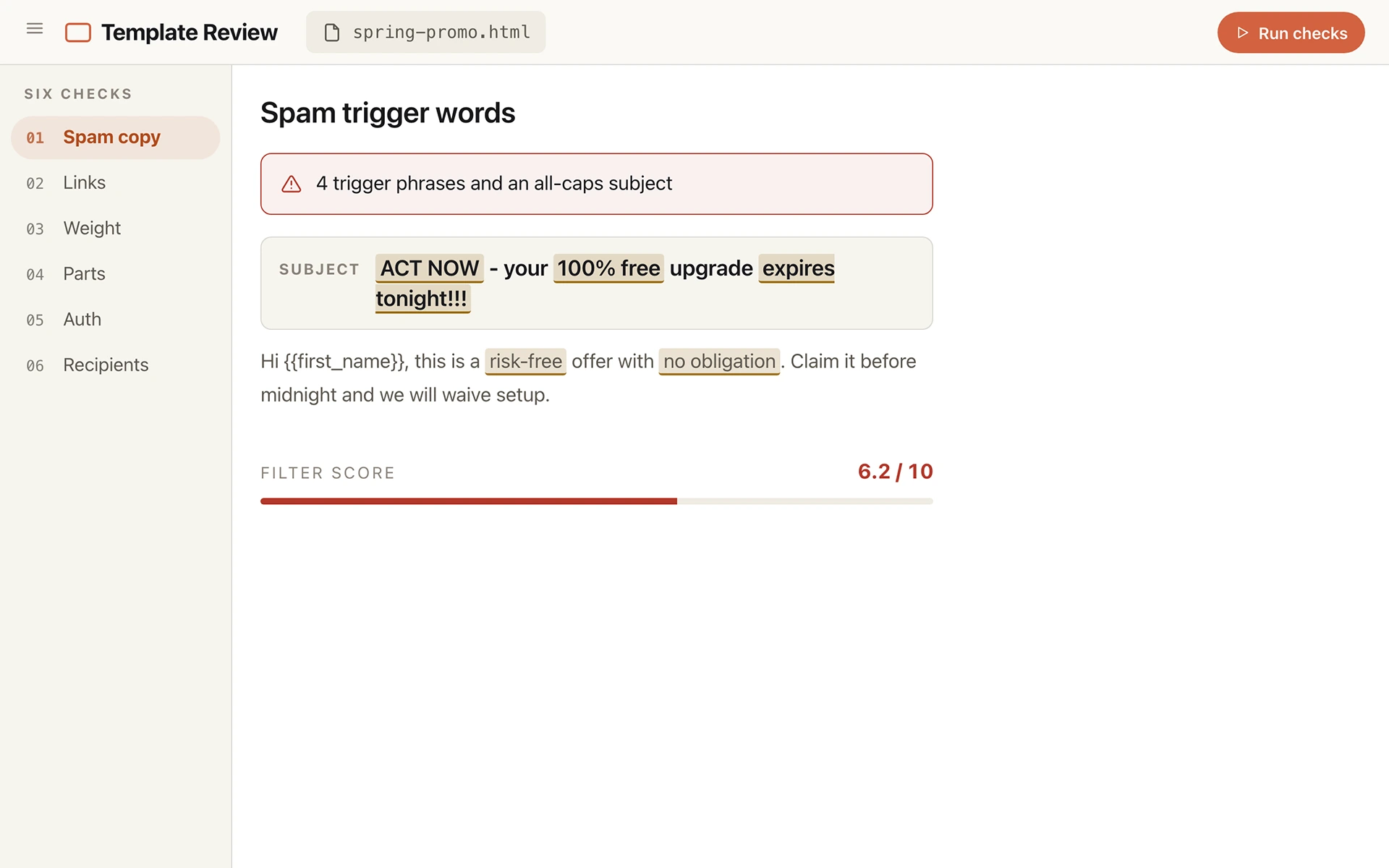
Urgency and money phrases (act now, 100% free, risk-free), all-caps subjects, and stacked punctuation push filter scores up fast. Run the subject line and body through the spam content checker before every campaign, not just the first send.
Dead URLs and misfired tracking parameters waste clicks, and some filters follow links before your reader ever does. The email link checker confirms every href in the template resolves, including the unsubscribe link the law requires.
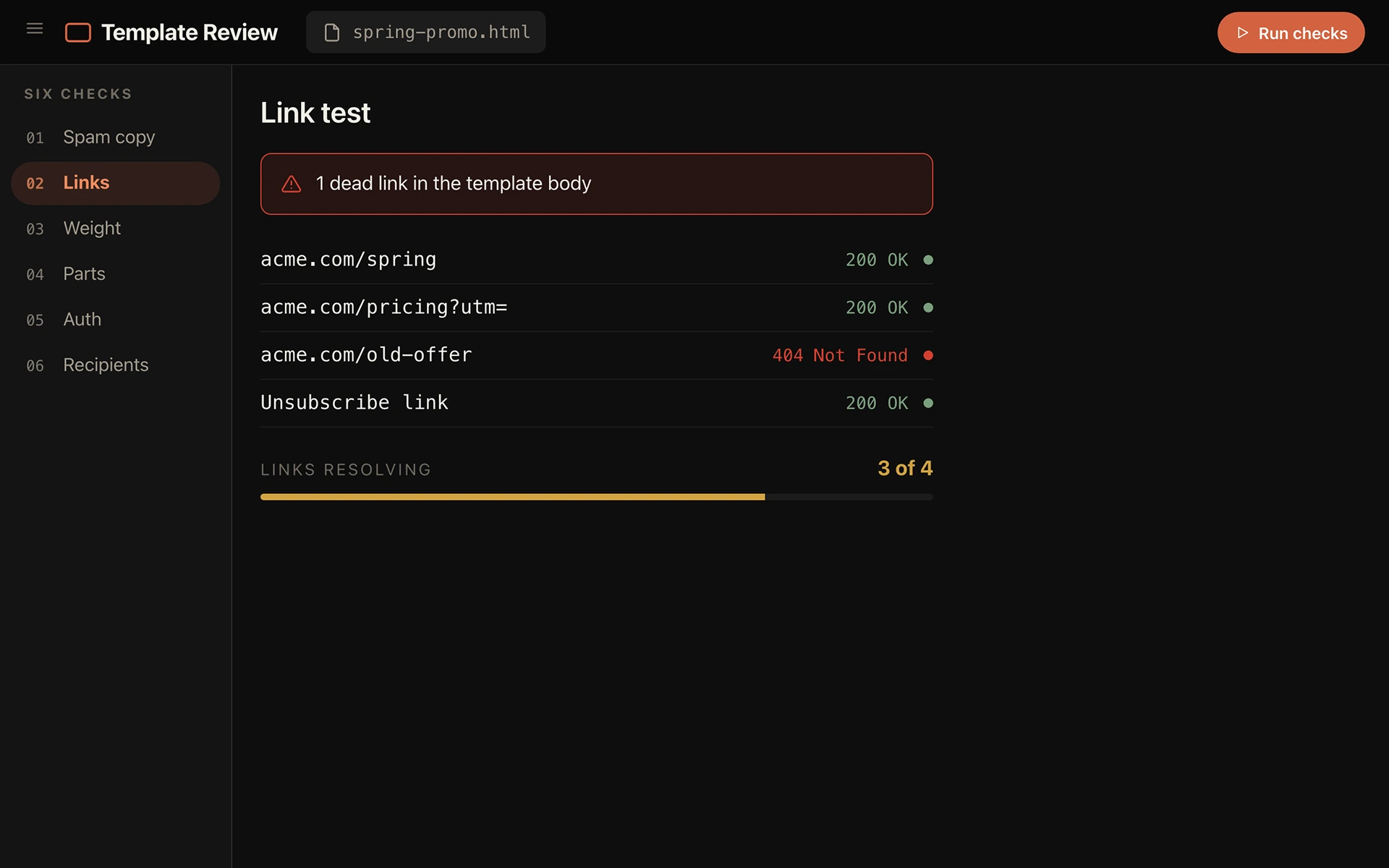
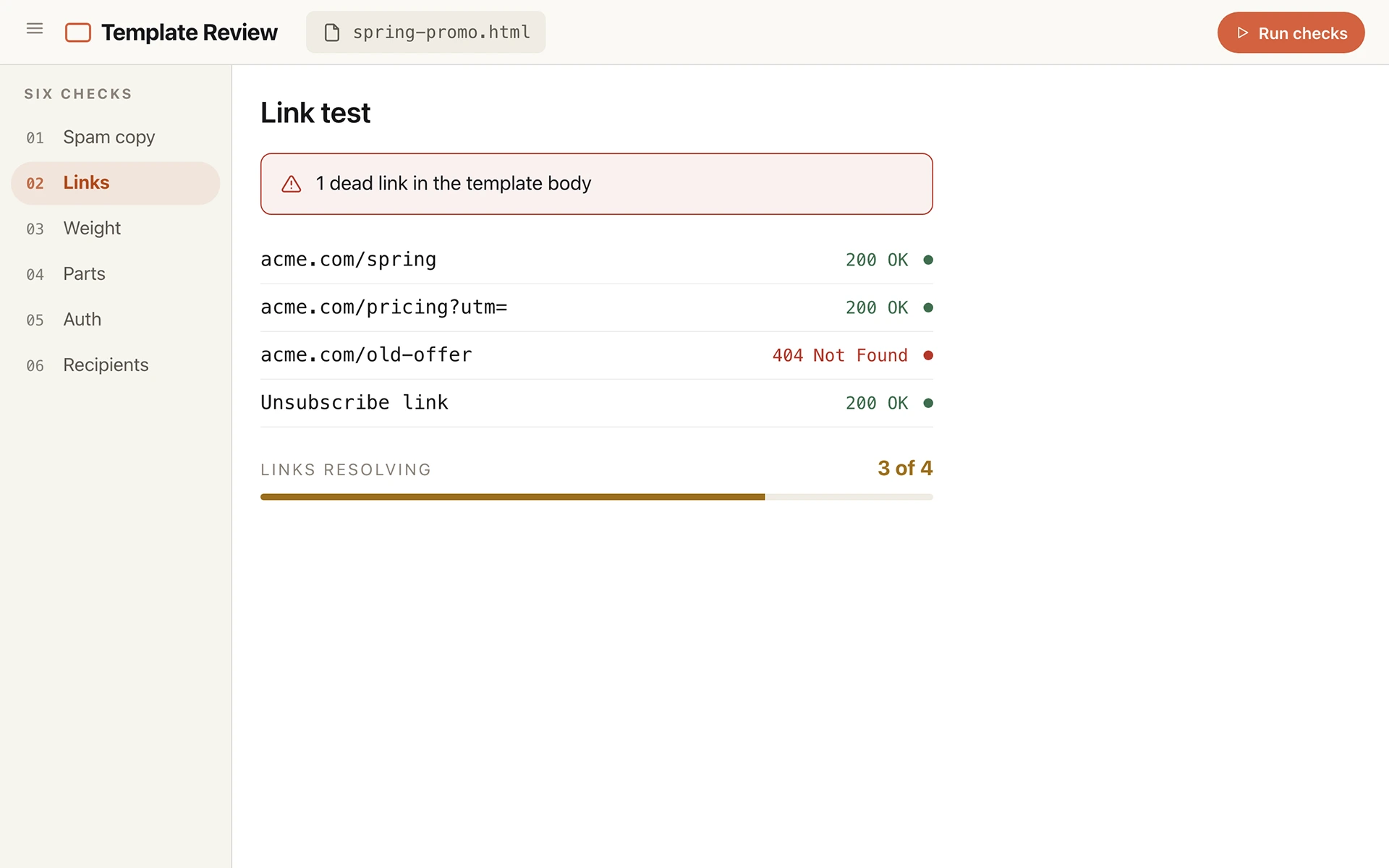
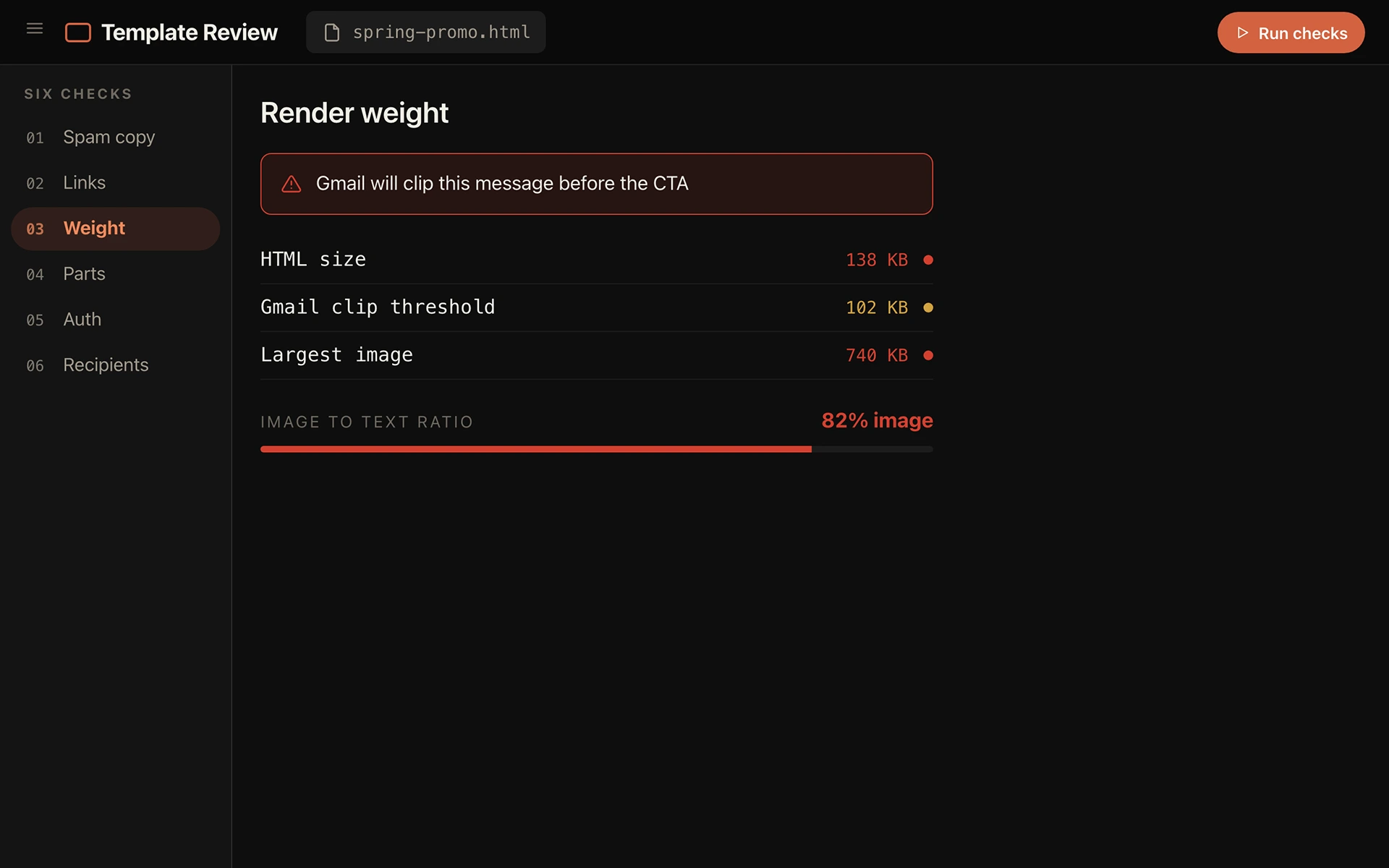
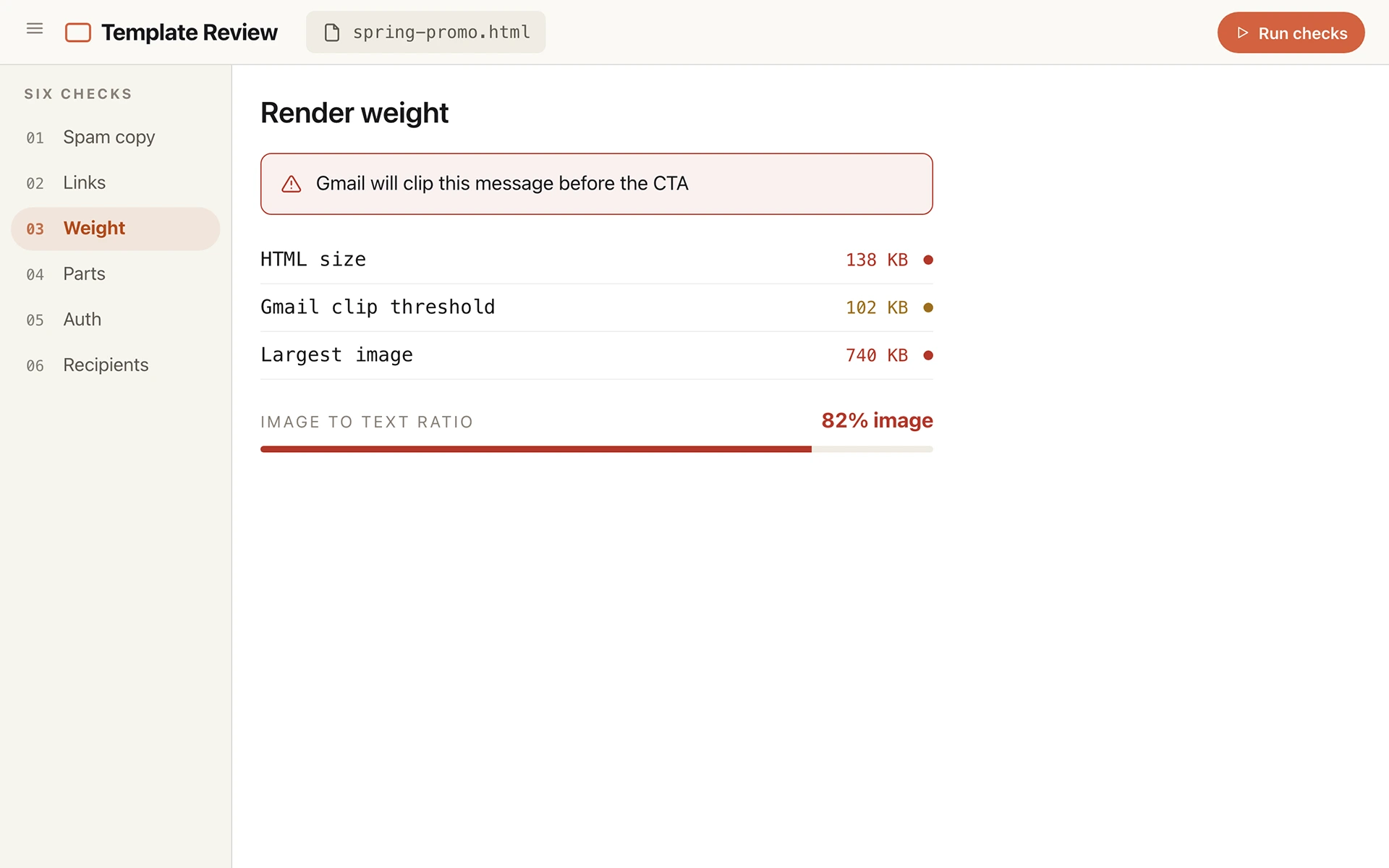
Image-only templates with thin text score poorly, and Gmail clips messages above roughly 102 KB, cutting off whatever sits at the bottom. Keep the HTML lean, compress images, and make sure the core message survives with images blocked.
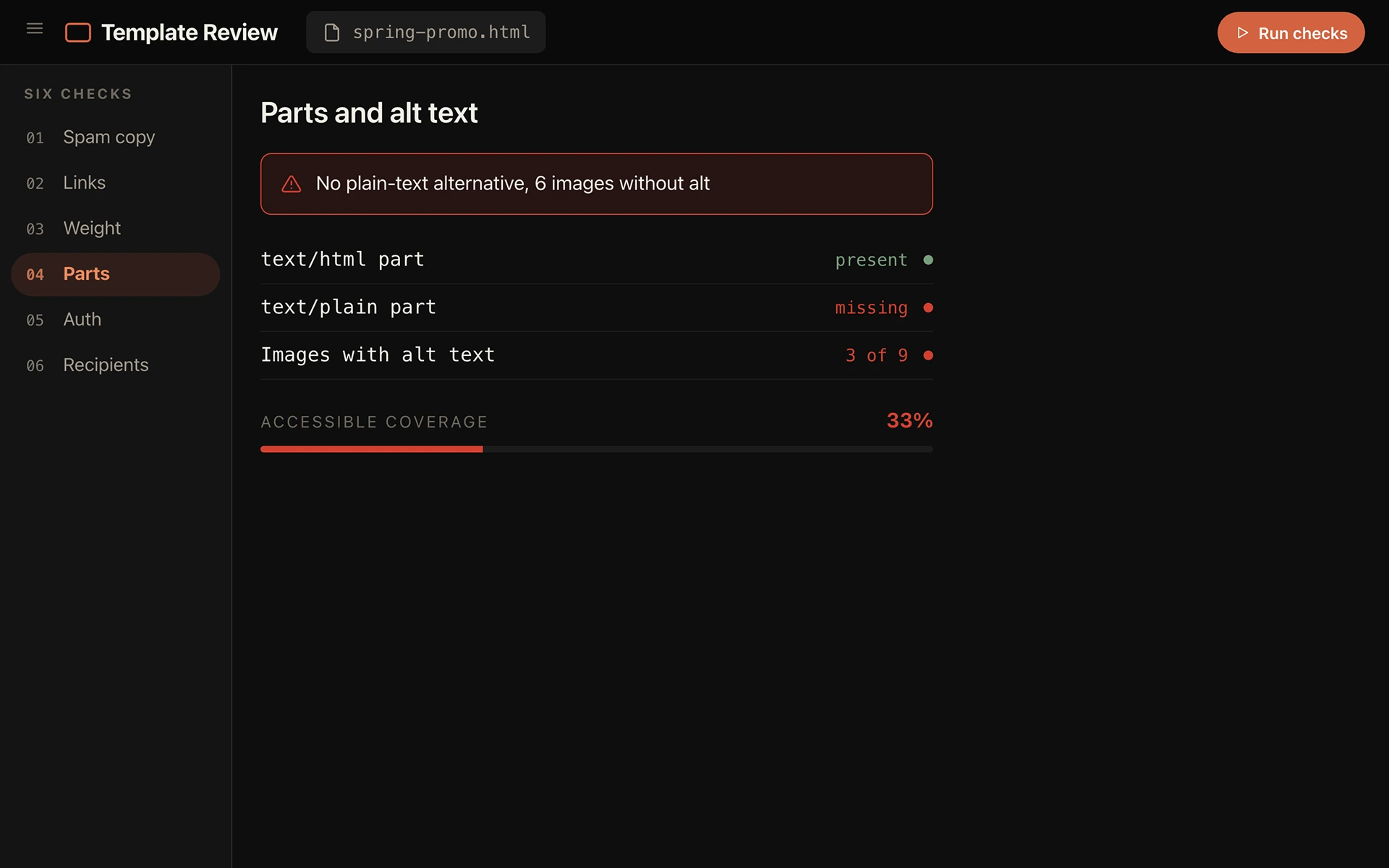
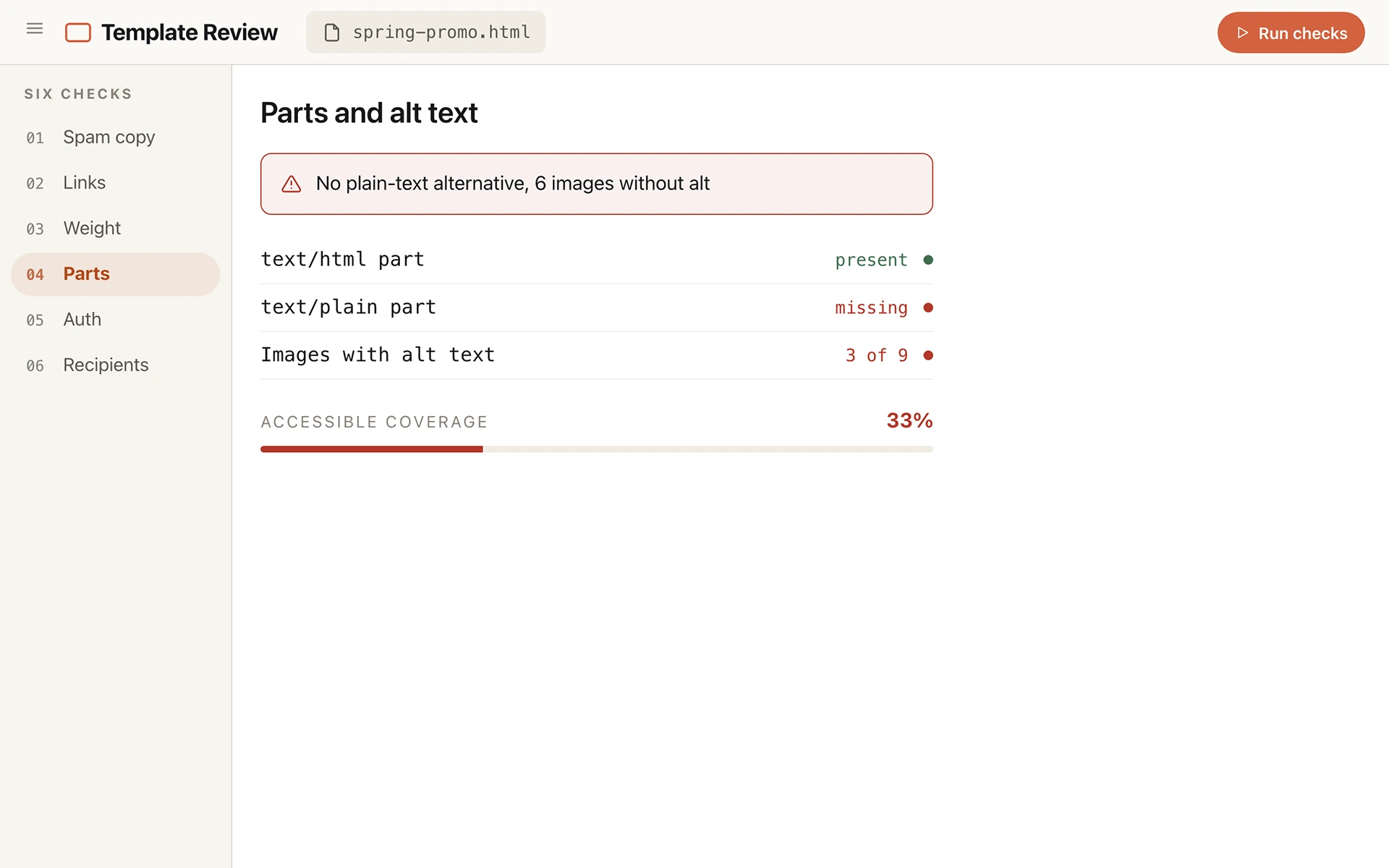
A multipart message with a real text/plain version reads as legitimate mail to filters and as usable mail to anyone on a watch or a screen reader. Alt text on every image keeps the template coherent in clients that block images by default.
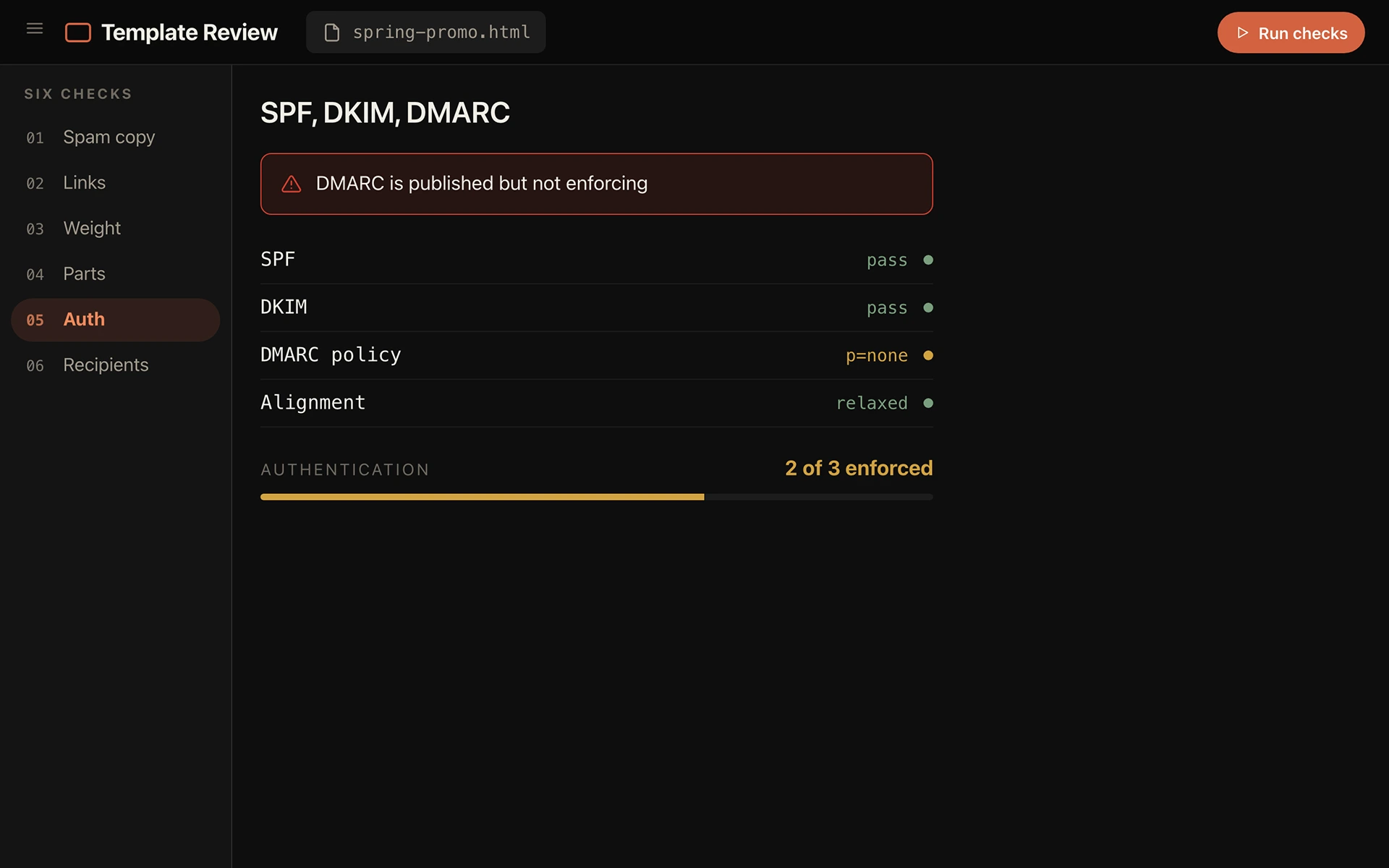
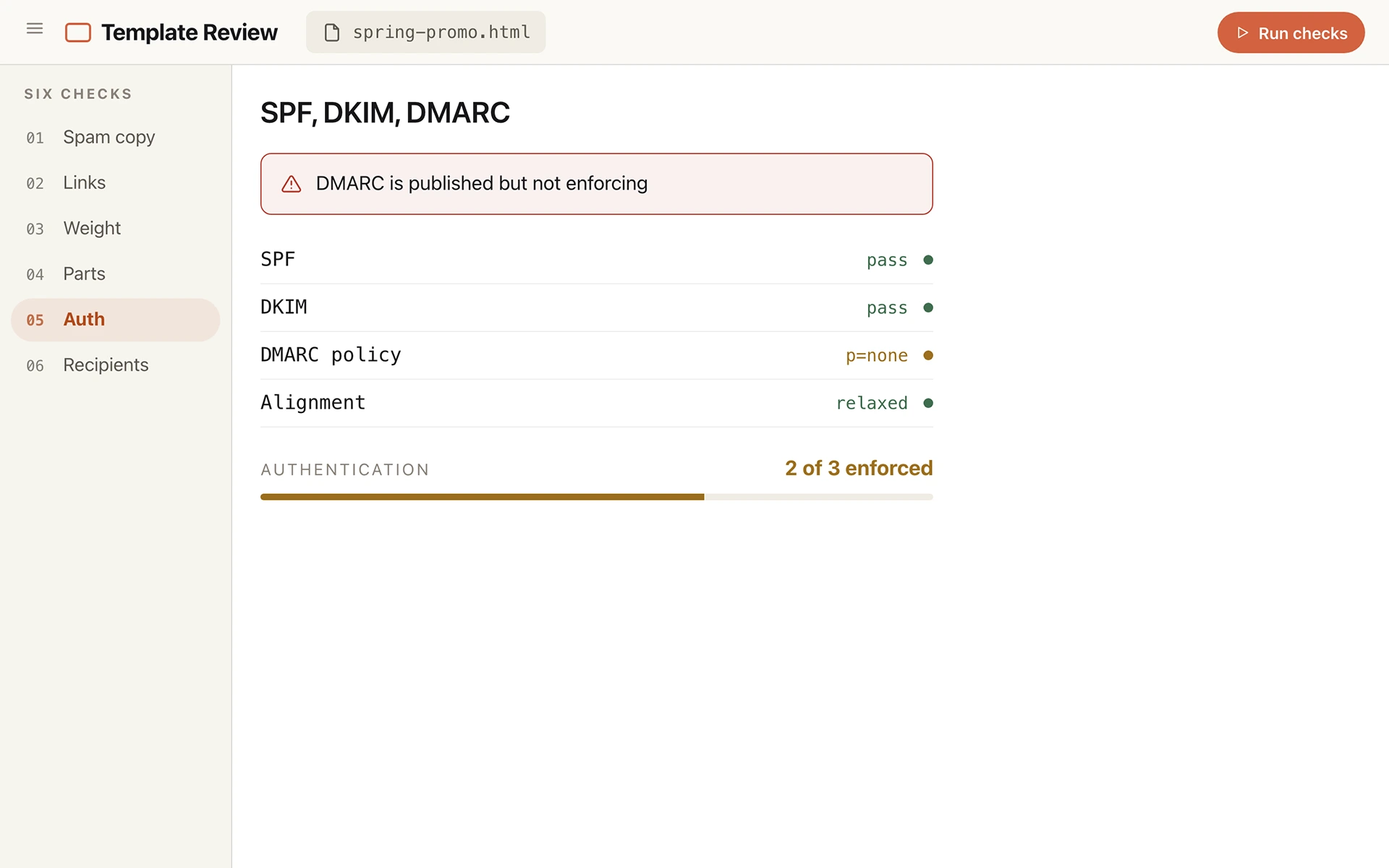
The prettiest template fails if the sending domain cannot prove it sent it, so filters quietly route it to spam. Check your authentication records with the DMARC, DKIM and SPF checker whenever you change sending tools or domains.
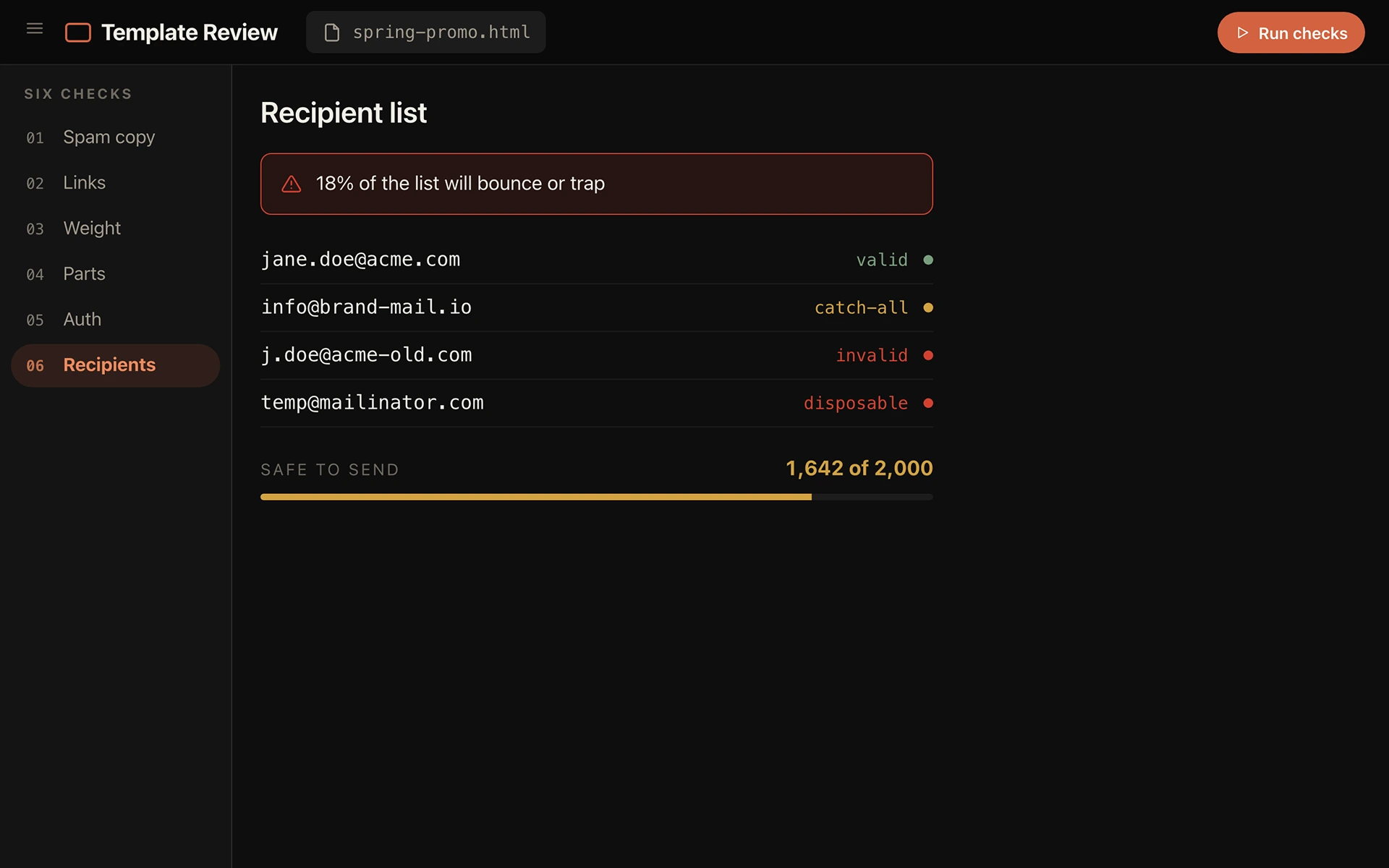
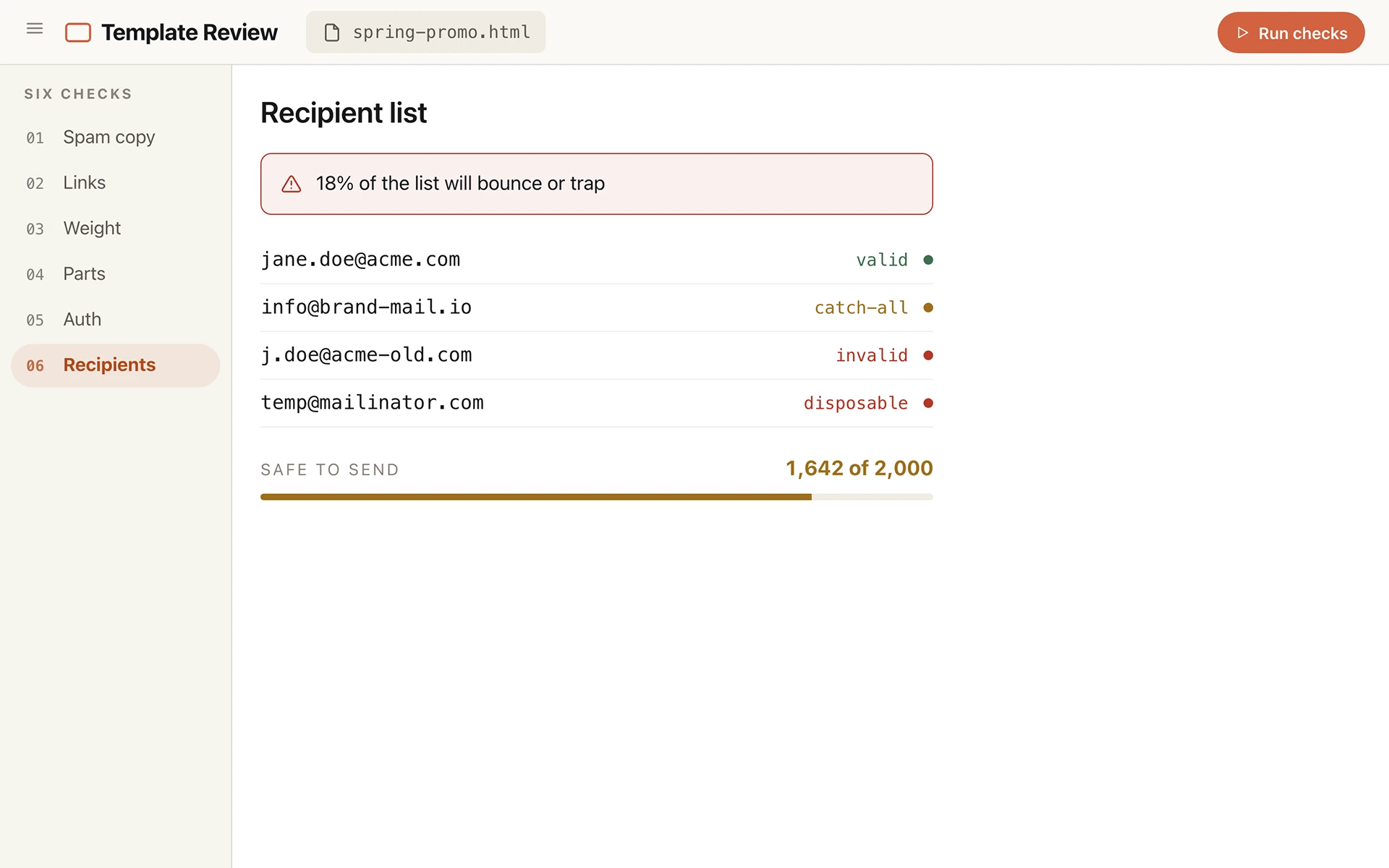
20-40% of B2B lists fail at catch-all domains, the check most free tools skip. The email verification engine behind our free email checker resolves them with an AI-confidence pass, so the finished template only goes to live mailboxes.
Paste your email's HTML and every check runs at once, from Gmail's 102 KB clip to missing alt text, folded into a single 0-100 score before you send.
Every rule runs in-process the moment you paste, no rendering farm and no test send.
Paste your HTML and read the score right here, no account, no card.
Size, alt text, client-safe CSS, unsubscribe and more, every rule on one paste.
A 0-100 score plus each finding by severity, so you know what to fix first.
Catches the faults that break sends: Gmail's 102 KB clip, Outlook CSS, images off.
A clean template still bounces off dead addresses. Verify your recipients free, no signup.
Your HTML is parsed in memory and dropped on response. SOC 2 · GDPR · CCPA.
Litmus and Email on Acid preview your HTML. Verifox lints the template and verifies the recipients it ships to
Most tools reset your balance every month. Verifox sells credits that sit in your account until you spend them.
forever
1,000credits on signup
No card required
2,500 with a work email
Free includes
one time
10,000credits
$0.0059 eachSAVE 34%
Everything in Free, plus
per month
15,000credits a month
$0.0053 each
Unused credits roll over
Everything in packs, plus
One credit verifies one address; a find costs 10. All prices in USD, checkout via Stripe.
Growth leads, marketers, and engineers running real campaigns on real lists, with a verified email on every byline.

We were paying ZeroBounce a four-figure monthly bill and still landing 3% bounces on cold campaigns. Switched the pipeline to Verifox, dropped to 0.4% bounces, and cut the bill by more than 90%.

Other tools flag 30% of our B2B list as 'risky catch-all' and leave the call to us. Verifox returns a real verdict on those addresses, with a confidence score. We send more, we send safer.

We had a Gmail spam-folder problem after a bad list import. Verifox cleaned the list and the warmup ran on the same engine. Back in primary inbox in six weeks. One vendor, half the cost.

Ran a 50,000-address outbound list through Verifox before our quarterly campaign. Bounces landed at 0.7%, sender reputation didn't move, replies were up 22% over last quarter.

Their MCP server let me wire email verification directly into our internal Claude agent in about ten minutes. Zero glue code. No other vendor in this space has thought about that workflow.

Tested Verifox at 10,000 verifications per minute on a Tuesday morning. Latency held under 400ms median, no soft failures, no rate-limit walls. The vendor we benched throttled at 2,000/min.

Our SDRs were enriching from three tools and 14% of the emails were invalid before they hit the sequencer. Verifox sits in the pipeline now and the team stopped seeing 'undeliverable' replies the next week.

Bulk upload, sorted CSV back in twenty minutes, plug into our growth stack. The half-day list-hygiene project per cohort turned into something the marketing intern runs on autopilot.

Verifox returns a 0-100 confidence score per address, not just a label. We thresholded at 75 for the cold sequencer, 60 for nurture, and our deliverability team finally has a knob they can tune.
We were paying ZeroBounce a four-figure monthly bill and still landing 3% bounces on cold campaigns. Switched the pipeline to Verifox, dropped to 0.4% bounces, and cut the bill by more than 90%.
We had a Gmail spam-folder problem after a bad list import. Verifox cleaned the list and the warmup ran on the same engine. Back in primary inbox in six weeks. One vendor, half the cost.
Their MCP server let me wire email verification directly into our internal Claude agent in about ten minutes. Zero glue code. No other vendor in this space has thought about that workflow.
Our SDRs were enriching from three tools and 14% of the emails were invalid before they hit the sequencer. Verifox sits in the pipeline now and the team stopped seeing 'undeliverable' replies the next week.
Verifox returns a 0-100 confidence score per address, not just a label. We thresholded at 75 for the cold sequencer, 60 for nurture, and our deliverability team finally has a knob they can tune.
Other tools flag 30% of our B2B list as 'risky catch-all' and leave the call to us. Verifox returns a real verdict on those addresses, with a confidence score. We send more, we send safer.
Ran a 50,000-address outbound list through Verifox before our quarterly campaign. Bounces landed at 0.7%, sender reputation didn't move, replies were up 22% over last quarter.
Tested Verifox at 10,000 verifications per minute on a Tuesday morning. Latency held under 400ms median, no soft failures, no rate-limit walls. The vendor we benched throttled at 2,000/min.
Bulk upload, sorted CSV back in twenty minutes, plug into our growth stack. The half-day list-hygiene project per cohort turned into something the marketing intern runs on autopilot.
We were paying ZeroBounce a four-figure monthly bill and still landing 3% bounces on cold campaigns. Switched the pipeline to Verifox, dropped to 0.4% bounces, and cut the bill by more than 90%.
Ran a 50,000-address outbound list through Verifox before our quarterly campaign. Bounces landed at 0.7%, sender reputation didn't move, replies were up 22% over last quarter.
Our SDRs were enriching from three tools and 14% of the emails were invalid before they hit the sequencer. Verifox sits in the pipeline now and the team stopped seeing 'undeliverable' replies the next week.
Other tools flag 30% of our B2B list as 'risky catch-all' and leave the call to us. Verifox returns a real verdict on those addresses, with a confidence score. We send more, we send safer.
Their MCP server let me wire email verification directly into our internal Claude agent in about ten minutes. Zero glue code. No other vendor in this space has thought about that workflow.
Bulk upload, sorted CSV back in twenty minutes, plug into our growth stack. The half-day list-hygiene project per cohort turned into something the marketing intern runs on autopilot.
We had a Gmail spam-folder problem after a bad list import. Verifox cleaned the list and the warmup ran on the same engine. Back in primary inbox in six weeks. One vendor, half the cost.
Tested Verifox at 10,000 verifications per minute on a Tuesday morning. Latency held under 400ms median, no soft failures, no rate-limit walls. The vendor we benched throttled at 2,000/min.
Verifox returns a 0-100 confidence score per address, not just a label. We thresholded at 75 for the cold sequencer, 60 for nurture, and our deliverability team finally has a knob they can tune.
Every layer of the stack carries a third-party attestation, so you can ship into regulated industries without rebuilding your compliance posture.

Independently audited to the SOC 2 Type II standard.

Built for the EU with full GDPR data-subject rights.

California opt-out, do-not-sell, plus DSAR handling.

Information security held to the ISO 27001 standard.

AI governance aligned to the new ISO 42001 standard.
An investigation into the money leaking out of your list - and the nine checks that decide whether your email is read, or never arrives at all.

57 pages, free PDF, no signup
Common questions
The questions we get from teams that land here with a finished template and a send button hovering, with the real numbers and real limits behind both halves of the check.
A complete template check covers two layers. The message layer: spam trigger words, broken links, malformed HTML, image-heavy layouts, and a missing plain-text part. The recipient layer: whether each address on the send list is real and live. The tool on this page lints the message layer, from size against Gmail's 102 KB clip to missing alt text, Outlook-unsafe CSS, and the unsubscribe link; the free email checker covers the recipient layer with 9 checks per address.
Run four passes. Paste the HTML into the checker above to catch size, alt text, and CSS issues. Scan the copy for trigger phrases with the spam check. Click-test every URL with the email link checker. Then verify the recipient list with the free email checker, because a clean template mailed to dead addresses still bounces. The whole loop takes minutes.
Filters score patterns, not single words, but the classic offenders are pushy money and urgency phrases: act now, limited time, 100% free, risk-free, no obligation, plus all-caps subject lines and stacked exclamation marks. One trigger rarely sinks a send. Several together, inside a heavy HTML template aimed at a stale list, usually do. The spam content checker scores your copy line by line.
Yes. Mail clients and filters penalize broken markup, image-only messages with thin text, and oversized payloads. Gmail clips messages above roughly 102 KB, hiding whatever sits below the fold, unsubscribe link included. Keep templates lean, balance images with real text, ship a plain-text part, and pair the HTML work with an address-level deliverability test on the list itself.
Because 20 to 40% of B2B email lists fail at catch-all domains, the check most free tools skip. Every hard bounce tells mailbox providers your hygiene is poor, and that reputation damage follows every future send regardless of template quality. The email verification engine resolves catch-alls with an AI-confidence pass, so you only mail addresses that can actually receive the template.
Yes. The template checker runs up to 30 checks an hour with no account, and the pre-send checklist is free forever. Recipient verification is free too: 4 addresses a day on the free email checker, or create a free account for 1,000 verifications, or 2,500 if you sign up with a work address. No card required, and paid credits never expire, with volume pricing shown for your region.
99.99% on a 1,000-address benchmark list, catch-all domains included. The free email checker runs the identical 9-point engine as the paid API: syntax, domain and MX, SMTP handshake and mailbox ping, disposable and role detection, catch-all resolution with AI-confidence scoring, domain age, and SPF, DKIM, and DMARC authentication. Run the list there once your template passes the check on this page. The free tier caps volume, never accuracy.
Yes. Upload a CSV or call the API and bulk verification runs at roughly 10,000 emails per minute on the standard tier. Median single-address latency is about 380ms, sub-50ms when cached, so most pre-campaign list cleans finish before the template clears design review. The free email validator handles bulk uploads on the same engine.
No. Your HTML is processed in memory and discarded the moment the check completes. Nothing stored, nothing logged, nothing sold. Verifox is SOC 2 Type II compliant, and the privacy policy spells out exactly what we touch and what we never keep. Your template and your send list stay yours.
Yes. The REST API reference documents request and response shapes for every endpoint, so your campaign tool can verify recipients before each send. HubSpot, Salesforce, Zapier, Klaviyo, Mailchimp, and Brevo connect out of the box, and the native MCP server lets AI agents like Claude or Cursor run the check without glue code.



