


Paste or upload
Drop one address into the pill above, paste a few hundred, or upload a CSV. Gmail, Outlook, custom domains and role aliases all go through the same front door.
Three steps from a raw address to a verdict you can act on, with no setup, no field mapping and no waiting on a support ticket.
Drop one address into the pill above, paste a few hundred, or upload a CSV. Gmail, Outlook, custom domains and role aliases all go through the same front door.
Nine checks fire in parallel: syntax, DNS, MX, a live SMTP handshake, disposable, role, catch-all, domain age, and SPF with DKIM and DMARC authentication. Nothing is sampled.
Valid, risky or invalid, with a confidence score, the per-check breakdown and a retry policy. Read it here, pull it over the API, or export the clean file. Nothing is stored.
The short answer, before the pitch. What a verifier checks, where the honest limits are, and why any of it moves revenue.
Email verification confirms that an address exists, is formatted correctly, and can actually receive mail before you send anything to it. A verifier checks the syntax against RFC 5321 and 5322, confirms the domain publishes valid MX records, then opens an SMTP conversation with the receiving server to ask whether the mailbox is real. Good engines go further and screen for disposable domains, role accounts like info@ and billing@, and catch-all servers that accept every address whether a human reads it or not.
A few free tools run without an account: the Gmail username checker tells you whether a Gmail mailbox exists, and for testing your own signup flow there are the random email generator, the random work email generator and the email verification code generator.
The same nine-check engine our paid email verification API runs. Every email, every verification, every time.
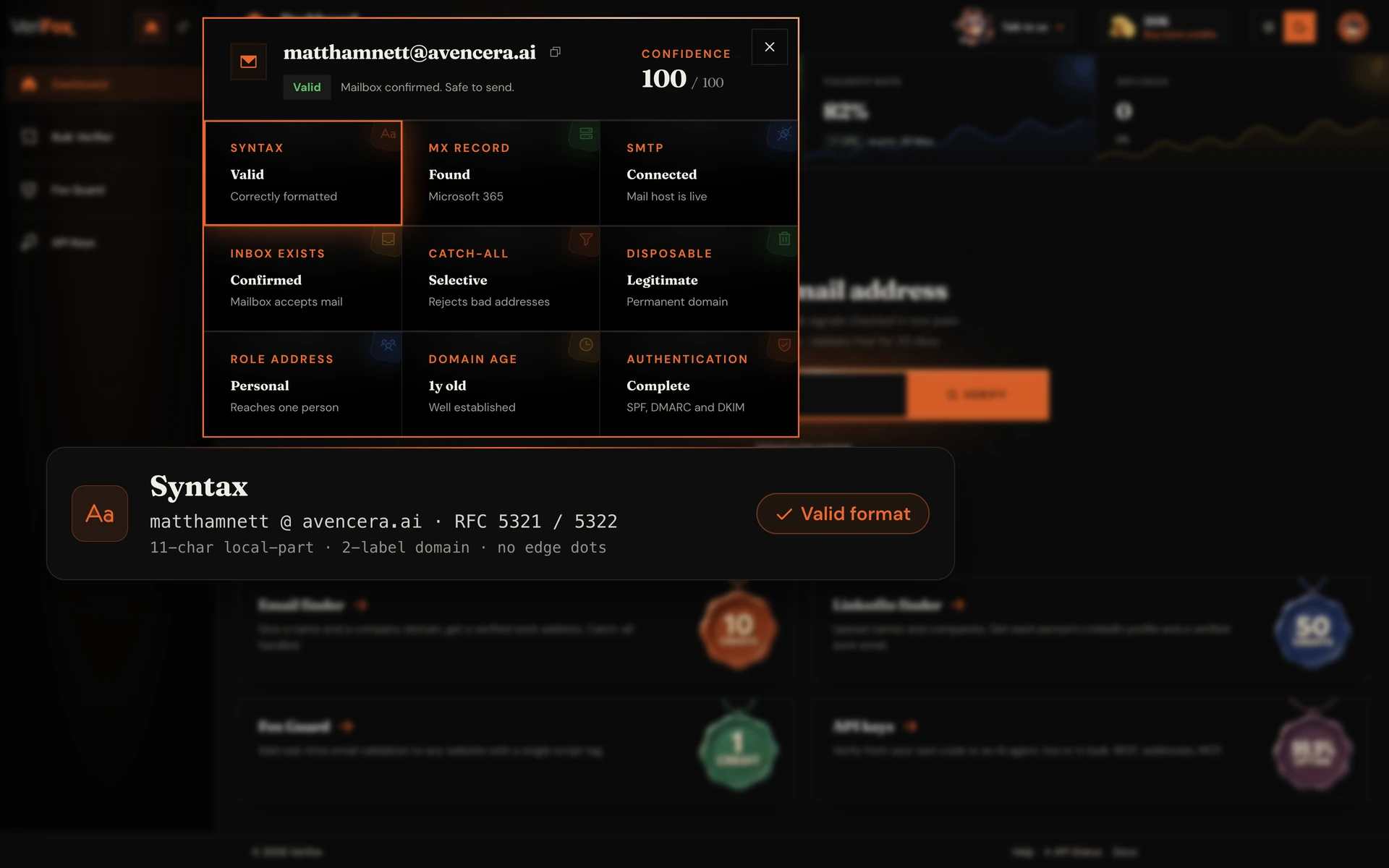
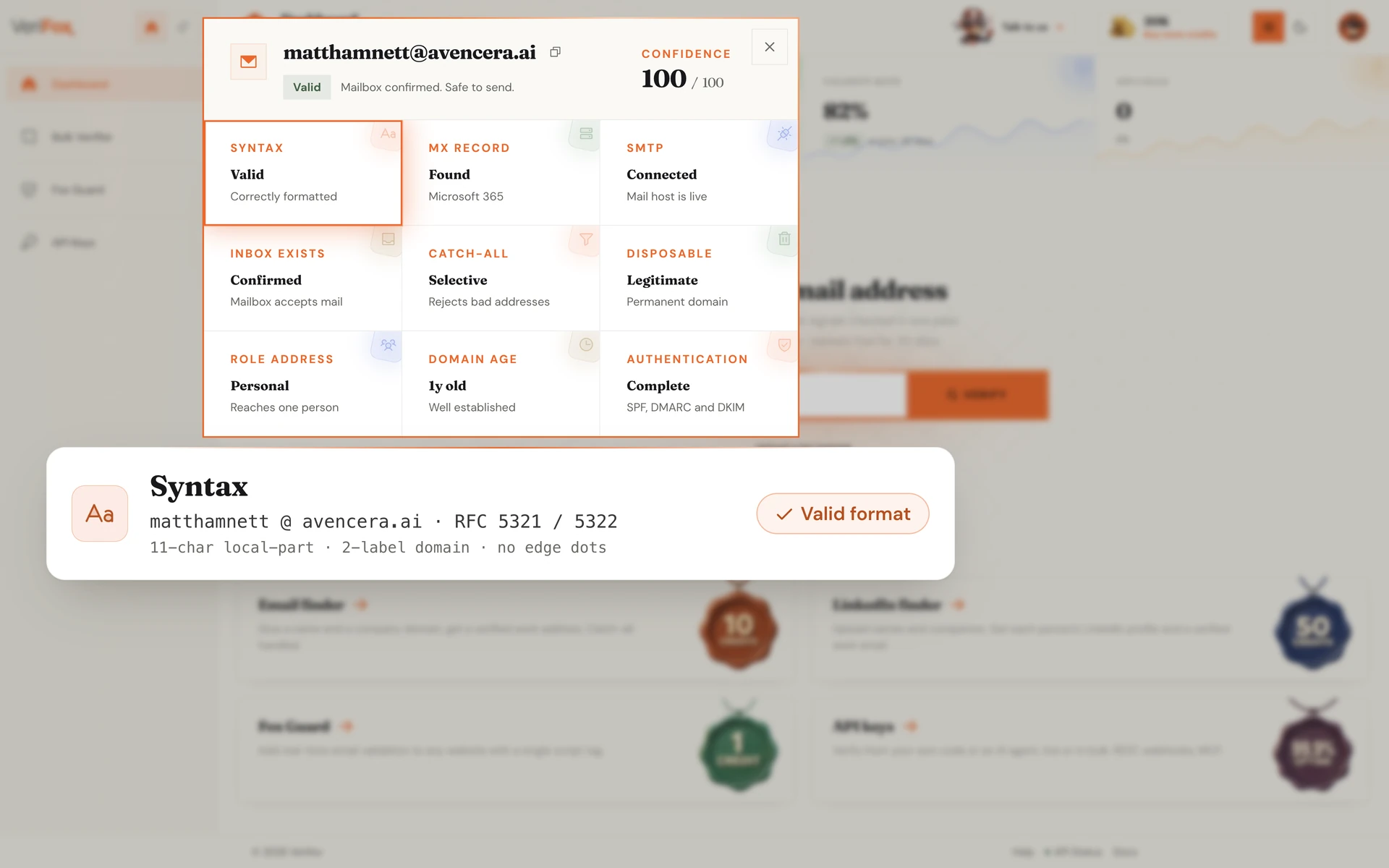
Every address runs a full RFC 5321 and RFC 5322 compliance pass before a single network call goes out. The engine catches what visual scanning misses, the double dot in alice@verifox..ai, the trailing period, the IDN homograph that looks valid but resolves to a different domain.
Bundled typo suggestions let your form offer “did you mean alice@gmail.com?” instead of rejecting silently.
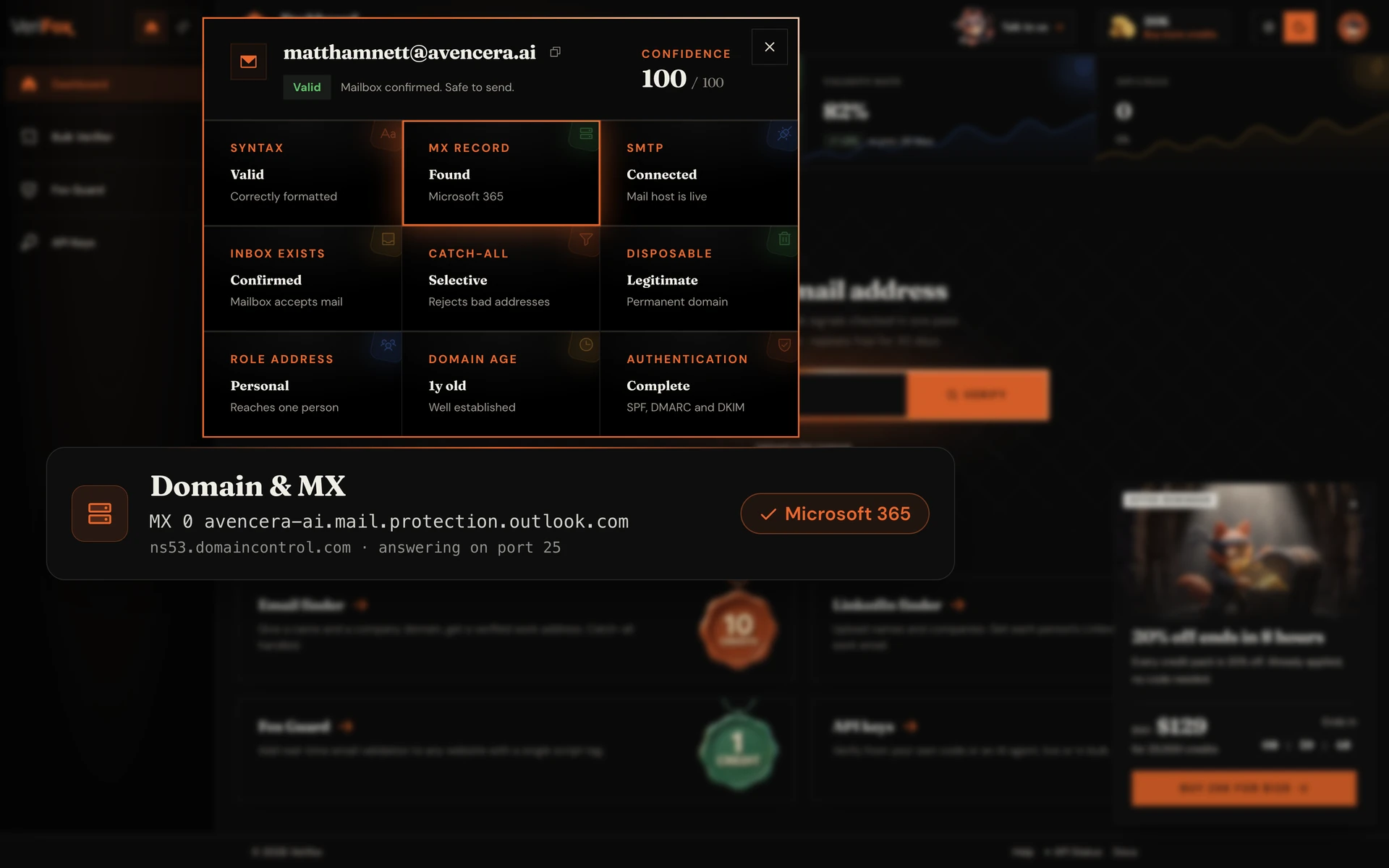
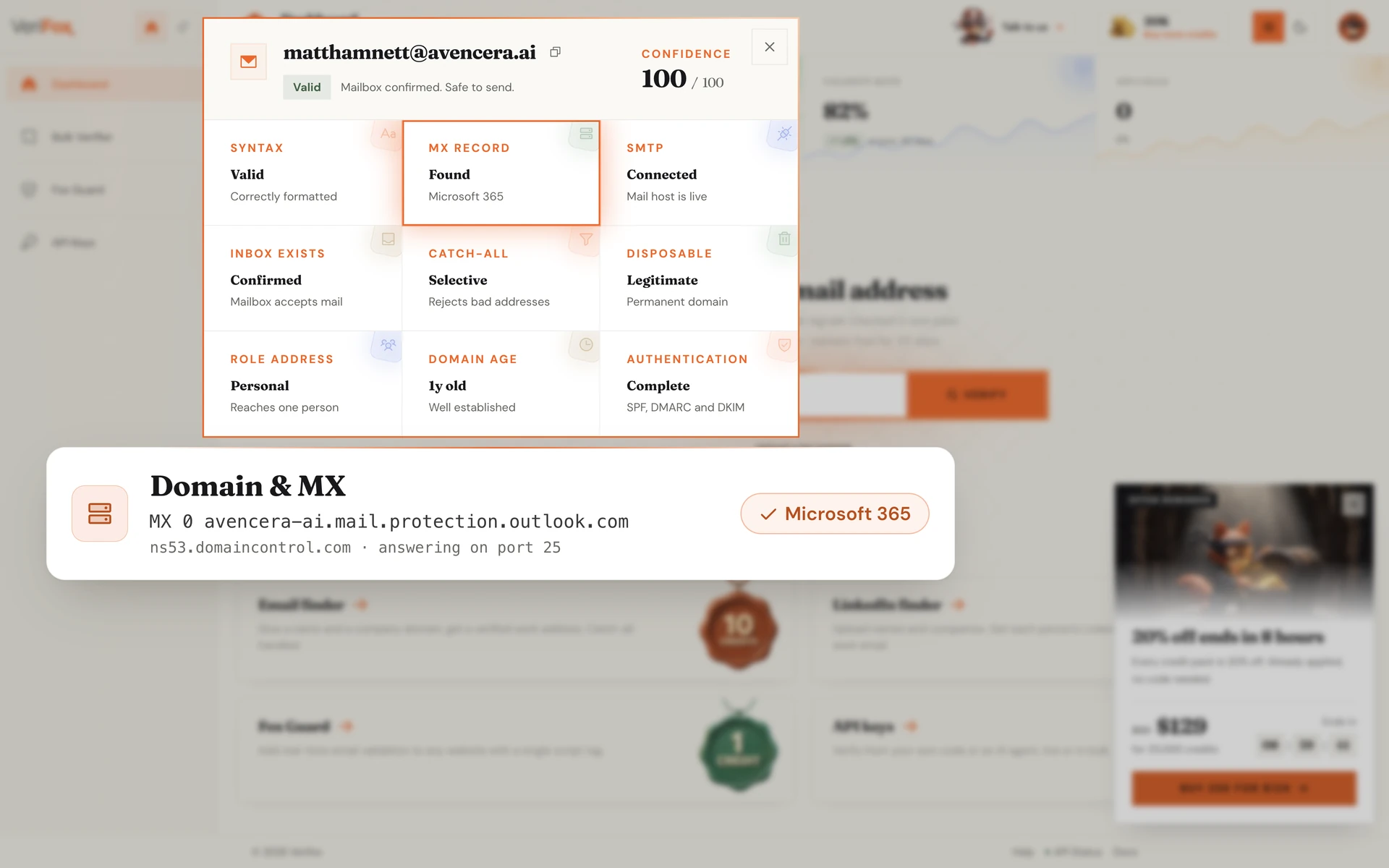
Once syntax passes, the engine resolves the domain. We confirm the DNS records exist, fetch the MX record priority list in order, and verify at least one mail-exchange server is actively accepting connections right now.
Misspelled domains like gmial.com, expired domains, and parked-for-sale domains all fail this gate before the engine wastes a single SMTP roundtrip.
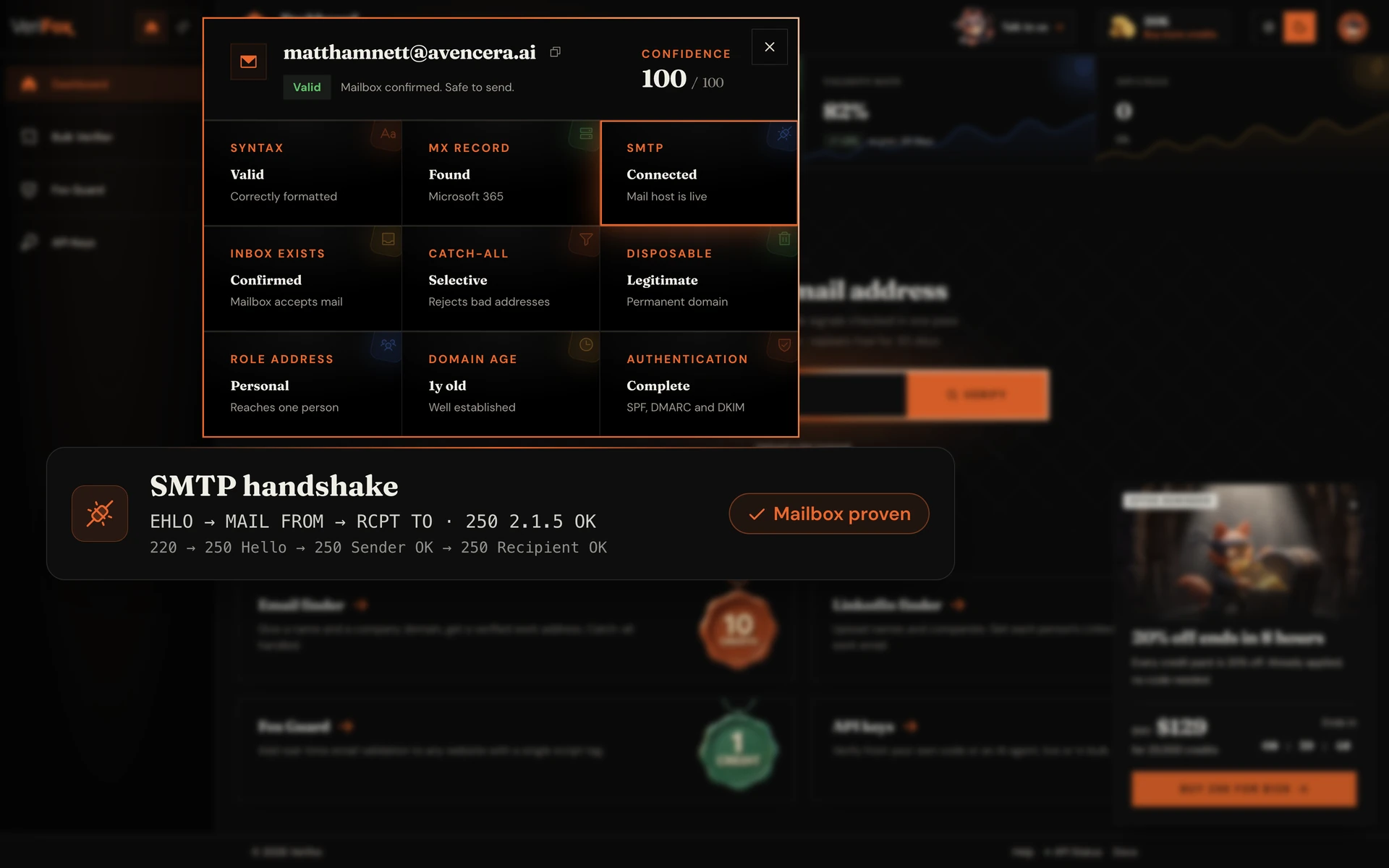
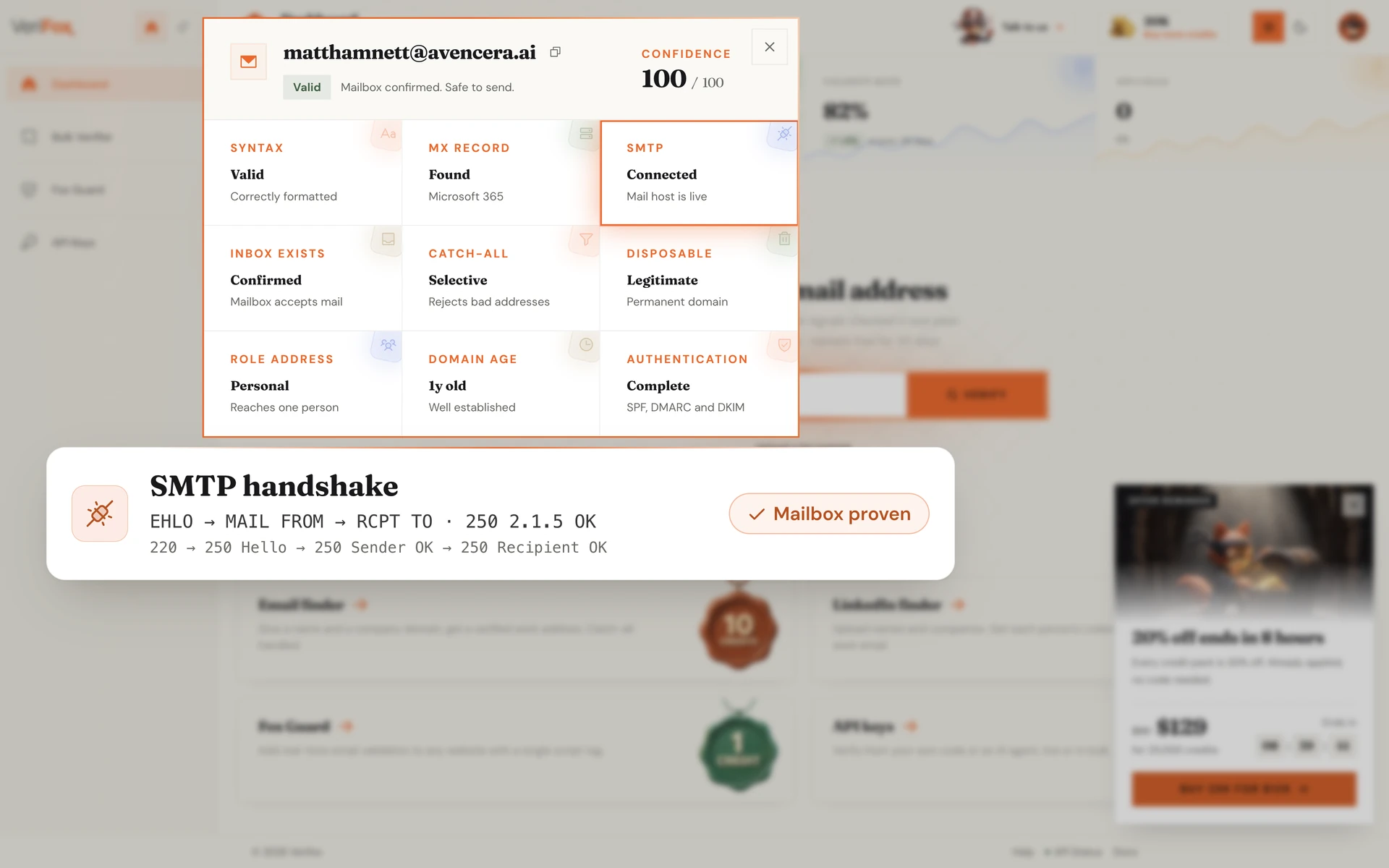
The engine opens a TCP connection on port 25, performs the EHLO handshake, then negotiates MAIL FROM and RCPT TO. Every server response code (220, 250, 550, 552) is parsed deterministically against the IANA enhanced-status registry.
This is the moment a mailbox proves it actually exists. No third-party guesses, no statistical heuristics, just the receiving server's own answer.
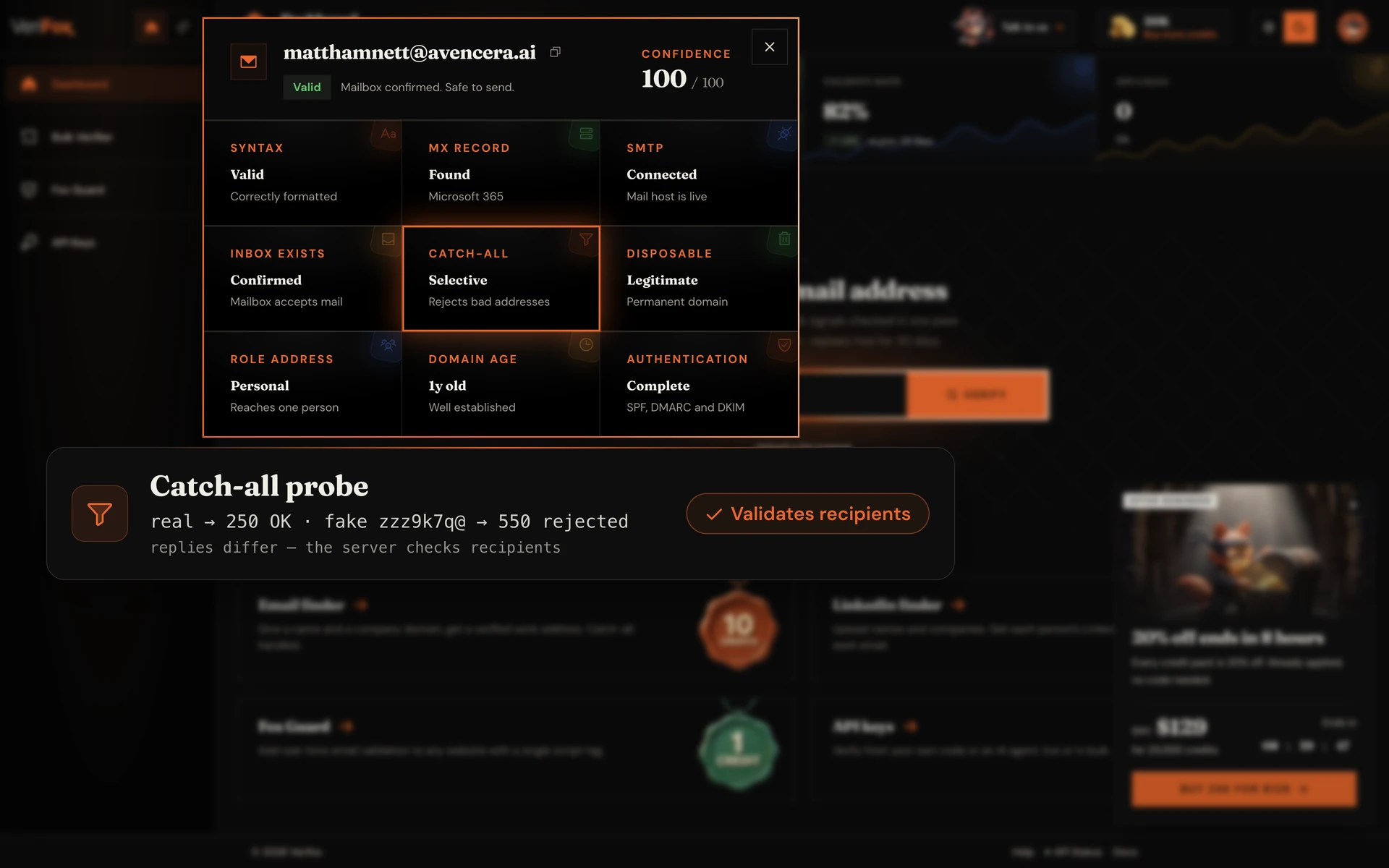
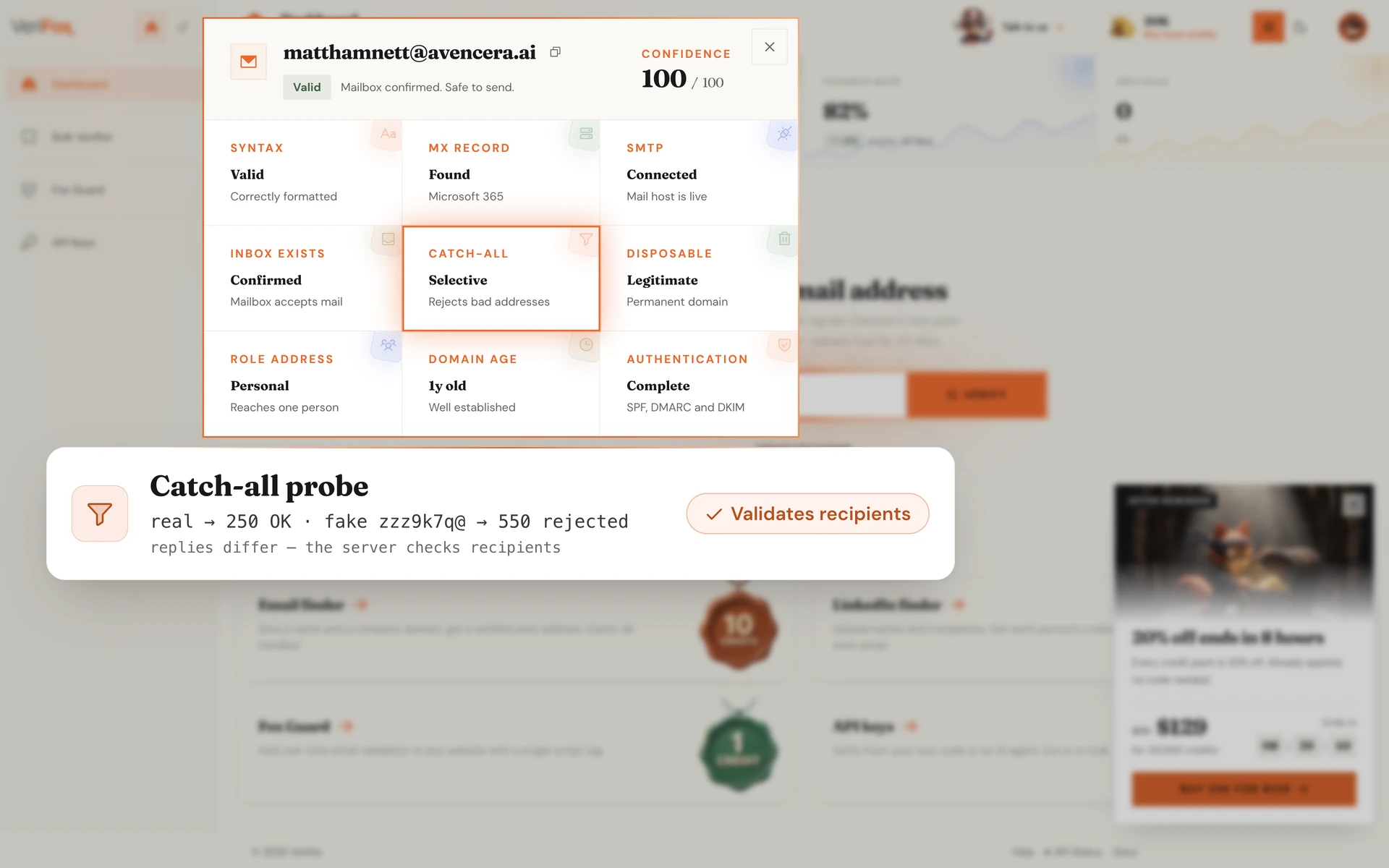
Some domains accept every email regardless of whether the mailbox exists, a setup known as a catch-all configuration. The engine sends a deterministic probe to a deliberately fake address (zzz9k7q@domain.com); if the server returns the same 250 OK it returned for the real address, the domain is catch-all.
The verdict isn't dropped, it's flagged RISKY so you know the deliverability signal is degraded.
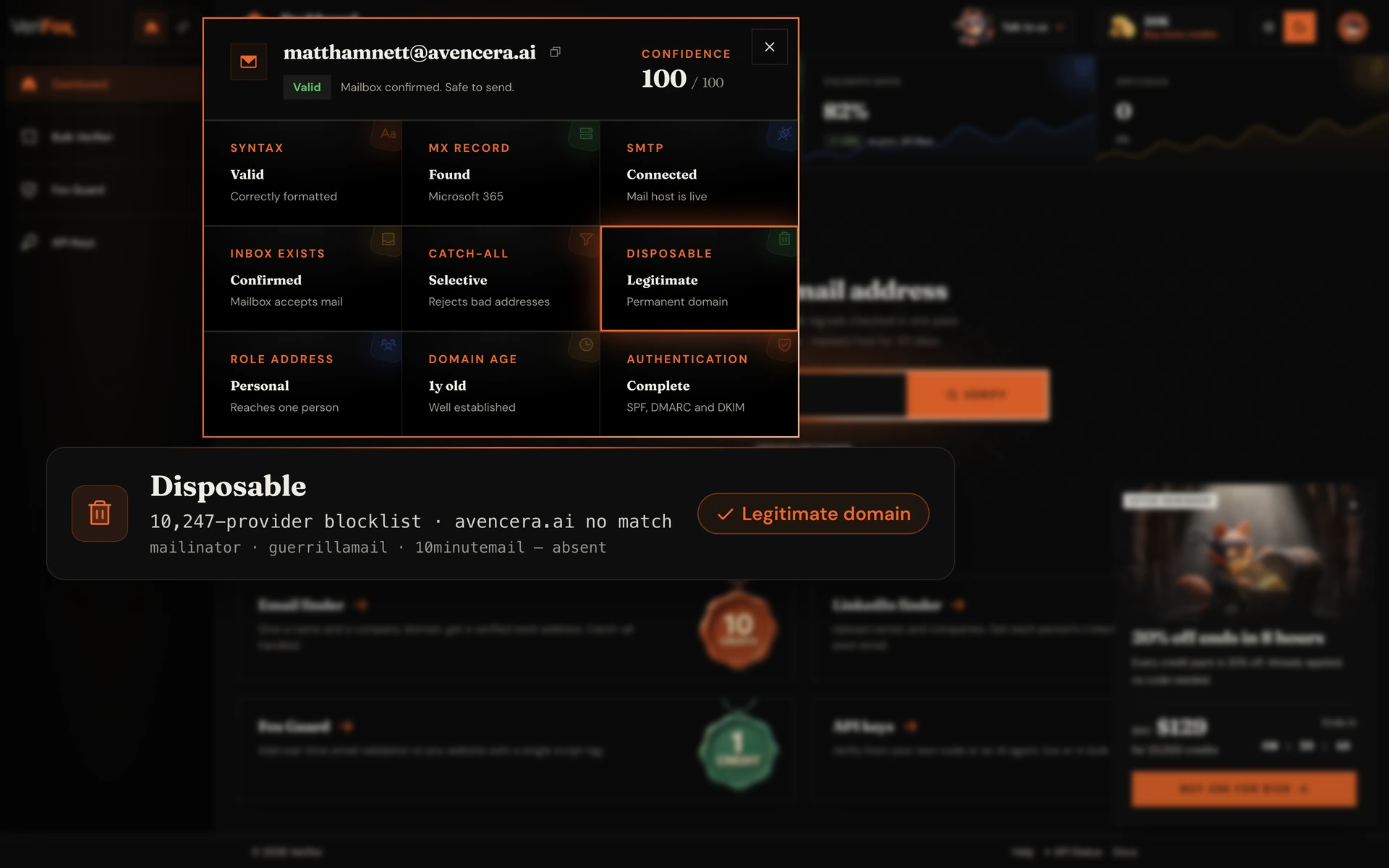
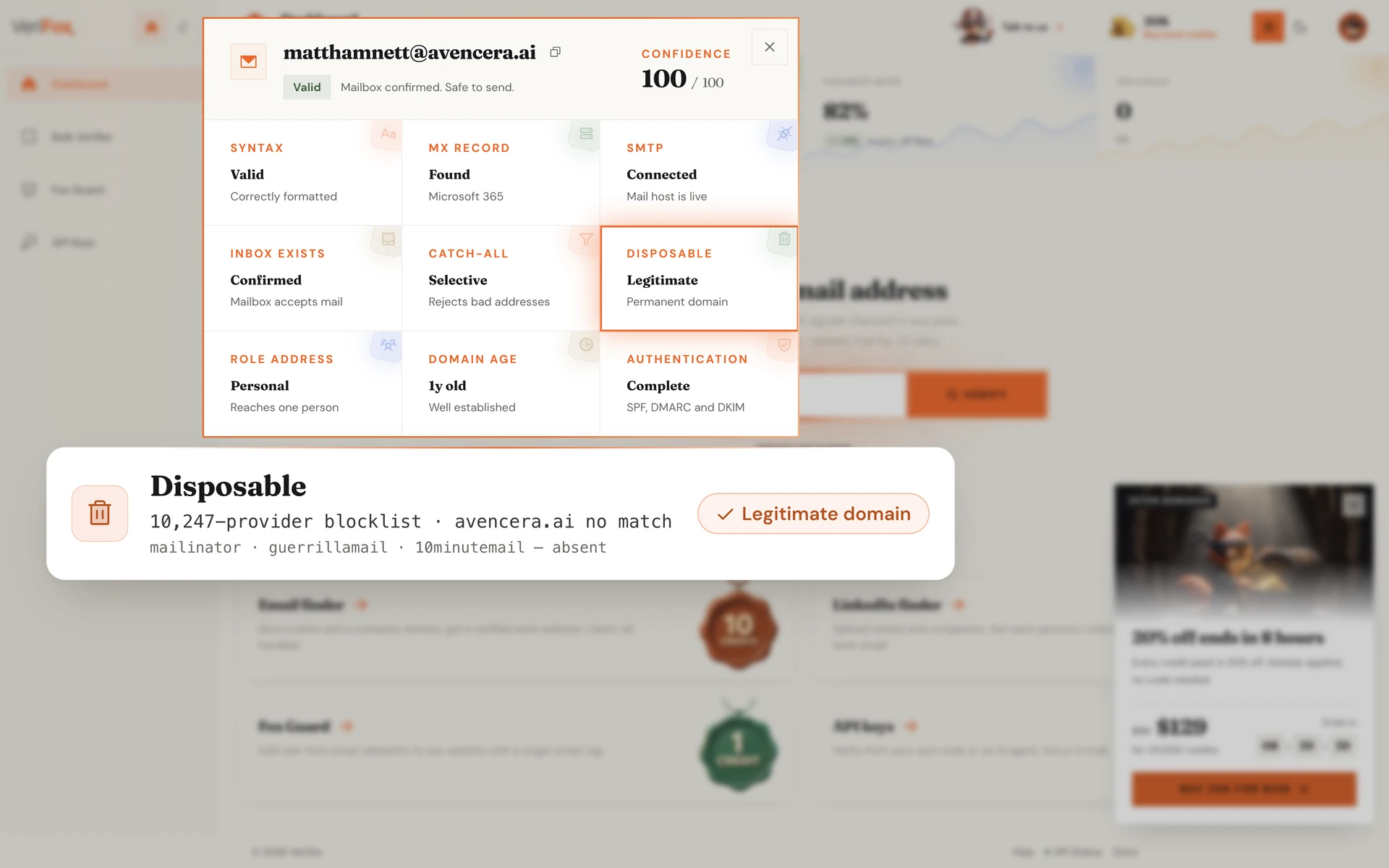
The engine maintains a curated registry of 10,247 disposable email providers, including Mailinator, Guerrilla Mail, 10MinuteMail, Tempmail, and the long tail of regional clones.
Any address matching the blocklist is flagged INVALID. Deliverability to a mailbox that exists for 10 minutes and is never checked is functionally zero, regardless of whether the SMTP handshake passes.
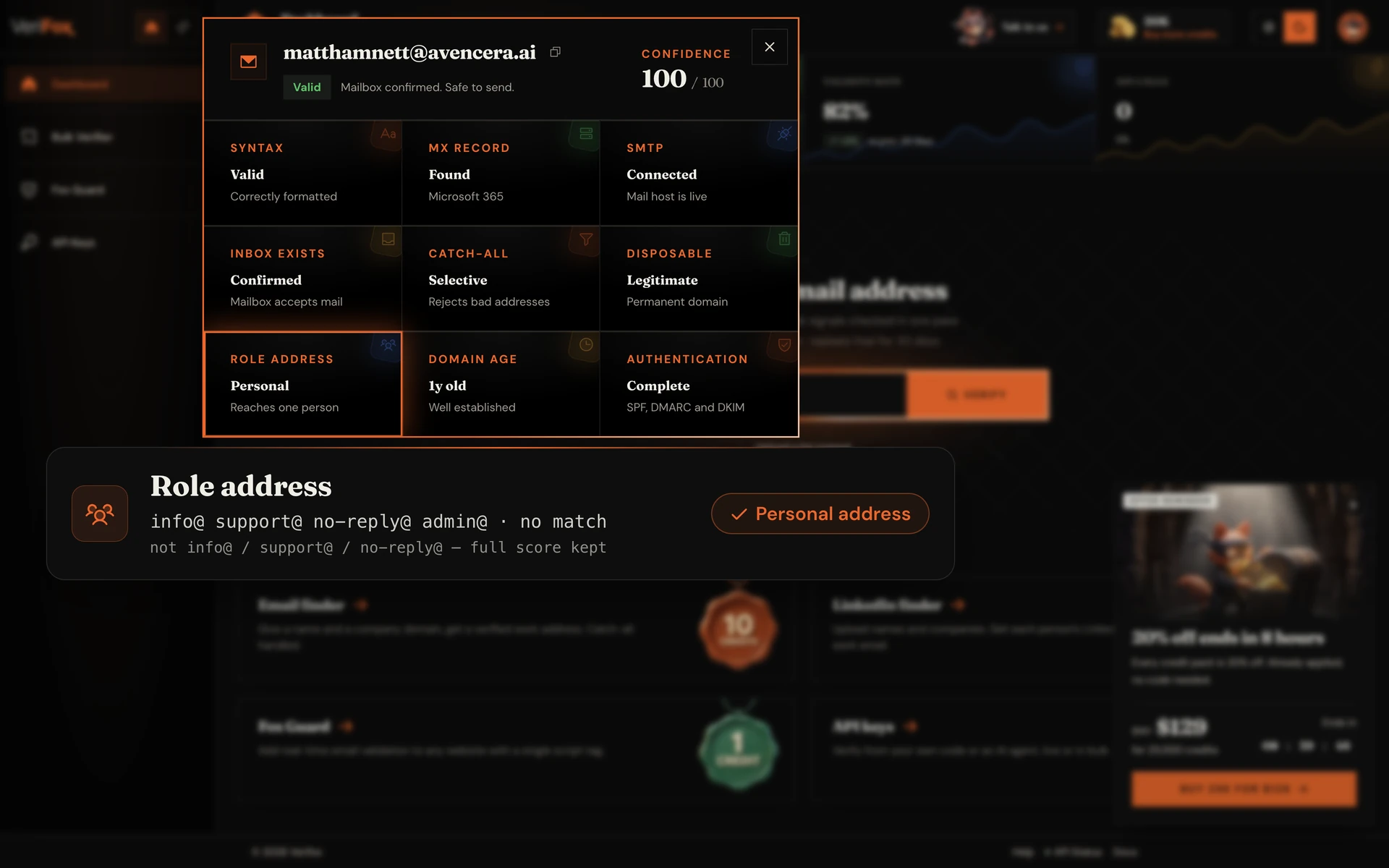
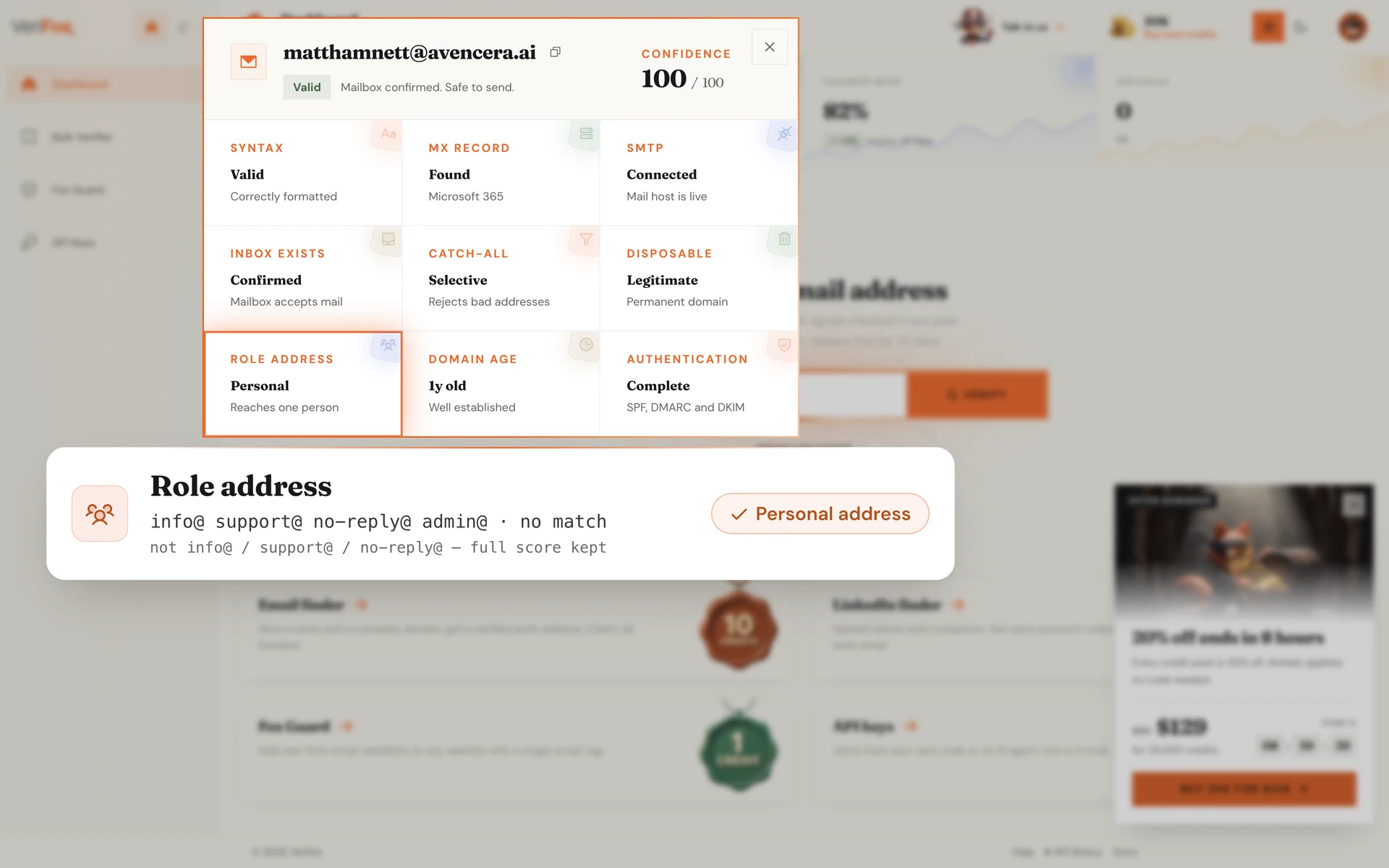
info@, support@, no-reply@, admin@, billing@. These are shared inboxes, not individuals.
The engine extracts the local-part of every address, matches it against the known role-prefix registry, and tags the result with a reduced engagement score.
You don't drop them automatically. The verdict flags them as roles so you can decide.
Fresh-spam domains registered hours ago are the single biggest source of inbound abuse. The engine queries WHOIS and RDAP for every unique domain, extracts the registration date, and flags anything under 30 days old with a “fresh” warning.
Domains aged 5+ years pick up a corresponding trust signal. The same heuristic spam filters have been using since the early 2000s, ported into the verdict.
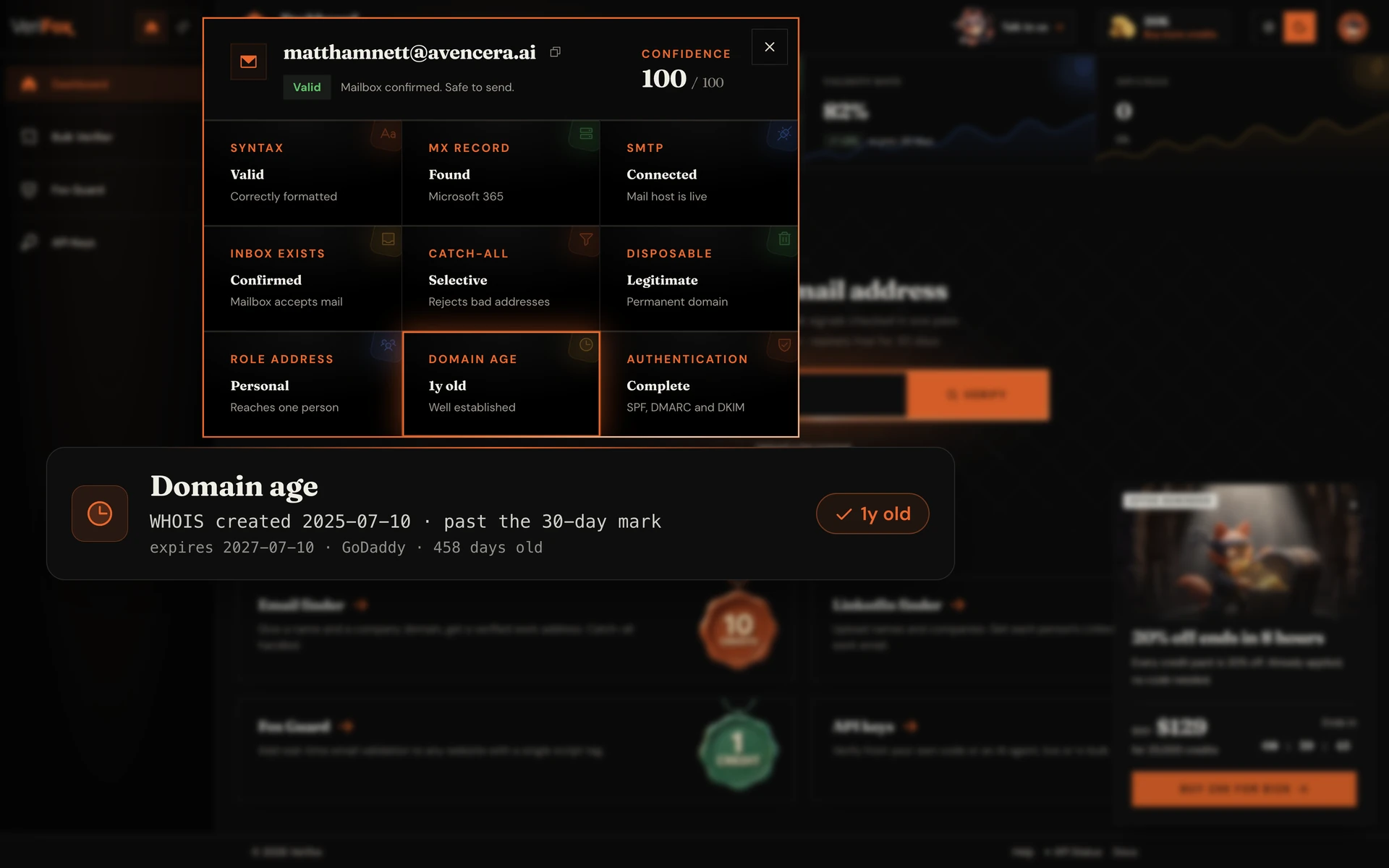
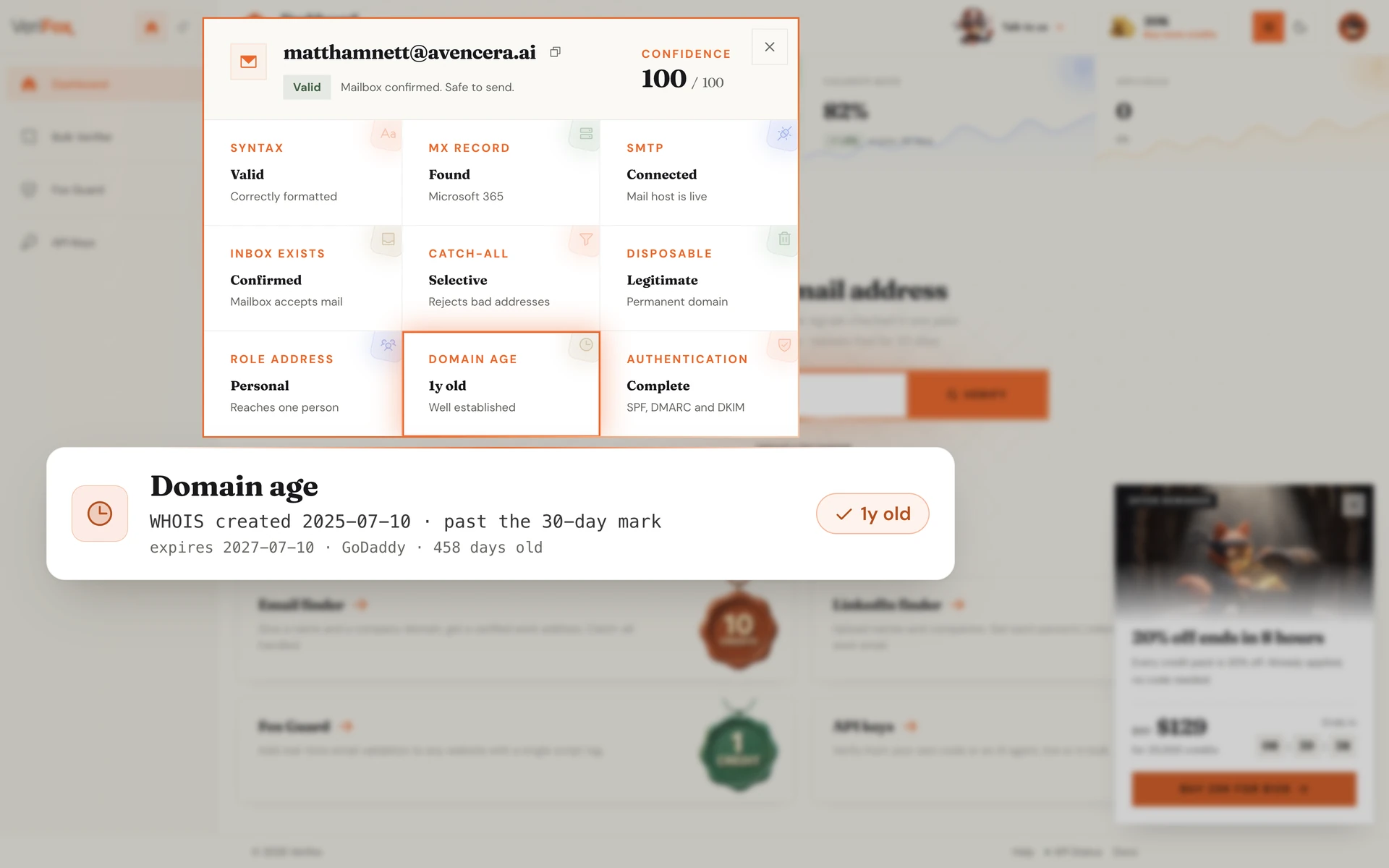
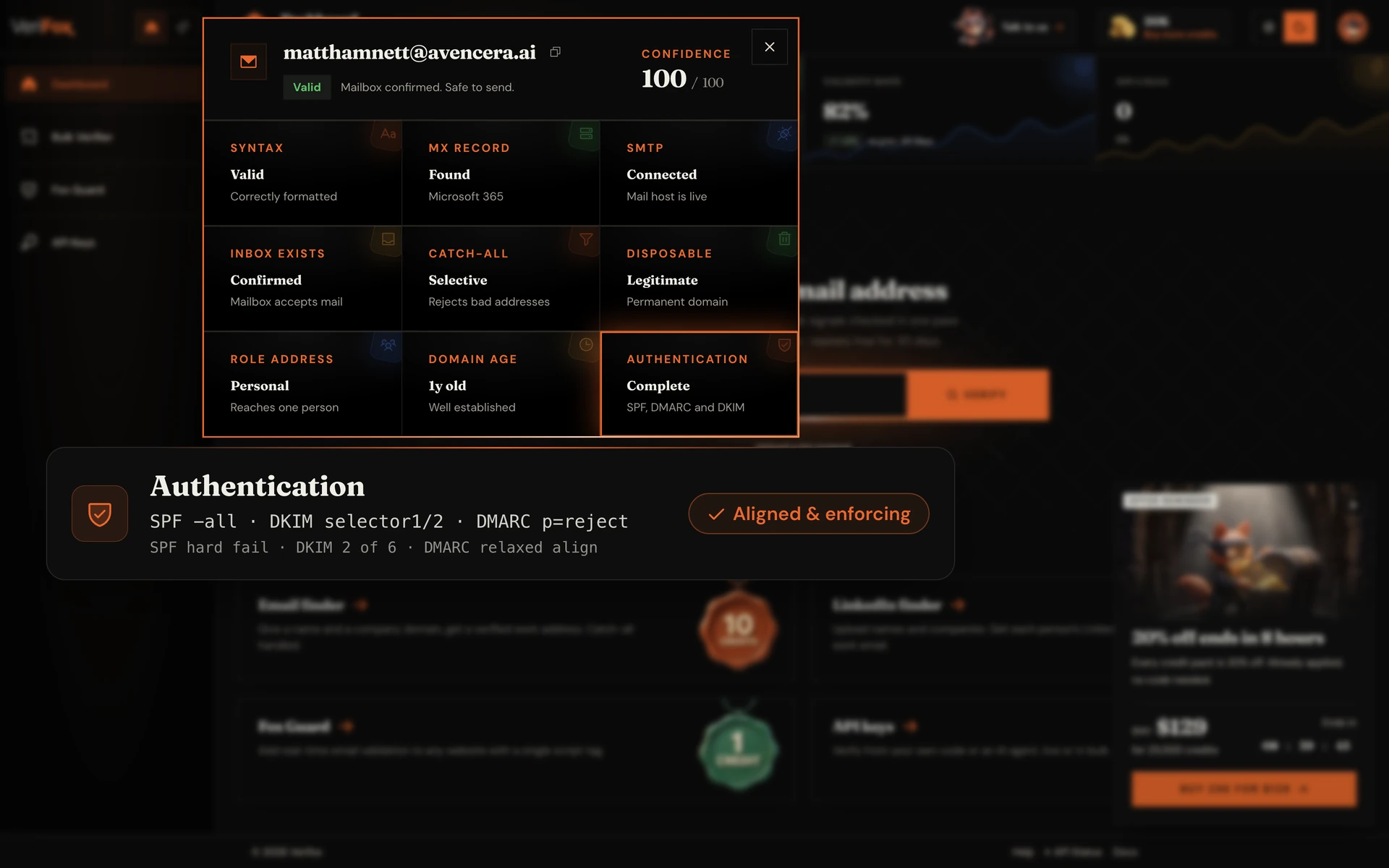
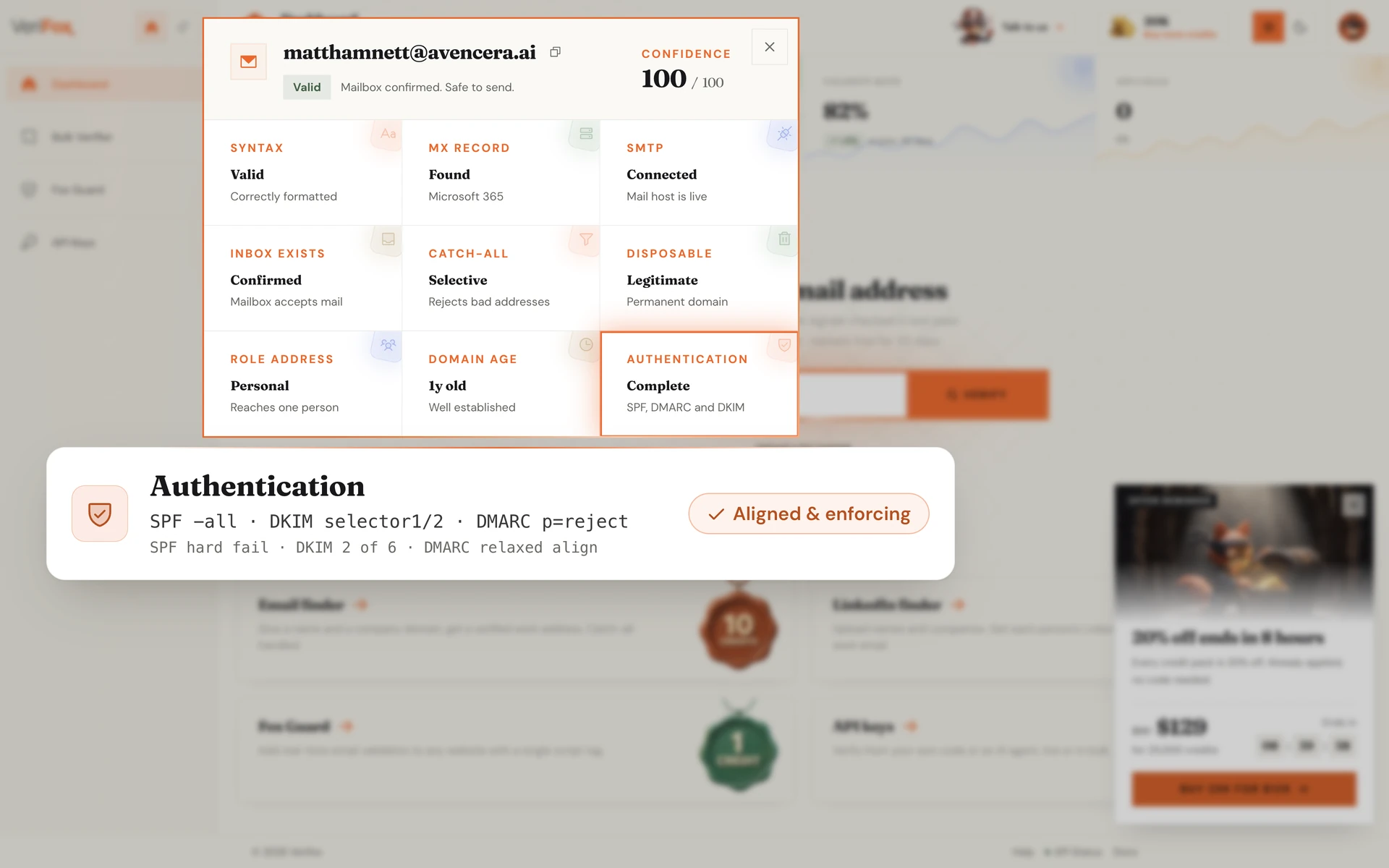
SPF, DKIM, and DMARC together prove the sender is authorised to send from that domain.
The engine reads each policy via DNS, validates SPF includes recursively, scans six common DKIM selectors, and confirms DMARC alignment with the From: header.
A failing DMARC policy means the sender can be spoofed, so the verdict warns you before you reply.
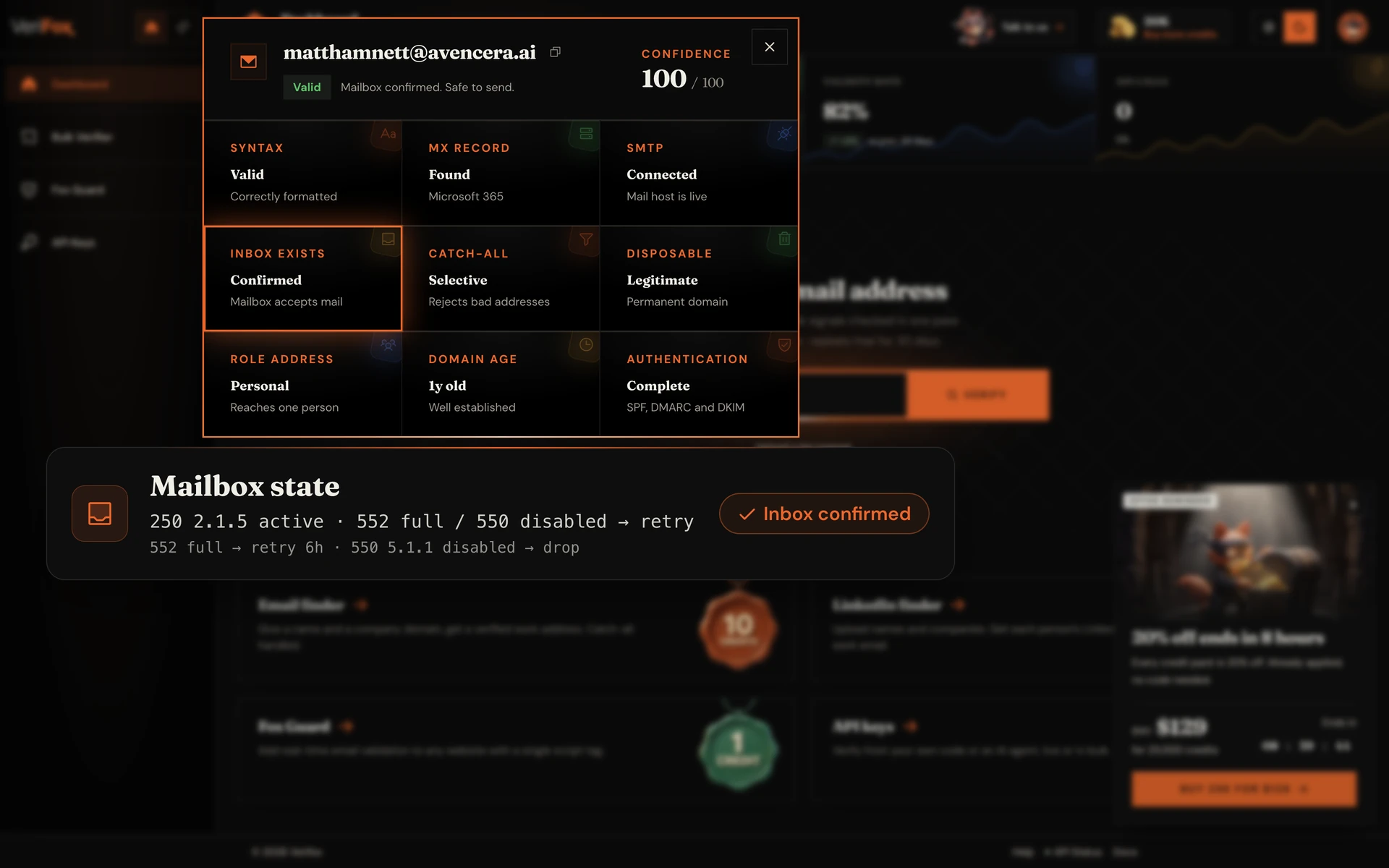
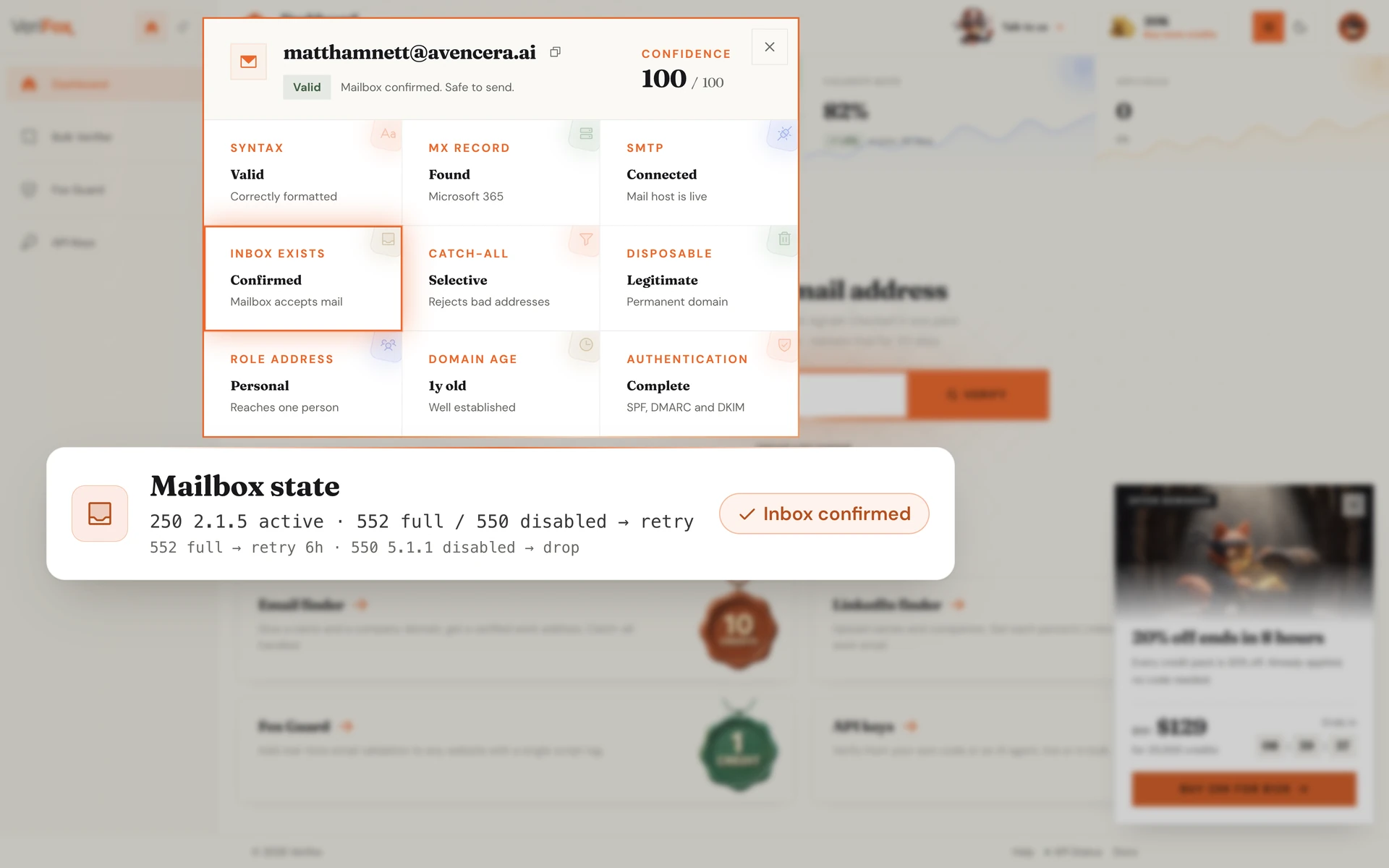
Beyond “exists vs doesn't exist”, the engine extracts the precise mailbox state from the SMTP server's response. Full inbox (552 / 522 quota), disabled mailbox (550 5.1.1), out-of-office autoresponder, frozen account.
Each state maps to a specific retry policy. Full inbox retries in 6 hours. Disabled drops permanently. The verdict tells you which bucket the bounce belongs in so your retry logic doesn't waste cycles.
Verify one address or a million, find the ones you are missing, and wire the same verdict into your product over the API or the MCP server.
The same nine-check pipeline runs on the free checker, the bulk uploader and the paid API. No stripped-down tier.
Verify your first emails right here, no account, no card.
Bulk CSV in, verified list out. Same checks on every plan.
Every address comes back already checked, with a confidence score.
Syntax and MX to a live SMTP ping, with catch-all scored 0-100.
1,000 free on signup. 2,500 with a work email. Pay as you go after that.
Used only to run the check. GDPR · CCPA.
Most tools reset your balance every month. Verifox sells credits that sit in your account until you spend them.
forever
1,000credits on signup
No card required
2,500 with a work email
Free includes
one time
10,000credits
$0.0059 eachSAVE 34%
Everything in Free, plus
per month
15,000credits a month
$0.0053 each
Unused credits roll over
Everything in packs, plus
One credit verifies one address; a find costs 10, a company search 100 and an email reveal 50. All prices in USD, secure checkout via Dodo Payments.
Prices are before tax. Any VAT, GST or sales tax your country charges is added at checkout. Buying as a business? Enter your VAT or GST number there.
The addresses you submit are used only to run your verification. They are never sold, and nobody on your list hears from us.

The addresses you submit are never sold or shared.
We ask the mail server. Not one message is sent.

Full GDPR data-subject rights for everyone in the EU and UK.

California opt-out, do not sell and DSAR handling.
An investigation into the money leaking out of your list - and the nine checks that decide whether your email is read, or never arrives at all.

57 pages, free PDF, no signup
Common questions
The questions teams ask before they move a list onto a new verifier, with the real numbers, the real limits, and the real opinions behind our nine-check engine.
Email verification is the process of confirming that an email address exists and can safely receive mail before you send to it. A verifier checks the address syntax, the domain’s MX records, and the mailbox itself over SMTP, then screens for disposable domains, role accounts, and catch-all servers. Instead of guessing, you get a verdict: Valid, Risky, or Invalid.
Verifox runs 9 checks on every address, including an AI confidence pass on catch-all domains and SPF, DKIM, and DMARC authentication. The full breakdown lives on the email verification service page, or you can test an address free right now.
ZeroBounce runs 4 checks. We run 9, and the five they skip are the ones that decide whether a B2B list is usable: catch-all detection with an AI confidence pass, domain age, and SPF, DKIM, and DMARC authentication.
The gap shows on catch-all domains, where 20-40% of B2B lists live and 4-check tools shrug with “unknown.” Run the same address through both engines and compare; the free email checker needs no signup.
4 per day with no account on the free email checker. Create a free account and you get 1,000 credits once you verify your email, or 2,500 if you sign up with a work email. No card either way.
Past that, credits are pay-as-you-go with volume discounts on larger packs. And if you need to find an address before you can verify it, the email finder is part of the same platform.
Catch-all domains accept mail for every address, valid or not, so a standard SMTP check can’t tell you whether a specific mailbox exists. Most tools stop there and return “unknown.”
Our AI runs a second-pass confidence analysis on those addresses and returns a real verdict: Valid, Risky, or Invalid. It’s the hardest part of our email verification service, and the reason catch-all-heavy lists come back usable instead of half gray.
It depends on the receiving mail server, because every check waits for its real SMTP answer. We would rather wait for that answer than hand you a fast guess. Bulk lists run as background jobs.
Endpoint shapes, rate limits, and code samples live in the API docs.
Yes. The real-time endpoint is built for signup flows: block disposable domains, role accounts, and dead mailboxes the moment someone types an address.
Wiring it up is one endpoint call; the API docs walk through it.
Never. Buy once, use whenever, even years later. Credits stay on your account permanently: no monthly minimums, no use-it-or-lose-it pressure. The pricing page shows the volume tiers.
The addresses you submit are used only to run the verification and show you the results in your account. We never sell them, and the platform is GDPR and CCPA compliant.
Yes, natively. Verifox ships an email verification MCP server, so Claude, Cursor, and custom LLM agents can verify addresses without glue code. Drop the MCP URL into your agent config and the tools are wired.
Prefer to call the engine directly? Everything the MCP exposes is also available over the REST API, documented in the API docs.



