Black Friday 2026: Retailer Email Spoofing Check
15 of America’s 100 biggest retailers don’t tell inboxes to stop email that fakes their domain.
DMARC, SPF and BIMI records of the NRF Top 100 Retailers, measured November 25, 2026.
Key finding
Black Friday email spoofing is easier against some of America’s biggest retailers than you might expect. Two days before Black Friday 2026, 15 of the 100 largest US retailers did not fully enforce DMARC, the DNS record that tells inboxes such as Gmail, Outlook and Yahoo what to do with email that fakes a domain. Twelve only monitor, two enforce it on part of their mail, and one has no DMARC record at all. The other 85 tell inboxes to reject or quarantine spoofed mail.
15
of the 100 biggest US retailers don’t fully enforce DMARC
68
tell inboxes to reject spoofed mail outright (p=reject)
10 of 12
retailers on monitor-only receive reports about failing mail but don’t block it
27
publish a BIMI record, so supporting inboxes can show their logo on authenticated mail
15 of the 100 biggest retailers don’t fully block spoofed email
Anyone can put a retailer’s address in the From line of an email. DMARC is how the retailer tells receiving inboxes what to do when a message claims its domain but fails SPF and DKIM checks. A policy of p=reject says refuse it, p=quarantine says send it to spam, and p=none says only report it.
On November 25, 2026, 68 of the 100 largest US retailers told inboxes to reject spoofed mail and 17 more told them to quarantine all of it. The remaining 15 did not fully enforce DMARC: 12 were on monitor-only, 2 applied their policy to only part of failing mail, and 1 had no DMARC record.
| DMARC policy | Retailers | What inboxes are told |
|---|---|---|
| Reject (p=reject) | 68 | Refuse mail that fails authentication |
| Quarantine, all failing mail | 17 | Send failing mail to spam |
| Quarantine, part of failing mail (pct below 100) | 2 | Apply the policy to only a share of failing mail |
| Monitor only (p=none) | 12 | Report failing mail, take no action |
| No DMARC record | 1 | Nothing at all |
Why it matters in Black Friday week
Scammers time their campaigns to the sales. KnowBe4 reported that Black Friday scam detections rose 260% in the first week of November 2026 over the week before. A fake order confirmation or “early access” deal that carries a retailer’s real domain is far more convincing than one from a lookalike. When that retailer’s DMARC policy is monitor-only, the receiving inbox has no instruction from the retailer to stop it and relies on its own spam filters instead.
Most of the 12 can already see the problem
Of the 12 retailers on monitor-only, 10 ask inboxes to send them DMARC aggregate reports. Those reports list every server that sent mail using the retailer’s domain and whether it passed. The information needed to move to p=quarantine and then p=reject is already arriving. The usual reason to wait is a legitimate sender, such as a marketing platform, that is not yet signing mail correctly.
SPF: most retailers use a soft fail
SPF lists the servers allowed to send for a domain and ends with a rule for everyone else. 63 retailers end it with ~all, a soft fail that asks receivers to accept but mark mail from unlisted servers. 30 use -all, a hard fail. 4 publish no SPF record and 3 have no closing rule. On its own, SPF does not protect the From address shoppers see, which is why DMARC enforcement is the number that matters.
27 show their logo, and 1 publishes MTA-STS
27 retailers publish a BIMI record, which lets inboxes that support it show the brand’s logo next to mail that passes authentication. BIMI only works with an enforced DMARC policy, and all 27 had one. Just 1 of the 100 publishes MTA-STS, which tells other mail servers to deliver to it only over an encrypted connection.
How shoppers can spot a fake retailer email
- Read the sender’s address after the @ letter by letter. Lookalike domains swap or add a character.
- Open the retailer’s site or app yourself instead of clicking a deal link, and find the offer there.
- Treat order confirmations for things you did not buy as suspicious, especially ones that ask you to log in or call a number.
Check your own domain before Black Friday
If you send Black Friday or Cyber Monday campaigns, the same records decide whether your mail lands. Gmail and Yahoo have required bulk senders to publish DMARC since February 2024. Check yours with the free DMARC, DKIM and SPF checker, then clean the list. Nearly 1 in 3 addresses on lists uploaded to Verifox for cleaning were undeliverable in our Email List Health Report 2026, so verify with the bulk email checker before the year’s biggest send. For a single address, the free email checker gives an answer in seconds.
Methodology
The list is the NRF Top 100 Retailers 2026, compiled by Kantar and ranked by 2025 US retail sales. For each retailer we used the domain of its main US website. For the 8 groups that trade under other names, we used the domain of their largest US banner.
On November 25, 2026 at 12:53 UTC we queried each domain’s DMARC, SPF, BIMI and MTA-STS records through two public DNS resolvers, Cloudflare and Google. Both returned the same DMARC record for all 100 domains. “Fully enforced” means p=reject, or p=quarantine applied to 100% of failing mail. We checked the main domain shoppers see in the From address. A subdomain without its own record inherits that policy. DNS records change at any time, so these results describe the moment we measured.
We do not name individual retailers. Journalists can request the domain-level results through the contact page.
Share or embed the finding
Writing about Black Friday scams? Use the card below in your story or post. Paste this code to embed it with a credit link:
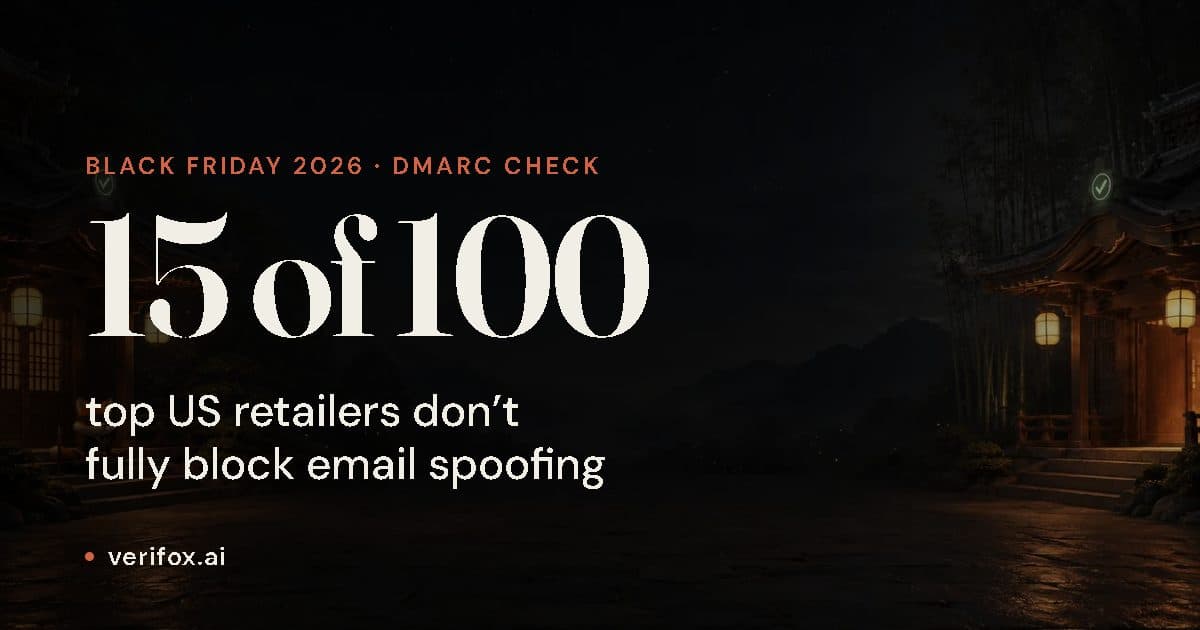
<a href="https://verifox.ai/research/black-friday-retailer-email-security-2026"><img src="https://verifox.ai/og/black-friday-retailer-email-security-2026.jpg" alt="15 of the 100 biggest US retailers don't fully block email spoofing (Verifox, Black Friday 2026)" width="1200" height="630" /></a>Download and cite the data
Every figure on this page is in the CSV. The data is free to use under CC BY 4.0. Please cite “Verifox Black Friday Retailer Email Security Check 2026” and link to this page.
Common questions
Black Friday email spoofing, answered
The questions this check answers most often, with the numbers behind each answer.
What is email spoofing?
Email spoofing is sending a message with a forged From address, so it looks like it came from a domain the sender does not own, such as a well-known retailer. A DMARC record lets the real owner of the domain tell receiving inboxes to reject or quarantine mail that fails authentication. Without an enforced policy, the inbox has no instruction from the owner and falls back on its own spam filters.
Which retailers don’t enforce DMARC?
We publish the totals, not the names: 15 of the NRF Top 100 retailers did not fully enforce DMARC on November 25, 2026. DMARC records are public, so you can check any retailer’s domain, or your own, in a few seconds with the free DMARC, DKIM and SPF checker.
What does a DMARC policy of p=none mean?
p=none is monitor-only. It asks receiving servers to send the domain owner reports about mail that fails authentication, but not to block or quarantine it. It is the usual first step before moving to p=quarantine and then p=reject. Of the 12 retailers at p=none, 10 already receive those reports.
Does DMARC stop all Black Friday phishing?
No. DMARC stops scammers from using the retailer’s exact domain in the From address. It does nothing about lookalike domains, where a scammer registers a similar name and authenticates it properly. Check the part of the sender’s address after the @ letter by letter, and go to the retailer’s site or app yourself rather than clicking a link in a deal email.
What should Black Friday email senders check before they send?
Since February 2024, Gmail and Yahoo require anyone sending more than 5,000 messages a day to their users to authenticate with SPF and DKIM and to publish a DMARC record. Check your domain with the free DMARC checker, then clean the list. In Verifox’s Email List Health data, 31.9% of addresses on lists uploaded for cleaning were undeliverable, so run the list through a bulk email checker before the biggest send of the year.