

Paste the address
Drop any email into the pill — Gmail, Outlook, custom domains, or role aliases like info@ and sales@. Verify one address free right now, or upload a CSV to check a whole list once you sign up.
Validate any email address and catch invalid, disposable, and catch-all addresses on the same 9-check engine our paid API runs.
Free to try. No signup, no card.
Three steps, no signup, no card on file. Paste any address, watch the nine-check engine validate it, read the verdict.
Drop any email into the pill — Gmail, Outlook, custom domains, or role aliases like info@ and sales@. Verify one address free right now, or upload a CSV to check a whole list once you sign up.
Nine checks fire in parallel: syntax, DNS, and MX records, a live SMTP handshake, catch-all and disposable detection, role and domain-age signals, mailbox state, and email authentication, then you get the full verdict.
Every address comes back valid, invalid, or risky, with the format, address type, server status, and mailbox status called out on the page. The API returns the same verdict with a 0-100 confidence score and the full per-check breakdown.
Not MX-only. Nine checks per address, including a live SMTP handshake, disposable detection, and AI-scored catch-all resolution.
Most free email validators check two things: whether the address looks like an email, and whether the domain has an MX record. That catches typos and not much else. The addresses that actually wreck deliverability sail through both tests. A disposable inbox from a burner service has flawless syntax. A mailbox deleted eight months ago still sits behind a domain with perfectly valid MX records. And a catch-all server says yes to every address you ask it about, which is why 20 to 40% of B2B lists fail there.
From one pasted address to a full CSV, every check runs the same nine-layer engine and hands you a verdict you can send on.
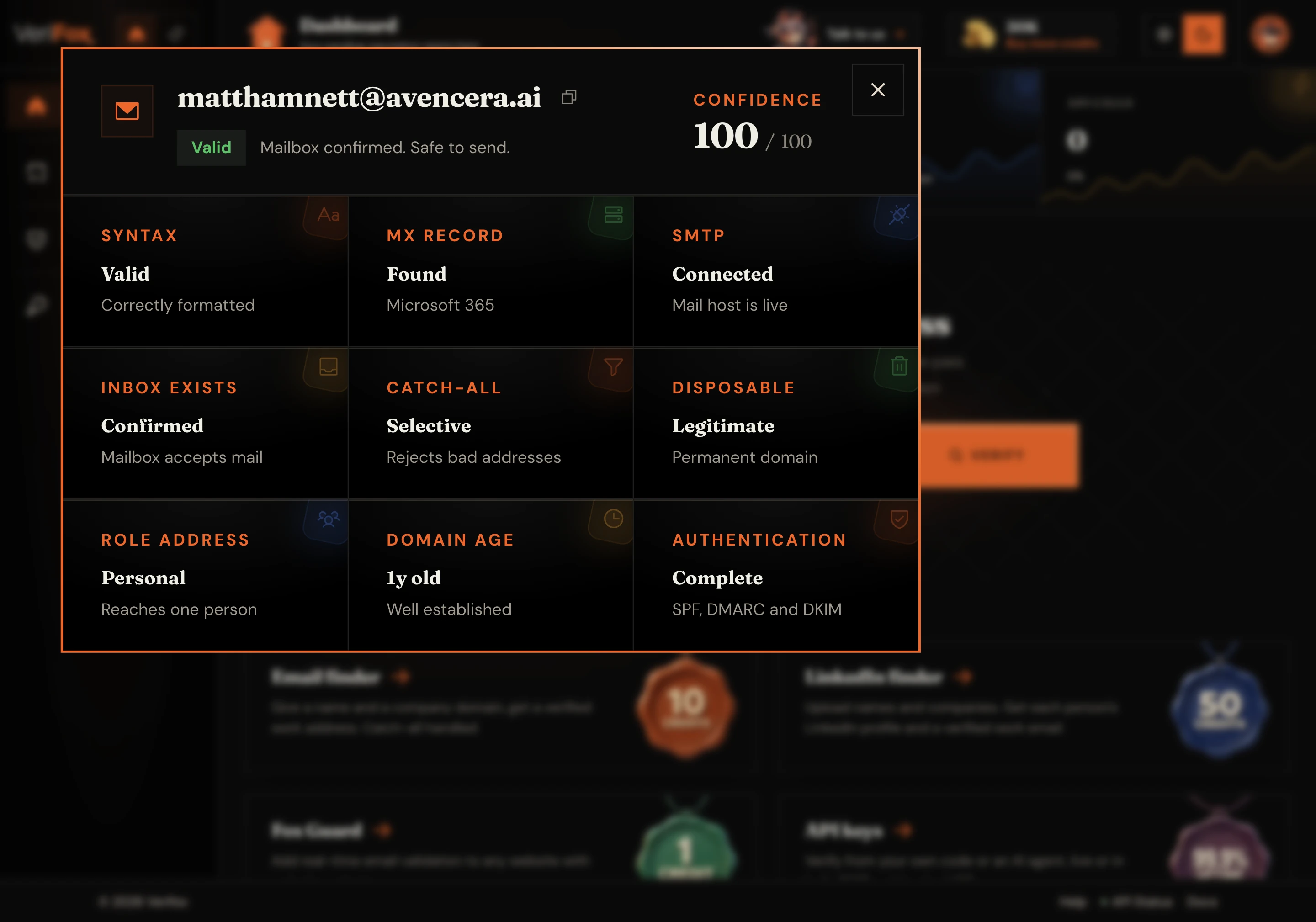
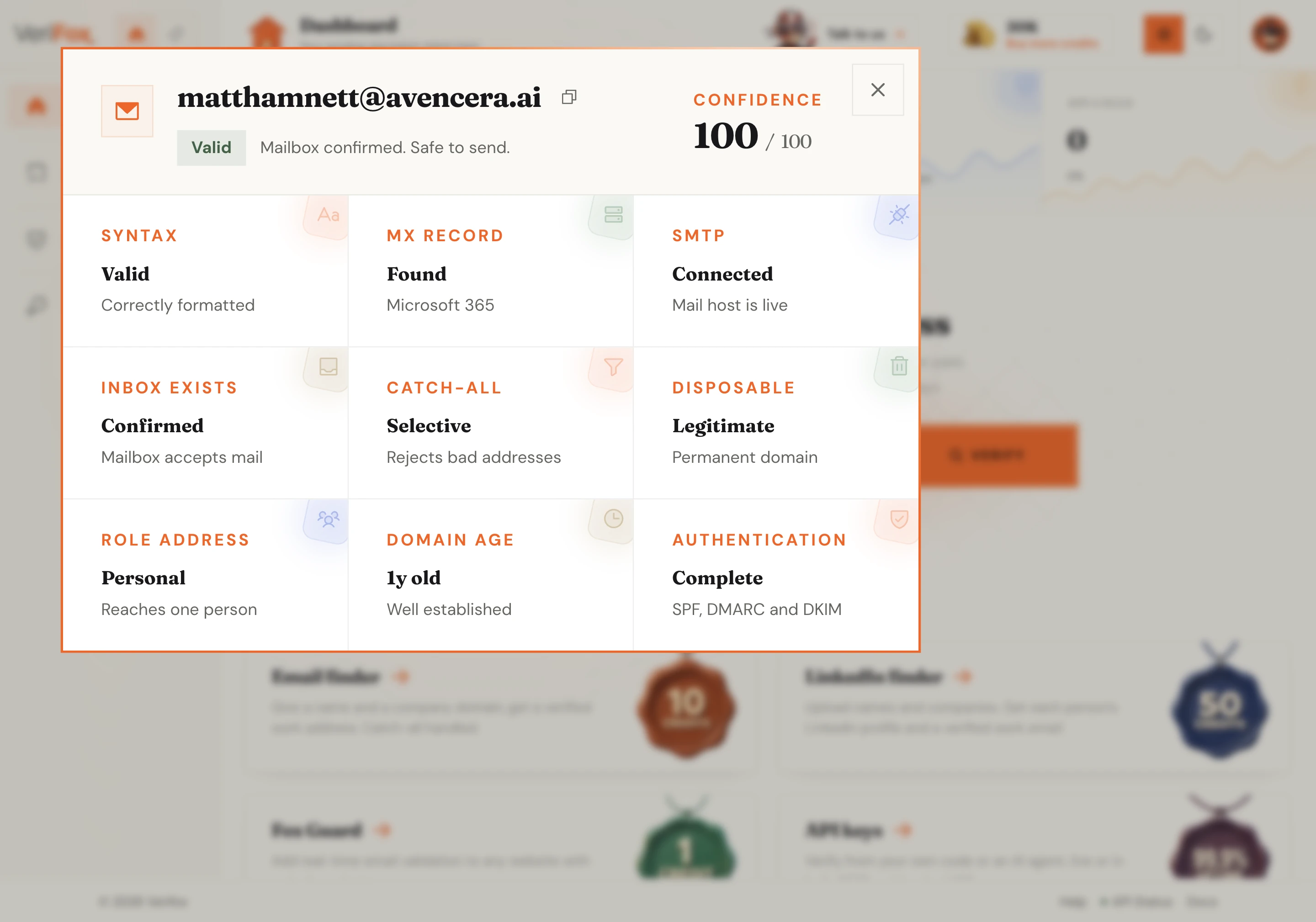
Paste an address and the checker runs all nine deliverability layers (syntax to live SMTP) and hands back a verdict, a 0-100 confidence score, and the full check-by-check breakdown. You send to a confirmed inbox, never a hopeful guess.
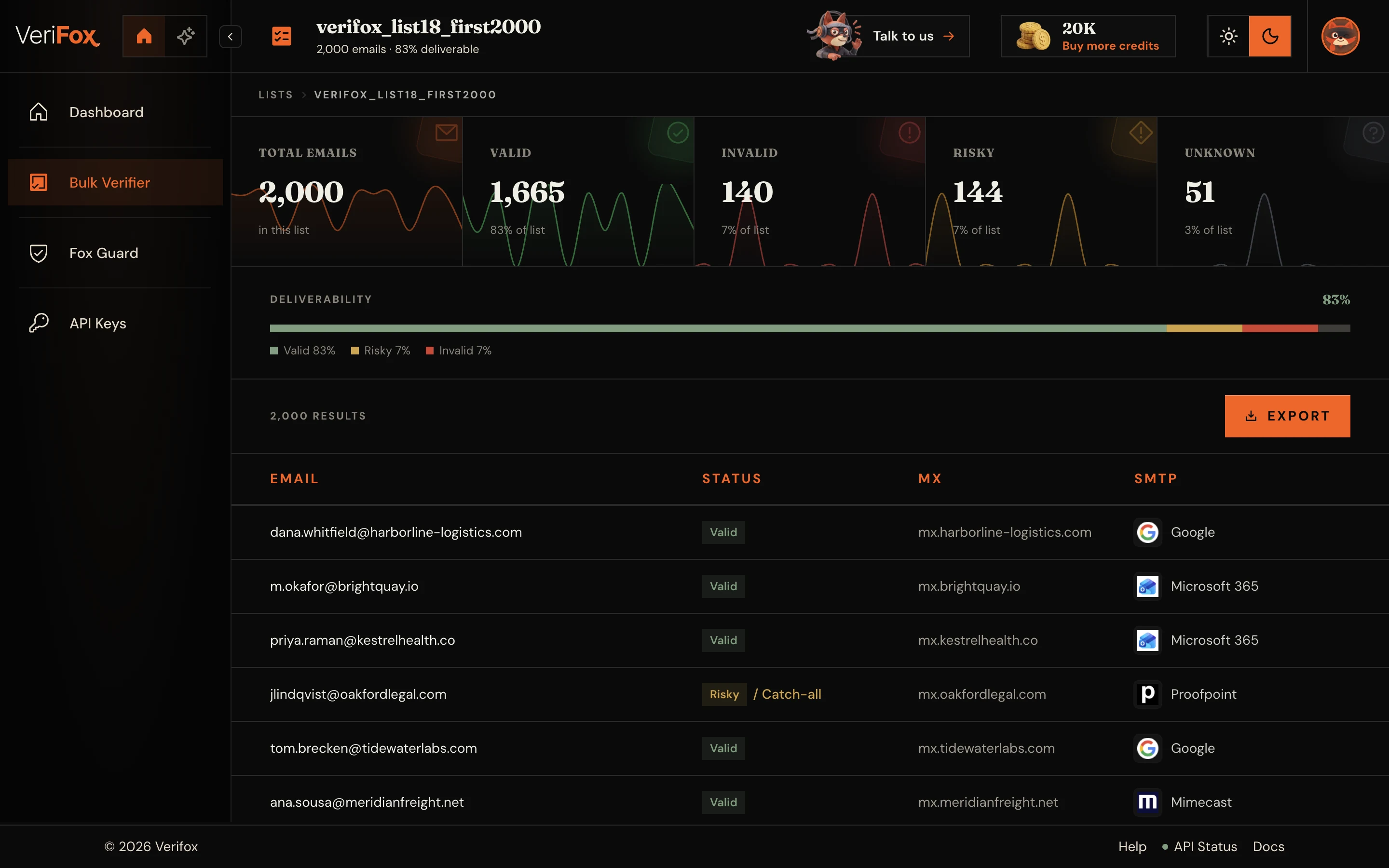
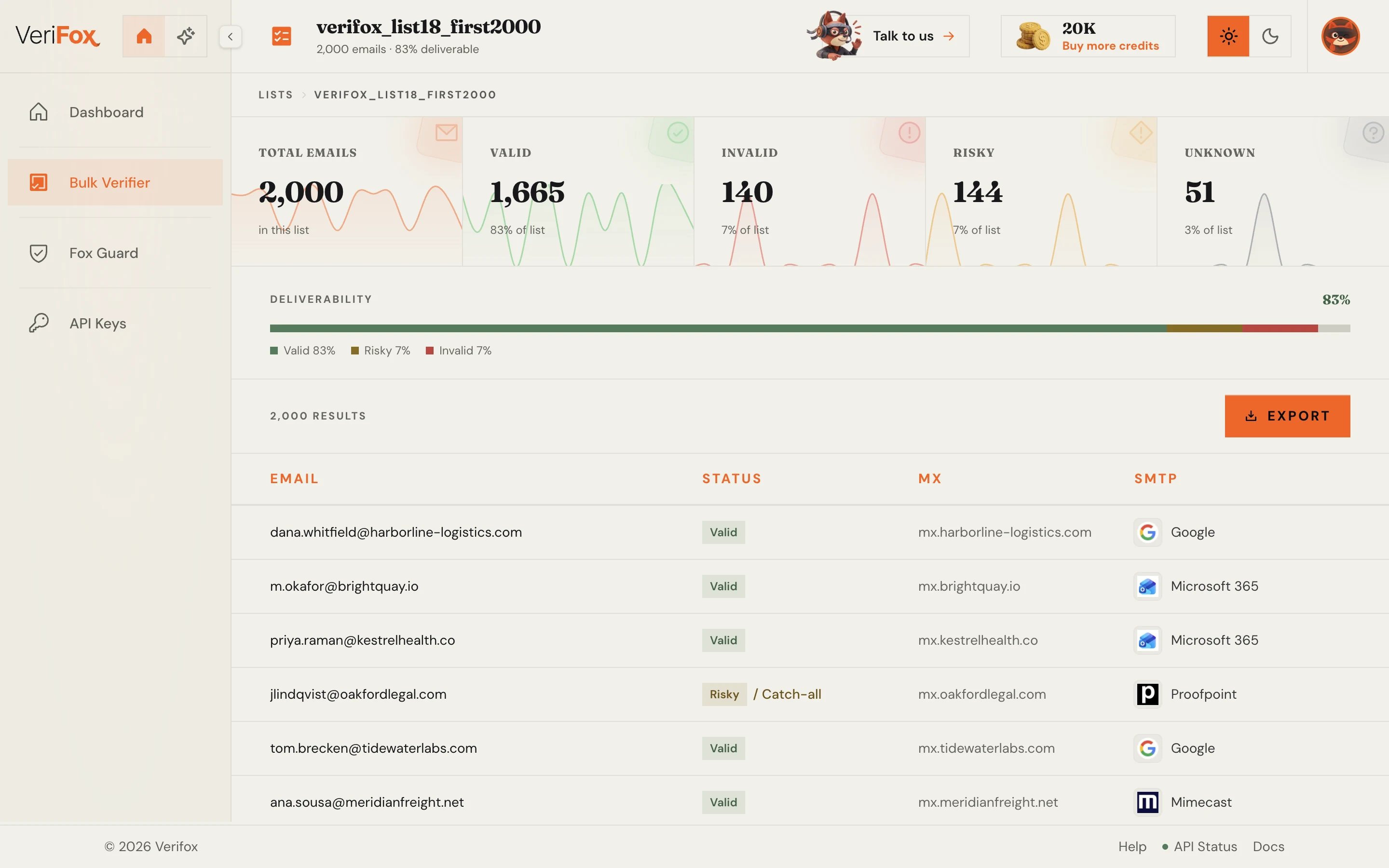
Upload a CSV or paste a list, and the checker works the entire batch (the same nine-check engine on every single row), then returns a clean file split into valid, risky, and invalid, ready to export.
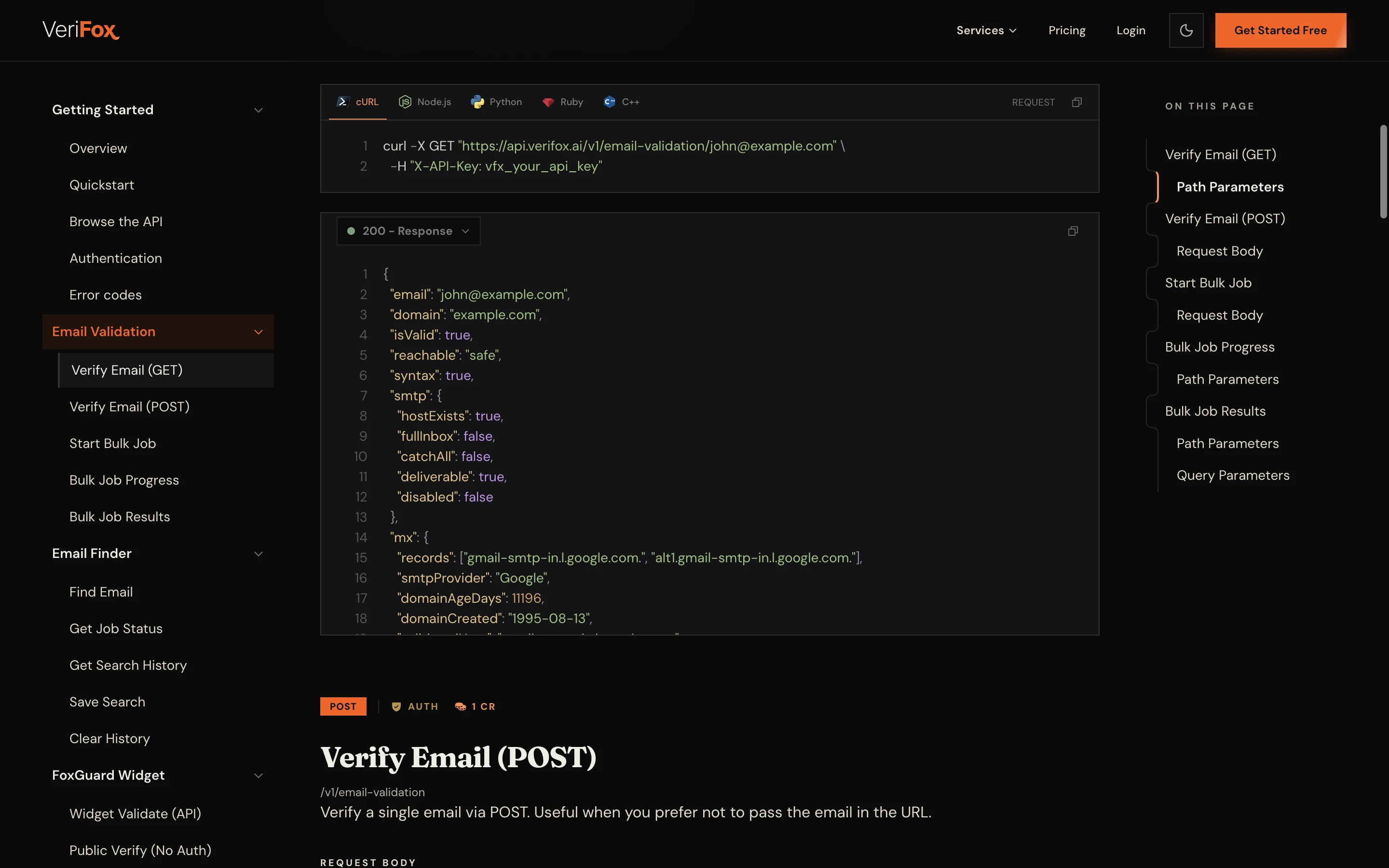
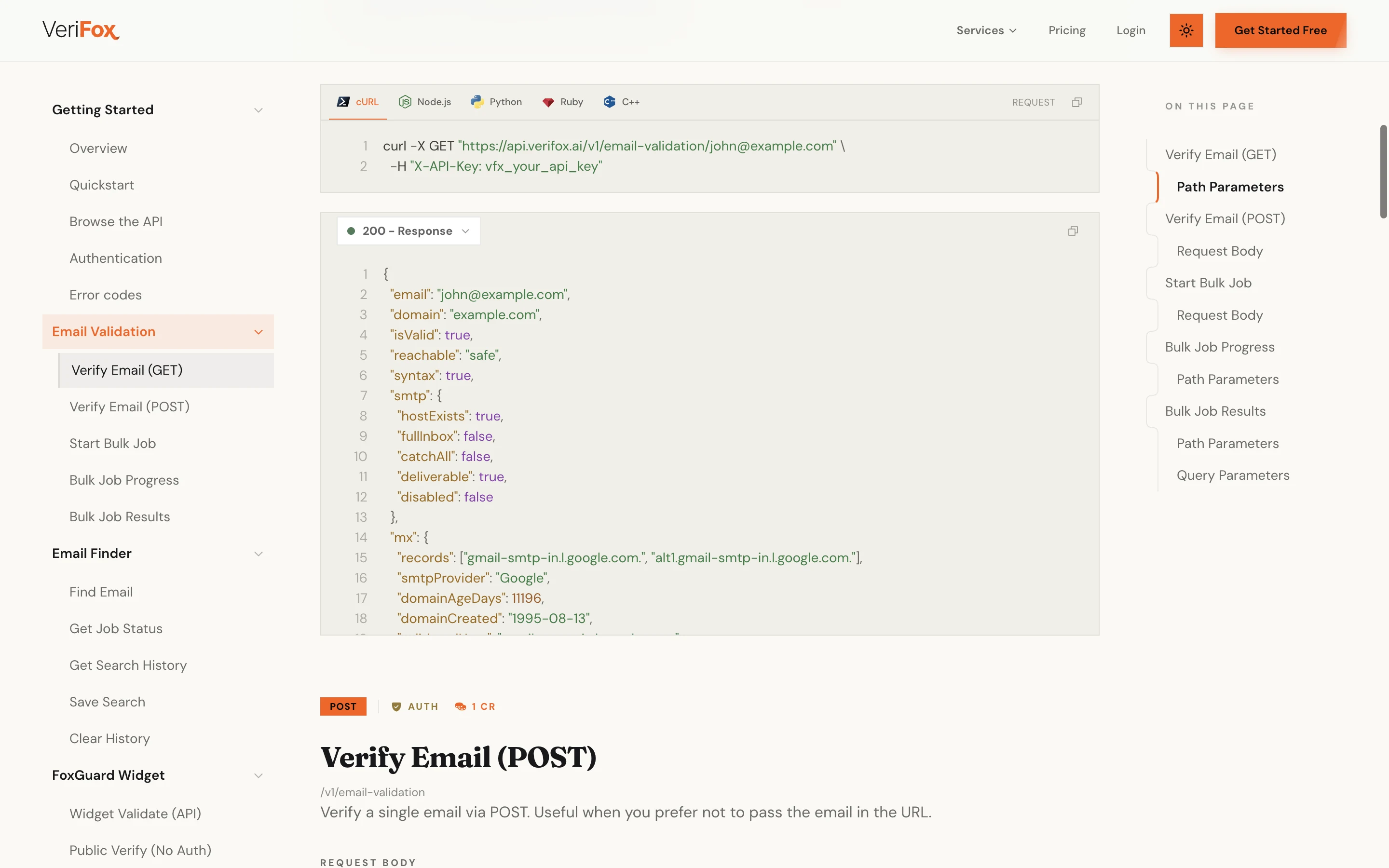
One REST call verifies an address and returns the verdict as JSON , with cURL, Node, and Python examples ready to copy. Wiring an AI agent instead? The same verification ships as a native MCP server.
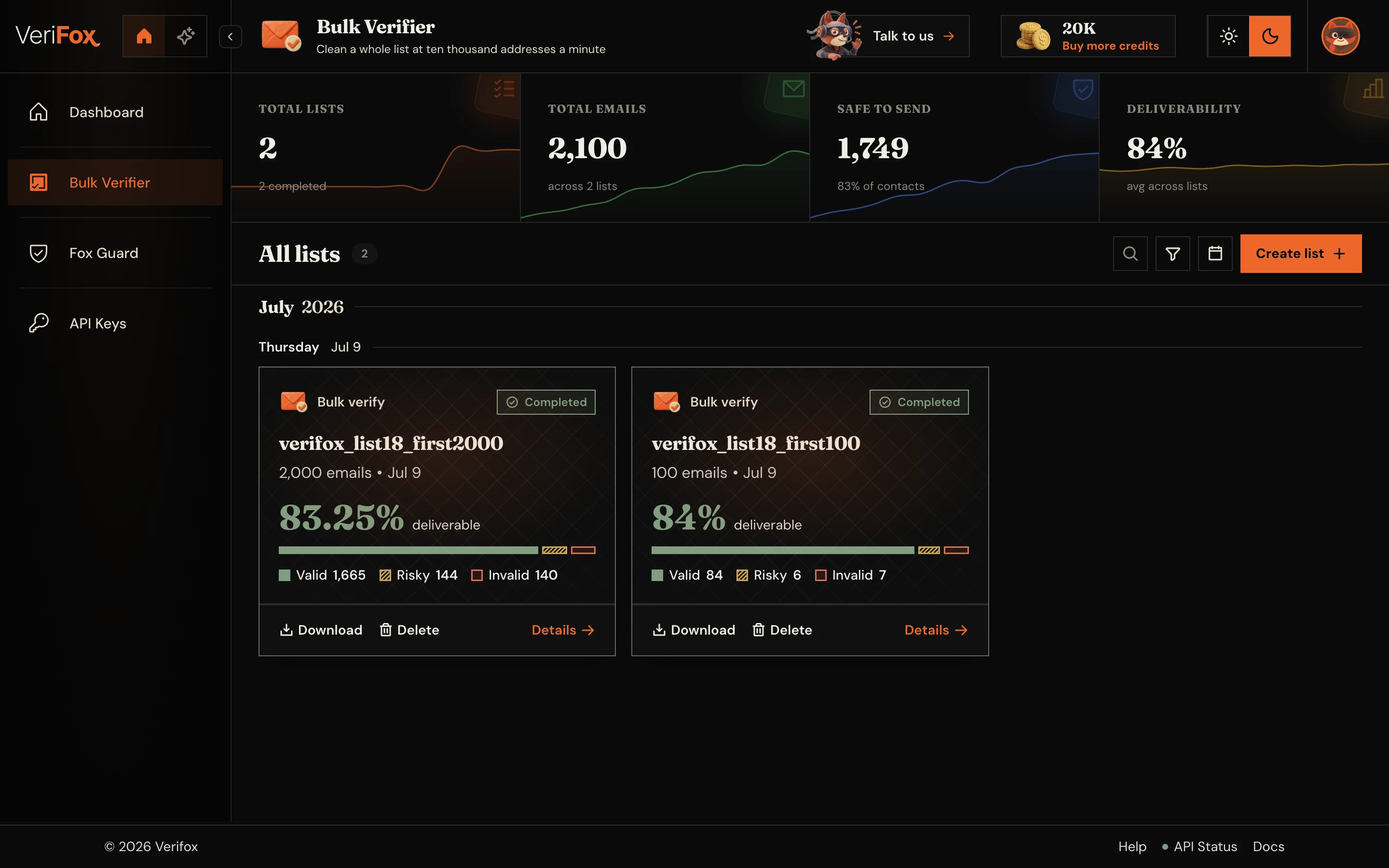
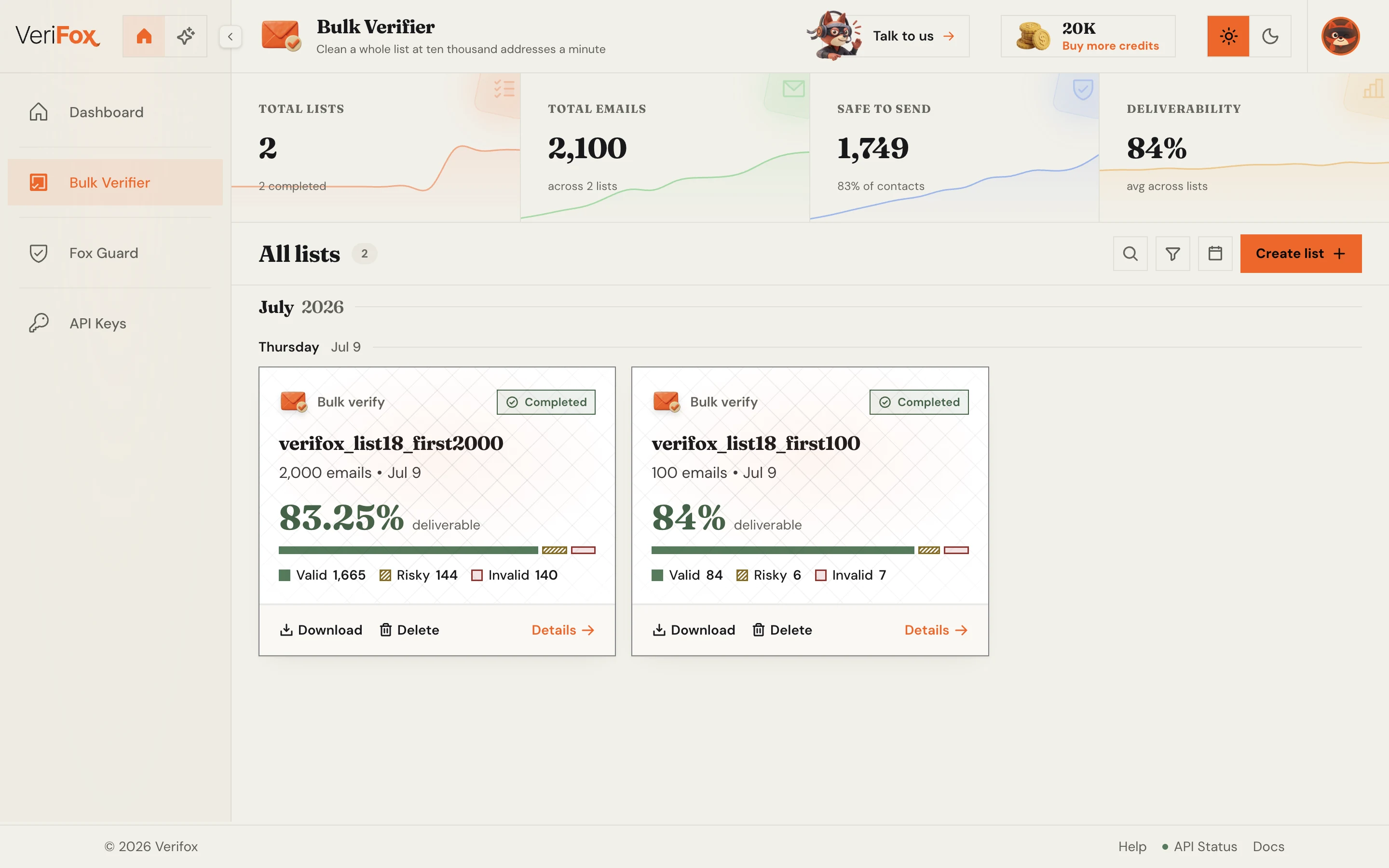
Every check you run rolls up into one activity view: volume, valid rate, and risk trends across single checks, bulk jobs, and API calls, so you catch a decaying list before it dents your sender reputation.
Most free tools stop at syntax. Ours runs the full nine-check pipeline the paid plans use - live SMTP, disposable, catch-all, and reputation - in one verdict.
The same nine-check pipeline as the paid API runs on every address, free or not.
Verify your first emails right here, no account, no card.
Bulk CSV in, verified list out. Same checks on every plan.
Every address comes back already checked, with a confidence score.
Syntax and MX to a live SMTP ping, with catch-all scored 0-100.
1,000 free on signup. 2,500 with a work email. Pay as you go after.
Used only to run the check. GDPR · CCPA.
NeverBounce and ZeroBounce both validate email addresses. Verifox layers nine checks into one verdict and adds no-signup validation.
Most tools reset your balance every month. Verifox sells credits that sit in your account until you spend them.
forever
1,000credits on signup
No card required
2,500 with a work email
Free includes
one time
10,000credits
$0.0059 eachSAVE 34%
Everything in Free, plus
per month
15,000credits a month
$0.0053 each
Unused credits roll over
Everything in packs, plus
One credit verifies one address; a find costs 10, a company search 100 and an email reveal 50. All prices in USD, secure checkout via Dodo Payments.
Prices are before tax. Any VAT, GST or sales tax your country charges is added at checkout. Buying as a business? Enter your VAT or GST number there.
The addresses you submit are used only to run your verification. They are never sold, and nobody on your list hears from us.

The addresses you submit are never sold or shared.

We ask the mail server. Not one message is sent.

Full GDPR data-subject rights for everyone in the EU and UK.

California opt-out, do not sell and DSAR handling.
An investigation into the money leaking out of your list - and the nine checks that decide whether your email is read, or never arrives at all.

57 pages, free PDF, no signup
Common questions
The questions we get from teams that land here to validate an email address before they send, with the real numbers, real limits, and real opinions behind our verification stack.
The validator opens a live SMTP conversation with the domain's mail server, asks whether that exact mailbox exists, and hangs up before any message is composed. The server's response code is the answer. The owner of the address never sees a thing: no email, no notification, nothing in their inbox.
That handshake is one of nine checks. The full pipeline, from RFC syntax through SPF/DKIM/DMARC authentication, is documented on the email verification service page if you want the per-check detail.
The catch is volume, never depth. You get 4 validations a day on this page with no account, then 1,000 free credits the moment you sign up (2,500 with a work address). No card at any point.
Every check the paid engine runs, the free tier runs too. If you later buy a credit pack, credits never expire, and an unused pack is refundable within 7 days under the refund policy, with volume discounts on larger packs.
A risk verdict with an AI-confidence score, not a shrug. Catch-all servers accept every address during the SMTP handshake, real or fake, which is why 20 to 40% of B2B email lists fail exactly there. Most free tools mark those addresses valid and let you eat the bounce.
Verifox layers an AI-confidence pass on top of catch-all detection, scoring domain age, authentication records, and mailbox signals to tell deliverable from dangerous. There's a dedicated catch-all email checker if that's your whole problem.
Yes. Export the sheet to CSV, upload it, and the engine runs all nine checks on every row. You get the file back annotated with a verdict and confidence score per address.
For a handful of addresses, pasting them into the multiple email checker is faster than exporting anything. Your 1,000 free signup credits cover most small lists outright; bigger jobs run on pay-as-you-go credits that never expire.
Directly, yes. Hard bounces come from addresses that fail the exact checks a validator runs: dead mailboxes, typo'd domains, disposable addresses that expired a week after capture. Strip those before the send and the bounces never happen.
That matters because inbox providers throttle senders whose bounce rate creeps past roughly 2%. If your list has already been burned, run it through the email bounce checker to triage, then keep the domain clean with the email health checker.
In practice, nothing. People say “validate email address” and “verify email address” to mean the same job: confirm an address is real, reachable, and safe to send to. Verifox runs the identical nine-check engine either way.
If you prefer the verification phrasing, the email verifier and the single-address free email checker are the same tool under different names. Same accuracy, same verification engine, same free tier.
This one is the paid tool, volume-capped. The same nine checksrun here, catch-all domains included, which get a 0-100 confidence score. There is no lighter “free pipeline” running behind this page.
Where free tools genuinely differ is which checks they bother with. Many stop at syntax and MX. The full nine-check stack, including the SMTP handshake and AI-scored catch-alls, is what the email verification tool and the paid API both run, and what this page runs too.
We never sell them. Addresses you validate are used only to run the verification and show you the result.
Our security overview covers the controls, and the privacy policy spells out exactly what we touch and for how long.
Yes. The REST API reference documents the inbound and outbound shapes for every endpoint, so you can drop real-time email validation into signup forms, CRMs, or any tool that speaks REST. HubSpot, Salesforce, Zapier, Klaviyo, Mailchimp, and Brevo all connect out of the box.
Verifox also ships native MCP server support so AI agents (Claude, Cursor, custom LLM apps) can validate addresses without glue code. Drop the MCP URL into your agent config and the tools are wired.
Speed depends on the mail servers behind your list, because every row waits for a real answer. Slow domains take longer than fast ones.
Custom SLAs are available on an annual Volume contract, with live status at status.verifox.ai and integration details in the API docs.



