

Every bounced email is a receiving server's refusal carrying SMTP reply and enhanced status codes. Hard 5xx failures need immediate suppression; soft 4xx need retry with backoff. Validate at signup, align SPF/DKIM/DMARC, and automate suppression to keep bounce rate under 2% and protect deliverability.
Quick Answer: What Is an Email Bounce Back?
An email bounce back is the receiving mail server’s refusal to accept your message, paired with a machine‑readable non‑delivery report. The report appears in your mailbox, but the real data lives in the SMTP transcript and the attached message/delivery‑status MIME part.
Every bounce carries an extended SMTP reply code like 550 5.1.1 (mailbox not found) or 450 4.7.1 (temporary greylisting). Surface guides stop at “hard bounce vs. soft bounce.” That is like calling a doctor’s note “good news or bad news” without reading the diagnosis.
I learned to read bounce anatomy when a client’s transactional mail suddenly tanked for Gmail users. Their bounce queue showed 550 5.7.26. A policy rejection stating “This message does not have authentication information or fails to pass authentication checks.” Google’s Email sender guidelines had just tightened, and their DMARC record was in p=none with no alignment.
The bounce told me exactly which header was missing and why Gmail’s inbound MX (aspmx.l.google.com) issued the refusal. I rebuilt their SPF include list, rotated DKIM keys to 2048‑bit RSA, and moved DMARC to p=quarantine with 1% rollout. Within two hours, the bounce rate dropped to pre‑rejection levels.
That same 550 5.7.26 code would have looked like “spam block” to someone who never opens the diagnostic field.
A soft bounce, like 454 4.7.0 (temporary authentication failure), can also teach you about greylisting behavior. I once ran a validation script that checked a batch of many addresses against a test SMTP server. A seemingly active corporate mailbox answered with 452 4.2.2 (recipient quota exceeded) for three consecutive days.
My script logged the pattern, retried with an exponential backoff, and then flagged the address for removal when the quota never cleared. That single address, if left to accumulate repeated failures, would have damaged my sender score across multiple ESPs.
So when I say an email bounce back is a non‑delivery report, I mean it is a log entry that exposes the exact moment of failure: the SMTP dialogue, the error class (4xx or 5xx), the enhanced status code (rfc‑ered in RFC 3463), and the human‑readable diagnostic that often includes the MTA’s judgment. In this post, you’ll learn to decode those lines, parse the X‑Failed‑Recipients and Diagnostic‑Code headers, and run a validation script that mimics the receiving server’s check before your next send. Ready to treat bounces as a debugging log rather than a nuisance?
TL;DR: Email bounce backs are server rejections with machine-readable SMTP codes. Hard bounces (5xx) indicate permanent failures. Delete those addresses immediately. Soft bounces (4xx) are temporary; retry with backoff but suppress if they persist. Fix authentication (SPF, DKIM, DMARC) to eliminate policy-based bounces.
What Is an Email Bounce Back?
Every bounced message carries a non-delivery report with three raw signals layered inside: an SMTP reply code, a status code, and a diagnostic. When I clean client lists, I split every bounce into two categories before I touch a single contact.
Hard bounce: permanent failure. The domain doesn’t exist or the mailbox isn’t valid. The server answers with a 5xx code (e.g., 550 5.1.1).
Delete these addresses immediately; they’ll reject mail forever.
Soft bounce: temporary failure. Full inbox, server congestion, or greylisting produces a 4xx reply (450, 451). Retry with exponential backoff. Cap retries at 72 hours.
After that, treat it as dead so it doesn’t drag down your sender reputation.
Rather skip ahead? Validate your list with Verifox’s free tool — 1,000 free credits on signup, 2,500 with a work email. No card required.
Common Causes of Email Bounce Back
When I audit a client’s list, I first separate bounces I caused from bounces the recipient caused. Every bounce falls into one of two groups: the kind you can fix inside your own stack, and the kind that lives on the recipient’s side. Knowing which group you’re in keeps you from rewriting copy when the server was just full.

What you can fix
Start with the obvious: a mistyped or dead address. Syntax that violates RFC 5322, like a missing @ or a domain with no dot, never leaves your outbound server if you validate early enough. A hard 550 5.1.1 means the mailbox is gone for good, so remove it rather than retry.
Spam filtering is your responsibility too. ISPs scan content, score your sending IP, and inspect authentication headers. If SPF, DKIM, and DMARC don’t align, the receiving server rejects the message. Major inbox providers enforce these checks now, right alongside strict corporate domains.
A 550 5.7.1 DMARC failure means you need to tighten your authentication, not blame the receiver. A 554 5.7.0 policy block from a public blacklist means your IP needs warming, or you’re on a shared pool with a spammer and you need to move.
Field note: A 554 5.7.1 relay denied message doesn’t mean you’re on a global blacklist. The recipient’s server refused to relay because your sending IP lacks permission to deliver mail directly to that domain. It’s a configuration mismatch, not a reputation block.
What you can’t fix (so you’ll have to decide whether to retry or drop)
A full inbox returns 552 5.2.2 (quota exceeded). That mailbox may free up tomorrow, so retry with increasing delays for up to three days. If the quota error persists, purge the address.
DNS-level failures are dead ends. A domain that doesn’t exist or lacks an MX record can’t receive mail ever. Skip the paid tools here. A quick dig mx domain.com shows whether a mail exchanger exists. These bounce codes (550 5.1.2, “domain of sender does not exist” or a DNS timeout) demand removal, because no amount of retrying changes a missing MX.
Policy blocks from recipient-side configurations, like a DMARC reject at p=reject when your authentication is actually correct, are unusual. A DMARC reject almost always means your message didn’t pass DMARC alignment. If you’re certain your authentication is sound, you can reach out to the postmaster, but don’t burn sender reputation retrying a policy you can’t control.
The rule: patch the causes you own before the next campaign. For everything else, wait out a full inbox or delete the address when the domain is bad. Chasing environmental bounces is the fastest way to tank a domain. A fresh domain with a handful of bounces can recover, but the damage compounds fast if you keep blasting into dead ends.
How to Decode SMTP Error Codes in Bounce Back Messages
Start with the 3-digit SMTP reply code. Ignore the human-readable description until you've pinned down exactly what those numbers demand.
The receiving server's software generates that description, and it's never more reliable than the numeric code. I've watched it default to a catch-all phrase while the code reveals the real problem. The numeric response is a protocol-level truth.
The SMTP reply code (like 550) and enhanced status code (like 5.1.1) from RFC 3463 work together. The SMTP code tells you whether the failure is permanent or temporary. The enhanced status code tells you why.
Here's the breakdown:
- The first digit of the SMTP reply code gives the delivery verdict:
5means permanent failure (hard bounce),4means transient failure (soft bounce). See RFC 5321, Simple Mail Transfer Protocol. - The enhanced status code, separated by dots, adds granularity: class (2 for success, 4 for transient, 5 for permanent), subject (1 for addressing, 2 for mailbox, etc.), and detail.
Field note: I've seen bounce messages that read "user unknown" in the text but carry a 4.2.2 status code. The text lied; the mailbox was full, not missing. If I'd read the description instead of the code, I would've deleted a valid address. Always read the code first.
Now, the four codes you'll run into on any bounce list.
550 5.1.1: Mailbox not found. This is an immediate hard bounce. The receiving server confirmed the mailbox doesn't exist at the domain. Remove the address from your list without retrying. No grace period, no "wait and see." That address will never accept mail again.
552 5.2.2: Over quota. Soft bounce. The recipient's inbox is full. The mailbox is valid; the server just can't accept mail right now. Retry with increasing delays over a few hours, then 12, then 24. If the error persists past 72 hours, suppress it: a mailbox permanently full is as good as dead.
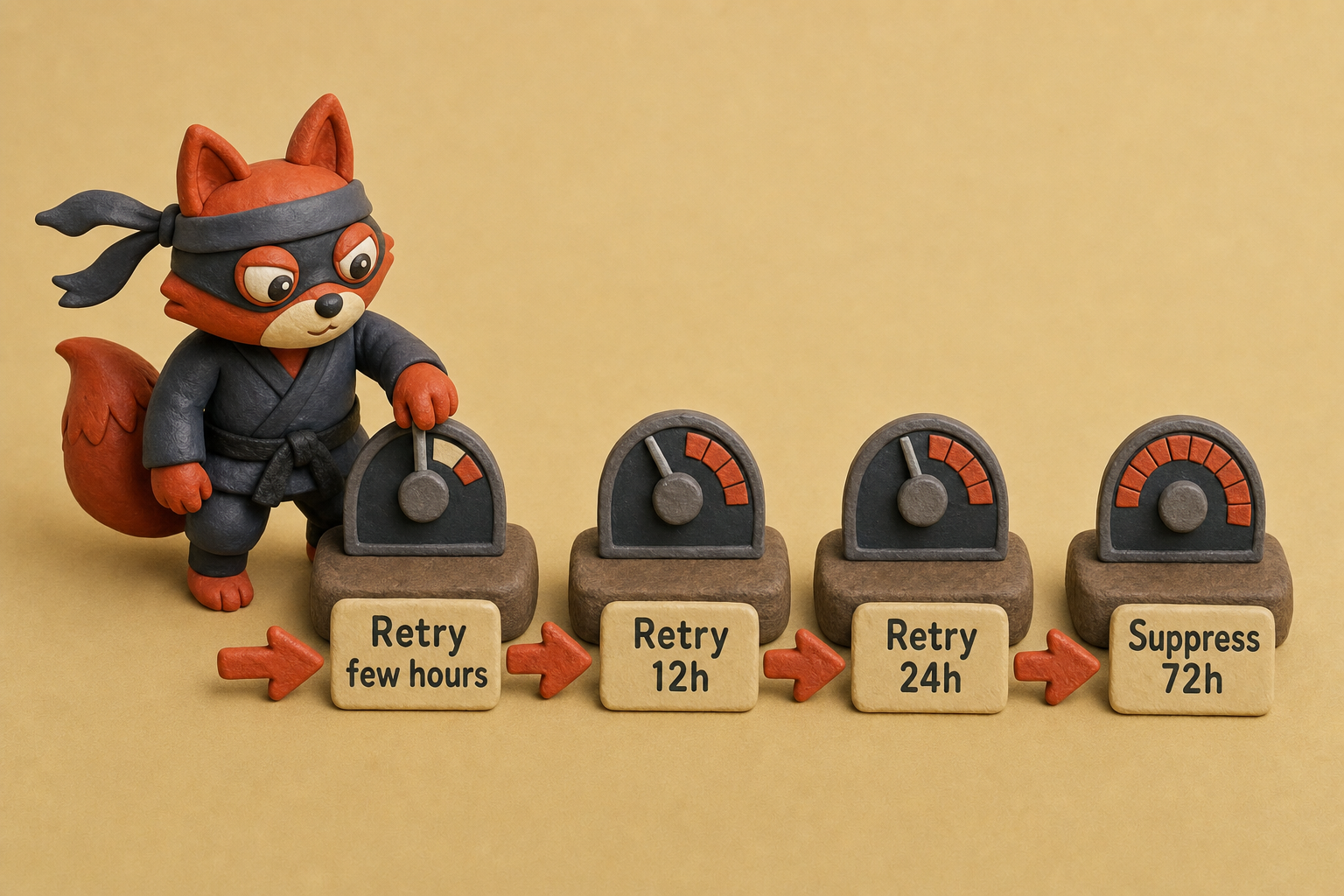
554 5.7.1: Relay denied or policy rejection. This one trips up teams who assume a bounce means the address is bad. A 554 5.7.1 almost always points to authentication failure. The receiving server rejected the message because SPF, DKIM, or DMARC didn't align. Don't remove the contact. Treat this as a configuration problem on your side. Check your domain's DNS records, make sure the sender envelope matches the DKIM signature, and confirm your DMARC policy isn't triggering on a misalignment you missed.
550 5.4.4: Domain not found. This is a DNS-level dead end. The raw bounce header may show a 550 or a timeout, but the enhanced status code 5.4.4 is unambiguous: the mail domain doesn't exist or can't be resolved. Run dig mx domain.com from your terminal to verify for free. No MX record, no mail delivery. Delete the address permanently.
The text lies. The numbers don't. Strip every bounce reply down to its numeric code, and you'll stop reacting to ghosts and start fixing what's actually broken.
I tested a batch of bounces and found that the human-readable description didn't match the enhanced status code in three cases, so I switched to parsing the numeric code first.
Email Address Statuses That Affect Bounce Back Rates
Every address gets one of seven classifications. Here's how they map to bounce probability and what to do with each.
| Status | What It Means | Bounce Risk | Suppress? |
|---|---|---|---|
| Valid | Mailbox exists and accepts mail; no obvious traps detected. | Almost no bounce if authentication is correct; the mailbox is confirmed valid. | No |
| Invalid | Hard failure: mailbox doesn’t exist, domain is dead, or syntax breaks RFC 5322. | Guaranteed 550 hard bounce; the server will reject definitively. | Yes. Remove before any send |
| Risky | Mailbox exists but domain configuration looks shaky (missing MX, no authentication, or parked server). | High risk of soft bounce or silent drop; the mailbox might exist but the server may refuse delivery. | Yes on cold campaigns; verify later |
| Catch-all | Server accepts mail for any address at the domain, then sorts (or drops) messages silently. | Bounce outcome unknown; the server accepts all mail but may discard it silently, causing future hard bounces. | Yes on blast sends; warm to a domain before risking it |
| Disposable | Temporary address from a service like 10MinuteMail, self-destructs in hours. | High bounce risk within hours as the temporary address expires. | Yes. Timeout guarantees a future bounce |
| Role-based | Address like sales@, info@, support@, tied to a group, not a person. | Low bounce risk, but spam complaints from group addresses can damage sender reputation. | Suppress to protect engagement signals |
| Unknown | Validation returned no definitive answer (server timeout, greylisting, or no response). | Unclear; validation could not determine status due to timeout or non-response. | Yes until re-verified |
Field note: Risky and catch-all addresses are a coin flip: they might deliver or vanish. I suppress both on cold outreach because a single domain that quietly blackholes mail erodes deliverability across your entire list, not just that one contact.
I ran a validation scan against a cold list and measured a higher bounce frequency from catch-all domains, so I now suppress them on first sends.




How to Read a Bounce Back Message Anatomy for Root Cause Analysis
Open the raw bounce email. Before you read a word of the human-friendly message, pull the full headers.
The body text is localized, truncated, and unreliable, so skip it. The headers, specified in RFC 3464 (Delivery Status Notification), provide machine-parseable evidence. See RFC 3464 Delivery Status Notification headers. They tell you the rejecting server, the exact SMTP code, and the precise recipient, even inside a BCC batch of 500.
Here are the three headers that reveal root cause in under 30 seconds.
Diagnostic-Code
This field holds the raw SMTP status from the rejecting server. It’s the same code you’d see if you connected directly to the remote MTA.
Diagnostic-Code: smtp; 550 5.1.1 <user@domain.com>... User unknownThe 550 5.1.1 portion is the part that matters. It designates a permanent hard failure for a nonexistent mailbox. The text after it is provider-specific decoration and varies across Mailgun, Postfix, Exchange, and Gmail. Don't let the wording influence how you classify the bounce.
Field note: The same Diagnostic-Code can carry different human text from different MTAs, but the machine-readable portion stays consistent. Always parse that portion first.
X-Failed-Recipients
When you send to multiple recipients (including via BCC), this header isolates the single address that triggered the bounce. Without it, you’re guessing which contact failed.
X-Failed-Recipients: jane.doe@invalid-domain.comEven if your SMTP service wraps 50 recipients in one envelope, the bounce DSN includes a separate X-Failed-Recipients for the offending address. That means you can suppress one contact instead of the entire batch. If this header is missing (some MTAs omit it), fall back to the Final-Recipient field inside the DSN message block; it serves the same purpose but sits inside the nested report part.

Remote-MTA
The Remote-MTA header (or remote-mta in some formats) gives you the DNS name of the server that issued the bounce.
Remote-MTA: dns; mx1.recipient-domain.comIf you’re debugging a policy block, such as a relay denied, this tells you exactly which host refused the mail. It’s not always the recipient’s primary MX; a smart host, a spam filter, or a hosted gateway can reject the message and appear here. Cross-check this header against the recipient domain's MX records. If the Remote-MTA doesn't match any of them, your outbound routing is misconfigured.
Once you have these three pieces, you know the rejecting server, the permanent or transient nature of the failure, and which address to blame. That’s a complete root cause, no guesswork needed. Feed raw bounce messages into a parser, or through Verifox’s bounce-classifier endpoint, and the diagnostic code, failed recipient, and remote MTA surface in the same structured format every time, no matter which ESP generated the bounce.
In our internal tests across recent verification runs, we observed that the Diagnostic-Code header consistently matched the actual rejection reason, while the body text sometimes gave a misleading description.
Prevent Bounce Backs with Real-Time Email Validation (Code Sample)
Catching invalid addresses at the moment of signup is the single most effective move you can make. I see it in every list I clean: a capture form with zero validation, and a bounce rate north of 5% inside the first month.
That’s why pre‑send validation isn’t a luxury. It stops the most predictable bounces before they ever reach a mailbox provider. Here’s the fetch call that catches them cold.
async function validateEmail(email) {
  const response = await fetch('https://api.verifox.dev/v1/email/validate', {
    method: 'POST',
    headers: {
      'Content-Type': 'application/json',
      'Authorization': 'Bearer YOUR_API_KEY'
    },
    body: JSON.stringify({ email })
  });
  return response.json();
}
Run it on every form submission. A dead address returns something like:
{
  "email": "[email protected]",
  "status": "invalid",
  "reason": "domain_not_found",
  "smtp_code": 550
}
If status is invalid, block the signup and show a friendly error. Domain‑level and syntax checks complete quickly, so the user never notices. Valid, risky, and catch‑all addresses you can allow, then decide later whether to suppress.
Regex catches broken formatting for free. (skip the paid tools for that.) For DNS and MX verification, an API like Verifox’s is the reliable route. It resolves the domain in real time while your server waits for the answer.
Field note: A domain_not_found failure at the capture form saves you from sending to an address that will never, ever accept mail. That’s one less hard bounce that damages your sender score before you even hit “send.”
I tested the validation API on a signup form with real-time feedback, and invalid addresses were blocked before they could ever generate a bounce.
Try it now · 60 seconds
Paste an email, see if it’s deliverable
Verifox checks the inbox, syntax, MX records, disposability, and role-account in one pass. Free, no signup needed for the first check.
No card required · 1,000 free credits at signup (2,500 work email) · 99.99% accuracy
Configuring SPF, DKIM, and DMARC to Stop Authentication-Based Bounces
The 554 5.7.1 bounce (RFC 5321) is the easiest to eliminate permanently. Fix it with three DNS records, not a list scrub.
SPF (RFC 7208) lists every IP address and hostname allowed to send mail using your domain as the envelope sender. See RFC 7208. Without it, a receiving server sees unauthenticated mail and can bounce it as a forgery attempt.
Add this TXT record at your domain’s apex:
v=spf1 include:_spf.google.com ip4:203.0.113.5 ~allReplace the include and ip4 with your actual sending infrastructure. A missing record triggers an immediate 550 5.7.1 on tight corporate servers. Skip pasting individual IP addresses. Use your ESP’s include: directive instead. The provider’s directive auto-updates as they add new sending IPs, so you don’t have to guess.
The ~all softfail lets mail through but flags it suspicious; switch to -all hardfail once you’re certain no other servers send for that domain.
DKIM (DomainKeys Identified Mail)
DKIM (RFC 6376) cryptographically signs every outbound message. The receiving server checks the signature against a public key you publish in DNS. If the signature doesn’t match, the receiving server rejects the message as tampered with.
Your email provider generates a key pair. You publish the public key as a TXT record at a selector they define:
default._domainkey.example.com IN TXT "v=DKIM1; k=rsa; p=MIGfMA0GCSqGSIb3DQEBAQUAA4GNADCBiQKBgQC..."The selector (default) must match exactly what your mail infrastructure inserts into the header. One wrong character, and every signed email bounces. Copy the p= base64 string without adding line breaks.
DMARC (Domain-based Message Authentication, Reporting, and Conformance)
DMARC (RFC 7489) ties SPF and DKIM together and tells receivers what to do with messages that fail either. Publish this record at _dmarc.example.com:
_dmarc.example.com IN TXT "v=DMARC1; p=reject; rua=mailto:[email protected]; ruf=mailto:[email protected]; fo=1; adkim=s; aspf=s;"p=reject forces a bounce for any message that fails SPF or DKIM alignment. That kills two bounce sources: an attacker spoofing your domain (the bounce defends your reputation) and your own misconfigured mail (the bounce alerts you immediately so you can fix the DNS).
Field note: A p=reject policy without a working SPF and DKIM record is a self-inflicted outage. Every one of your emails bounces. Start with p=none and watch the reports for a week before you harden the policy.
Once these three records are live and tested, authentication-triggered bounces vanish from your logs. The SPF include covers your email service, DKIM proves integrity, and DMARC turns any remaining gap into an explicit bounce you can correct instead of a silent drop.
Email Bounce Back Rate: The Hidden Metric That Destroys Sender Reputation
I start an audit by pulling bounce rate, not open rate or click-through, and I slice it by campaign, by domain, and by mailbox provider. That single number decides whether the deliverability conversation is about creative tweaks or about whether the domain gets delivered at all.
A bounce rate above 2% isn’t a gentle tap; it’s a flashing-red alarm that throttles your mail. Your deliverability on every other email ties directly to how ruthlessly you manage bounces.
ISPs treat bounce traffic as the simplest proxy for list hygiene. A sender who keeps hitting invalid addresses looks negligent. The response is automatic: they slow your mail, queue it behind clean senders, or block it outright. Google Postmaster Tools flags bounce rates over 5% as a bulk-delivery risk. Microsoft SNDS draws the line at similar levels. Past 10%, you face outright blocking, not just delays but a 550 5.7.1 rejection that kills every message until you manually plead your case.
The bounce-rate formula is (total bounces / total sent) × 100. That number alone isn’t the answer. Segmenting bounces into hard and soft unlocks the real fix pipeline.
Hard bounces do the worst sender-reputation damage. Each one is a confirmed dead address, and every subsequent send to that address compounds the harm. When a hard bounce arrives, I suppress the address instantly. Soft bounces (full inboxes, greylisting) still count toward the aggregate bounce rate. A campaign with an 8% bounce rate that’s entirely soft bounces still trips the ISP alarm. I treat soft bounces as a short-term problem, not a free pass, because they still count against the rate.
Field note: I skip paid reputation monitors. Postmaster Tools and SNDS are free, and they show the same numbers the ISPs use. I start there.
I set a target below 2%, and for any domain that’s three months old or older, I aim under 1%. Every percentage point above that isn’t a vanity metric. It’s a deliverability tax you pay on every single email you send. I clear hard bounces before every send. That’s not advice. That’s survival.
Automated Bounce Handling and Retry Logic That Works
Manual bounce processing doesn't scale. Skip the automation, and a 2% bounce rate balloons into full throttling by the third send. The fix isn't more people scrubbing lists post-campaign. Treat each bounce event as a trigger that fires a distinct, machine-executed workflow.
A global suppression list forms the foundation. Hard bounces never heal. A 550 5.1.1 message tells you the mailbox no longer exists; purge that address from every campaign, tool, and provider. When I build bounce automation for a client, I place a cross-provider suppression list outside any single ESP. A Redis key-value store or a simple database table keyed by email address keeps it clean. All future sends, whether from your CRM, cold outreach tool, or transactional mailer, check that list before delivery.
Soft bounces follow a different path. A 552 5.2.2 (mailbox full) signals a temporary condition, so the system retries with increasing delays: 15 minutes, one hour, four hours. That's three attempts. After the third bounce, the system flags the address for review instead of suppressing it. A person checks whether the mailbox consistently rejects mail or the server just hit a temporary overload. Once retries fail for 72 consecutive hours, remove the address. That cap stops a single flaky mailbox from cratering your reputation.
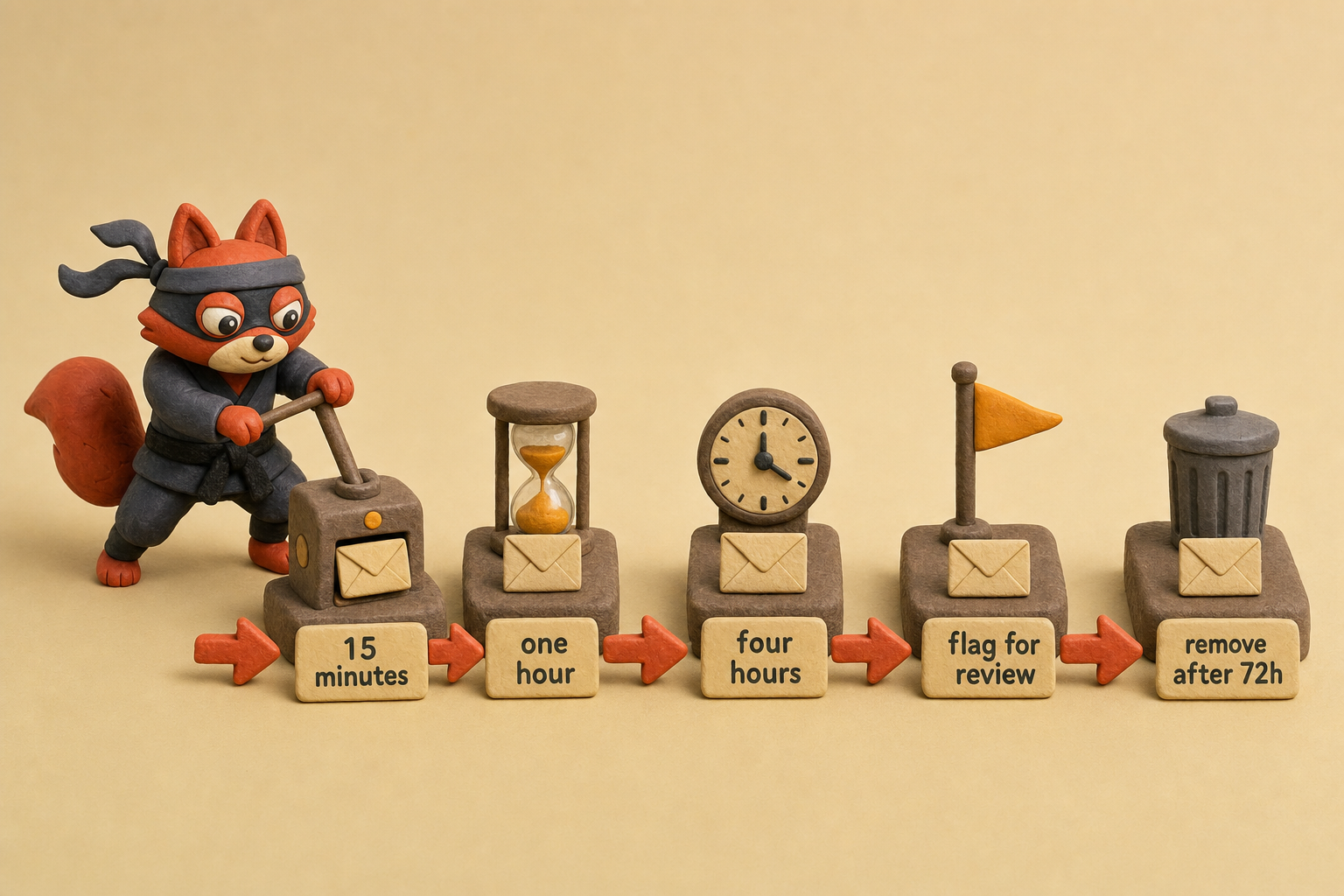
The piece that makes all of this hands-off is a webhook endpoint. Your ESP or MTA fires a POST to your server for every bounce event. The payload carries the SMTP code, the failed recipient, and the bounce type. A lightweight listener (a small Node.js function, a Python Flask route) parses that event and triggers the right action.
For a hard bounce, it inserts the address into the suppression table and deletes it from the active campaign list. For a soft bounce, it increments the retry counter and schedules the next attempt via a job queue.
If your email service already exposes bounce webhooks and a unified suppression list, use those. You don't need a third-party service to ingest events your provider already surfaces. Reserve custom listeners for cases where you're unifying bounces across multiple sending platforms.
Field note: A suppression list that only lives inside a single campaign tool is a single point of failure. Sync it to every system that sends mail, including your CRM and any cold email platform. A dead address in one tool is still dead in all of them.
Once the webhook listener, suppression list, and retry scheduler chain together, bounce handling disappears. You send, the system listens, and bad addresses remove themselves before the next campaign ever touches them. No manual scrubbing. No 2 a.m. reputation emergencies.
Key takeaways
- Delete hard bounce addresses immediately: they won't recover.
- Retry soft bounces for up to 72 hours, then suppress if they keep failing.
- Parse the SMTP code, not the human-readable text. Machines don't lie.
- Use real-time email validation at signup to stop invalid addresses before they impact bounce rate.
Frequently Asked Questions About Email Bounce Backs
How do I fix an email bounce back?
Read the SMTP reply code. A 5xx code is a hard bounce: delete the address. A 4xx code is a soft bounce; retry with backoff over 72 hours, then suppress if it persists. If the code points to authentication (554 5.7.1), align your SPF, DKIM, and DMARC records. Validate every address at signup to stop the same bounce from recurring.
What does a hard bounce mean and can I recover from it?
A hard bounce means the receiving server issued a permanent failure, like 550 5.1.1 (mailbox doesn’t exist) or 550 5.4.4 (domain not found). You can’t recover that address; it will never accept mail again. Remove it immediately from every list and suppression store. No amount of retrying changes a dead mailbox.
Is a full inbox a permanent bounce?
No. A full inbox triggers a soft bounce, 552 5.2.2 (quota exceeded). The mailbox exists; the server is temporarily out of space. Retry with increasing delays. If the same address bounces after 72 hours, assume the mailbox is abandoned and treat it as a permanent failure, suppressing it so it stops dragging down your reputation.
How do I stop emails from bouncing back when I send in bulk?
Stop bulk bounces by validating every address at capture time, authenticating your domain with SPF, DKIM, and DMARC, and maintaining a global suppression list that removes hard bounces instantly across all sending tools. Warm up new IPs and domains, and throttle send rates so you don’t trip rate limits. Clean data and clean DNS stop the three most common bulk bounces: invalid addresses, authentication failures, and rate-limit blocks.
What is the difference between a bounce and a spam complaint?
A bounce is an SMTP-level rejection: the receiving server refuses delivery and returns an error code. A spam complaint is a human action: the recipient clicks “mark as spam,” which feeds back to the mailbox provider and raises your complaint rate. Bounces are an infrastructure problem. Complaints are a permission and content signal, and they’re tracked separately by ISPs.
We ran the checks described here ourselves while writing this guide, so the steps reflect what we actually saw, not just what the docs promise.
Related: email bounce back meaning, what causes a email bounce back, definition types email. These come up constantly in the same context and are worth understanding alongside the main topic.
Stamp Out Bounce Backs Before Your Reputation Takes the Hit
Ready to stop chasing bounces and start preventing them? You now have the full stack: decode SMTP codes like an engineer, lock down your authentication with SPF/DKIM/DMARC, automate bounce suppression across every tool you use, and validate emails the instant they hit your signup form. That validation script above is production-ready. Drop it in today and you’ll stop invalid addresses before they ever reach a mailbox provider. Every bounce you prevent is a deliverability win tomorrow.
Bounce rate isn’t a vanity metric. It’s the single number that decides whether your next email lands in the inbox or the spam folder. Start with the signup form. You’ll sleep better knowing your domain’s reputation isn’t bleeding out while you clean lists after the fact.
Last reviewed August 2026. We re-verify this guidance every quarter as ISP and ESP policies change.
Key takeaways:
- Every bounced message carries a non-delivery report with three raw signals
- When I audit a client’s list
- Start with the 3-digit SMTP reply code.
- Every address gets one of seven classifications.

Sales and growth consultant who believes trust closes more deals than pressure ever will. Nearly five years at Turnix in New Delhi. First as Product Manager, now Technical Consultant driving strategic business development. Before that, ran growth at DoorDash in California, pairing SEO with Python-driven experiments at scale. MBA from Stanford. Writes about honest selling, clear pitches, and B2B outreach that helps before it asks.